RCK Programme Methods
RCK Transformation Market Review
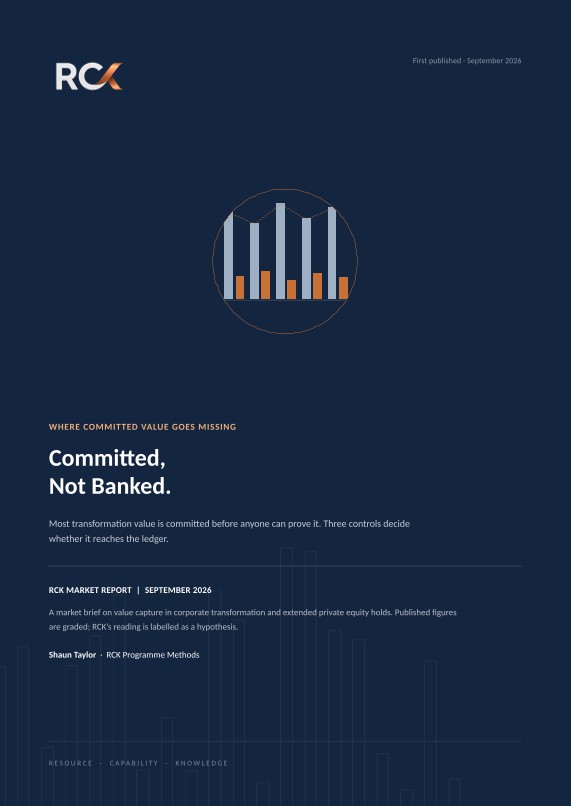
Committed, Not Banked - Most transformation value is signed off long before anyone can prove it reaches the ledger. The new RCK Programme Methods Market Report (September 2026) examines why so much of that committed value disappears, across corporate programmes and extended private equity holds. The 2026 research is blunt: ✅ Deloitte (500 senior leaders, April 2026): Only 14% fully captured the value targeted by their highest-priority initiative last year. Yet 67% expect to meet or exceed overall targets this year. Only 24% even price leakage into the target. ✅ Alvarez & Marsal (200 European PE investors and portfolio executives): 65% achieved less than half the value targeted in plans over the past two years. Three controls decide whether committed value is actually banked: 1️⃣ A frozen, CFO-signed baseline 2️⃣ An evidence register reconciled to the ledger every month 3️⃣ Execution support inside the workstreams, not just reporting on them Skip any one and the gap between plan and ledger persists. RCK’s own operating evidence (one client-verified programme) shows what happens when the controls are funded and independently checked: $128M in-year cost reduction. The report includes a practical playbook you can start with a finance partner and a spreadsheet, a model for extended PE holds, and how to structure adviser fees so they are paid on evidence rather than hours. Published figures are graded; RCK’s reading is labelled as a hypothesis, with a clear statement of what would disprove it. If you run or oversee a large cost, cash or value-creation programme, take the nine questions in section 4.8 to your next review. If the answer to any is “no,” the number is a forecast, not banked value. What does the gap between committed and banked value look like in your largest programme right now? Please comment and give us your thoughts below 👇 #Transformation #PrivateEquity #CFO #ValueCreation #CostTransformation #OperatingPartners #ChiefTransformationOfficer
Engagement over time
Not enough history yet to show a trend.