Listen Library
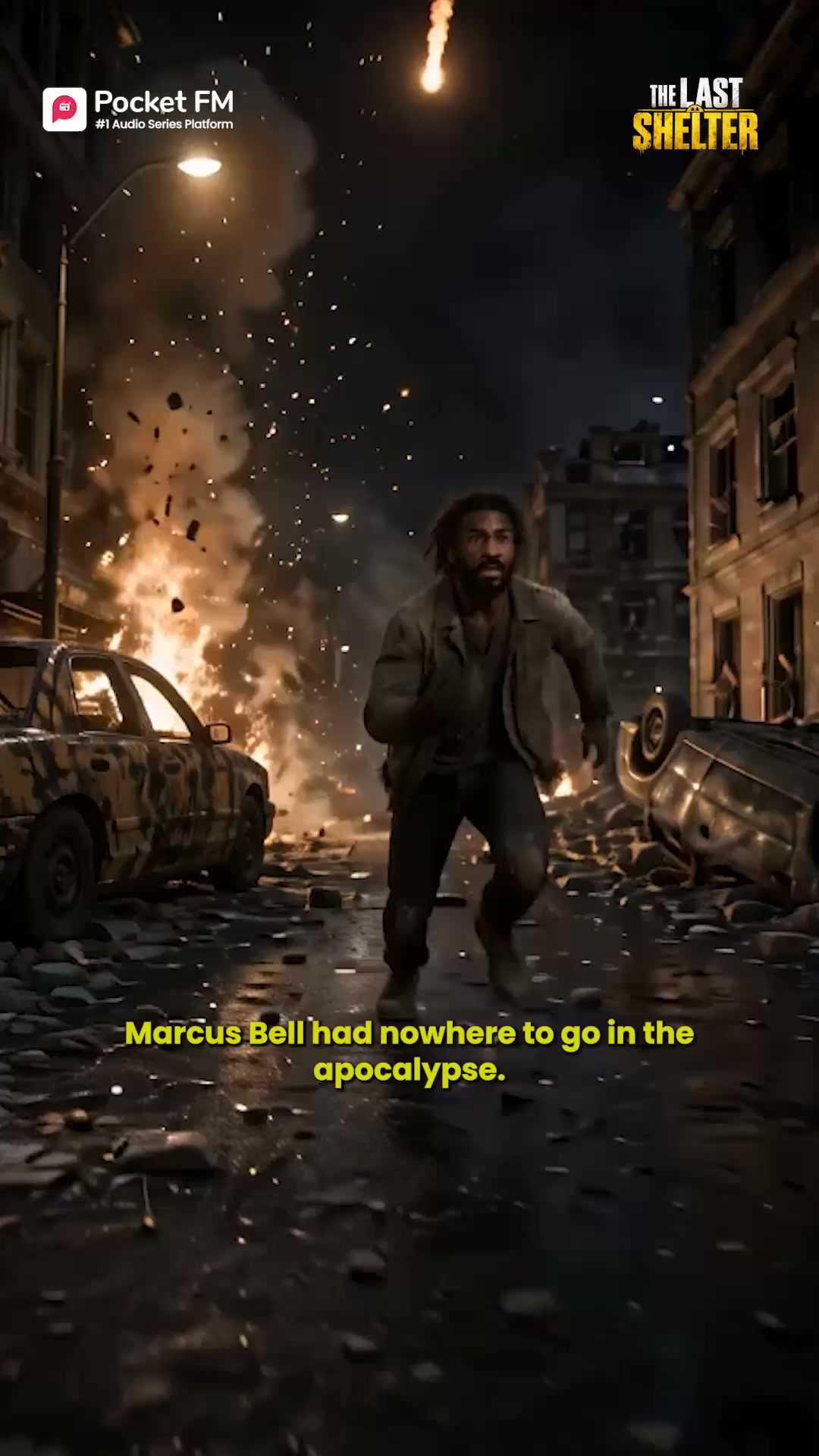
To find out, listen to the audio series 'The Last Shelter' (FREE for a limited period of time) Click on the link below to download the Pocket FM app, now!
Marcus Bell had nowhere to go in the apocalypse. The bombs had been down for two days when Marcus Bell reached his girlfriend's building. She was not alone. There was another man with her. They did not pretend. She stood in her own doorway and told him there was not enough food for three. The man told him to get moving. He heard them laughing through the door. He lived with that betrayal through the apocalypse. Ten years of it. Then he impossibly woke up in his own bed, in a city that was still standing, ninety-two days before the first bomb fell. His phone was ringing. It was her. He looked at her name for a long time and did not pick up. He had wasted a lifetime on that woman. This time he was going to spend his days helping people who would actually need him. This time, he was ready. The question was whether ready was enough The first thing Marcus Bell did was sit down and remember. Not research he already had the information. What he needed was to organise it, to pull it out of a memory that had been compressed by ten years of subsequent trauma and scrambled by the physical shock of moving backward through time. He closed his eyes and worked through it methodically, the way he had learned to work through things in his previous life: start with what you know for certain, then move outward. The Capital: more than forty nuclear warheads, from five countries. The missile defence systems intercepted most of them, but not enough. The southern districts took the first and largest impact August fifth, nine:thirty a.m., a crater where apartment blocks and morning commuters had been. That afternoon: two more in the west, close to the city centre. The following day: a fourth, east of the capital, positioned to drive fallout across the metropolitan area on the prevailing wind. Radioactive dust turning the August sky into grey winter. The evacuation routes heading northwest and west, toward the railway stations and military camps, were where the broadcasts directed people. The last missiles of the war had followed the crowd north. The trains had not arrived. Marcus Bell had known people on those trains. He did not spend time thinking about them. The northeast was different. Old factory conversions, university campuses, media parks. Low population density, no major military installations, no railway junction. The kind of area that warhead planners overlooked. He drew a circle on the map near the Fifth Ring Road and began calling real estate agents. He found the building on his third viewing. The agent was pitching the bathhouse across the road when the system appeared in his field of vision: "A suitable shelter location has been found: the power distribution building." Marcus Bell walked past the agent mid-sentence. The agent assumed he had not heard and followed him. The power distribution building sat inside a walled courtyard. The outer wall was three meters of old red brick with wire mesh still intact at the top. Inside the courtyard: a tall metal water tower, a pump house beneath it, and the building itself three storeys of solid reinforced concrete, each floor over five meters high, built to house industrial transformer equipment at the level of structural integrity that industrial equipment demanded. The south wall had been demolished when the factory relocated its transformers, the bricks still piled in the yard, but that just meant Marcus Bell could walk inside and see the frame clearly. Heavy reinforced concrete. Floor slabs poured solid. Staircase wide enough to move machinery. And below the courtyard, accessed through a steel door in the stairwell: an underground garage, five hundred square meters, dry, high-ceilinged, with narrow ventilation windows ringing the upper wall and a waterproofing job that had kept the floor dry for thirty years. He went back to the agent the next day and told him to get better lease terms. He signed the five-year lease at eight hundred and sixty thousand dollars per year and paid the first quarter before the ink dried. He transferred three hundred thousand dollars to Old Chuck as a renovation deposit the same afternoon, calling him from the car: "Get every worker you have and start in two days." He called Zack Zhao that evening. Zack Zhao was eight years younger, an electromechanical engineer who had been systematically swindled out of everything he owned by a business partner in his mid-twenties and had arrived at Marcus Bell's courtyard door with nothing except his skills and his stubbornness. Marcus Bell had lent him two hundred thousand dollars without asking for collateral, on the assessment that Zack Zhao was the kind of man who honoured his debts. He had been right. Zack Zhao repaid every dollar within two years, and he had framed the promissory note and hung it in his office as a reminder of who had believed in him when no one else would. He now ran one of the city's technically sharpest security companies. Marcus Bell told him to come out and look at the building. Zack Zhao arrived the following morning and spent half a day walking every centimeter of the property. Marcus Bell described what he needed: no blind spots, full perimeter coverage, automated drone patrol, motion sensors on the outer wall, three monitoring stations inside the building, and a wrist-mounted controller that could display the whole system on a single display. Zack Zhao called it something from a video game. Then he threw himself into it with the focused joy of an engineer given a problem worth solving. He ordered four one automated security drones from his own company's best product line each one equipped with high-definition cameras and infrared sensors, capable of memorising its patrol route after a single flight and repeating it independently, with over four hours of flight time and the ability to track and follow moving targets automatically. Then thirty-six surveillance cameras, outdoor and indoor models, plus hidden cameras for the stairwell and kitchen. A sliding camera platform installed on the south wall that could extend a camera arm above the wall when needed. All of it integrated with a custom wrist controller. Marcus Bell bought a hundred of the premium outdoor cameras without bargaining. Zack Zhao stared at him. "You're not short of money," Zack Zhao observed. "I'm not planning to be short of much for long," Marcus Bell said. What Old Chuck's workers built over eight weeks was nothing that would have been recognised as an office renovation. The outer courtyard wall received an interior concrete skin a second layer built against the original brick, steel beams packed between the two, the combined structure now thick enough to absorb a car collision. The iron gate was torn out and a custom steel replacement installed on sliding rails with a locking bar mechanism operated from the inside: immune to forced entry from the exterior, tested by the fabricator against vehicle collision. Every window received double-layered bulletproof tempered glass, sealed behind aluminium louvers that locked shut, the entire assembly enclosed in steel grille cages that took any first impact before it reached the glass. The first-floor railings were custom-fabricated at a specialist plant. The south wall was rebuilt and lined with lead-coated metal sheeting sandwiched in a forty-centimeter composite skin, radiation-resistant and structurally dense. In the underground garage: two sixteen-cubic-meter fuel tanks installed in the corner and sealed under poured concrete thirty-two tons of diesel, enough to run the generators for an extended period. The generators themselves were positioned and connected. A lithium battery array equivalent to twenty electric vehicles went onto the first floor; an identical array on the third. The roof was waterproofed and covered with solar panels inefficient in the radioactive-dust sky that was coming, but capable of delivering any amount of free electricity for as long as there was light. The building received central air conditioning and a fresh air system with controllable pressure differentials when sealed, the internal air pressure could be raised above the outside, preventing external contamination from finding its way in through any gap the seals had missed. The first floor was divided into a large preparation room and a dining room designed for fifty, with a semi-open commercial kitchen behind a long counter four stoves, industrial refrigerators and freezers, a cold storage room for frozen meat. The second floor was dormitory space: six four-person rooms and two two-person rooms, each with two computers, storage boxes, and a wardrobe. The third floor was Marcus Bell's studio, bedroom, and personal storage, plus the all-purpose workbench along the east wall. The basement held the workshop, the refining machine, three large warehouses, and a generator room. The medicine room a space of less than fifty square meters held three refrigerated cabinets stocked with antibiotics, wound care supplies, anti-radiation drugs in both oral and injectable forms, and radiation treatments. Marcus Bell had annotated his post-apocalyptic supply map with additional pharmaceutical sources: hospitals, pharmacies, distribution warehouses. He knew, from experience, that medicine was one of the three hardest currencies in the post-apocalyptic world. He bought as much of it as he could before the world ended and trusted the map to help him find more afterward. He stockpiled food in three separate locations. The logic was simple: if one location was breached, the other two still held. Most of the long-shelf-life food compressed military biscuits, canned goods, field rations, powdered milk, cocoa, sugar, salt went to the supply warehouses in the underground garage, behind sturdy walls and locked iron gates. Some went to the food storage room behind the kitchen. A reserve went to his personal warehouse on the third floor. Three locations. Three independent lines of failure before the food was gone. He also sent Zack Zhao out to buy five off-road electric motorcycles, a Chevrolet Express passenger van, an off-road pickup campervan, and a medium-sized Ford flatbed truck. He drove the flatbed himself from the used-car lot, stopped to load spare tires, and parked everything in the yard under a tarpaulin shelter built from salvaged steel tube and two layers of canvas, anchored down so the shockwave from a detonation would not send the vehicles rolling across the yard. The vehicles mattered for a specific reason Marcus Bell understood from his first life. After the apocalypse, petrol would become scarce within months refineries destroyed, distribution networks gone, the remaining stored fuel controlled by whoever had the weapons to hold it. Noise would matter equally: a conventional engine was audible for hundreds of meters in a quiet post-apocalyptic city, and in a world where radiation zombies were drawn to sound, noise was a targeting beacon. Electric vehicles were silent. Their fuel was electrical energy, which the shelter's generators and battery arrays could produce from diesel that Marcus Bell had buried in the ground. The five motorcycles had a hundred kilometers of range each. The farm tricycle had two hundred. In the ruins of the Capital, that was freedom of movement that no petrol vehicle could reliably match. The post-apocalyptic supply map on the third floor was the last piece of the preparation architecture, and in some ways the most valuable thing in the building. Marcus Bell had spent hours annotating it over the weeks of construction, pulling from memory every resource location he had visited or heard reliable reports of in his first life: hospitals with intact pharmaceutical stores, police stations with armories that had been overlooked in the initial chaos, warehouses on the edges of the blast zones where the shelving was still intact, civil defence facilities whose locations were not publicly known, logistics hubs where food and medicine had been waiting for distribution when the bombs fell. He printed it in sections, laminated each sheet, and filed them in a waterproof folder in his personal storage on the third floor. He had survived ten years of the post-apocalyptic Capital, in his first life, navigating that environment without this map, learning its geography through costly experience. Now he had a detailed, annotated reference built from ten years of that experience, compressed into laminated sheets and available to anyone who needed it. Eight weeks. Eighty million dollars. The building that Old Chuck's workers had renovated looked, from the road, like an unusually well-built commercial studio conversion. From inside, it was a fortified survival structure designed to function as a community anchor for dozens of people across an extended period of apocalyptic conditions with the food, water, power, medical supplies, weapons, manufacturing capability, and intelligence infrastructure to make that possible. The last item on the shelter's twelve-component checklist was the one that could not be solved with a phone call or a bank transfer. Weapons. What he needed was not the most powerful firearm available. It was the most useful one, useful specifically in a post-apocalyptic city where the ammunition supply would be whatever had survived the collapse of the civilian and military logistics networks. He already knew the answer from ten years of post-apocalyptic experience: The crate arrived on an ordinary afternoon, exactly as promised. Marcus Bell checked the action on each weapon, seated the scopes, pressed the suppressors to confirm the thread fit. Everything had been made to the specification he had described in the encrypted emails. He locked the firearms in the weapon cabinet in the maintenance room and turned the handle. The system notification appeared instantly: "Side mission: Weapon inventory in the maintenance room complete. All twelve branch tasks completed. Main Quest My Sanctuary Completed." Three rewards. Simultaneously. He ran the basic draws first: four in sequence, four pointers spinning simultaneously in the pale blue interface floating in his field of vision. The first intermediate draw produced six throwing knives in a leather case each blade balanced to a precision that went beyond what ordinary manufacturing could account for. The second intermediate draw produced the sealed plastic injector with the fluorescent red fluid inside. A bio-enhancing potion. Marcus Bell set it on the desk and held it for a long time. He knew what it was. A single basic-level injection increased a person's core physical attributes by twenty to fifty percent depending on underlying physique. Strength, endurance, nerve-reflex speed: all of them pushed beyond ordinary human maximums in a single session. He set it in the desk drawer. There was still a day of work to complete first. He spent his remaining hundred bottle caps on the advanced lottery draw. The result: “One primary material refining machine, extracts basic common materials from various impurities; generates bottle caps.” Feed it scrap metal, demolition debris, organic matter: it sorted everything to standardised base components and returned them graded and purified. In the ruins of a city, where raw materials were everywhere but usable manufacturing feedstock was not, this machine was the difference between a workshop that could keep producing indefinitely and one that eventually ran out of what it needed. Marcus Bell positioned it in the workshop, connected the power cable, and went up to the third floor to run the all-purpose workbench's first real test. He placed a wrench from the tool rack on the scanning surface. Blue light swept the metal in thin parallel passes. The screen asked: Scan and save blueprints? He said yes. A white blueprint appeared in the display panel three craftable variants listed below it, iron and steel and aluminium, with the aluminium option highlighted as the only material currently loaded in the inventory tray. He clicked it. The workbench vibrated. Twelve seconds of mechanical sound from inside the fabrication unit. Then the discharge bay opened and an aluminium wrench rose into the light every surface machined cleaner than the original it had been scanned from, the threads on the jaw sharper and more consistent. He worked through the entire tool rack over the next two hours. Wrenches, pipe fittings, structural hardware. Each item that went into the library was another item the workshop could produce on demand, without Marcus Bell being physically present at the machine to make it. He tried the ninety eight K. The workbench declined: "Item too complex. Workbench level insufficient. Intermediate-level upgrade requires five hundred bottle caps." Zero bottle caps remaining. He acknowledged the limitation without frustration. The upgrade would come later. The workbench would eventually reach the level where it could blueprint firearms and produce them automatically. For now, what mattered was the shutdown sequence. With three days left, the system issued its final pre-apocalypse mission: replenish supplies. Two bottle caps per ton of weight. Marcus Bell rented the remaining ten warehouse units across the road. Eight he filled with metal ingots and processing materials dense, heavy, efficient generators of bottle caps per dollar spent, and the post-apocalyptic manufacturing feedstock the refining machine would need to produce materials faster than he could collect scrap. The last two he loaded with canned goods and compressed biscuits. The news was accelerating. Domestically, things remained surface-stable. Internationally, the picture was deteriorating in the way that only Marcus Bell could read accurately: not as a developing situation, but as a countdown. He watched it with the specific detachment of a man who already knew the outcome and was no longer watching for information but for timing. Three days. He needed to make the most of each one. On the penultimate day, he went to the suburbs. From a used-car lot near the eastern ring road, he found a three-wheeled electric farm vehicle the heavy-duty kind, with a lithium battery upgrade already done and a semi-enclosed canopy. The range was close to two hundred kilometers. In a city where petrol would become scarce within weeks of the apocalypse and noise would attract every radiation zombie within earshot, a silent electric vehicle with that range was worth more than any petrol car. He drove it back to the cultural park himself. He went back for a Chevrolet Express van and an off-road pickup campervan, hiring a driver for the van while he drove the campervan. Then the Ford flatbed truck, stopping on the way back to fill the bed with spare tires. Five off-road electric motorcycles, ordered from a flagship store, with ten spare battery packs; compact, silent, a hundred kilometers of range per charge, the kind of transportation that left no trail of noise in a world where noise was fatal. He covered everything in the yard under a salvaged-steel shed and double-layered it with canvas tarpaulin, the trucks anchored down so the shockwave from a nuclear detonation would not roll them across the yard. On the last day, the birds were wrong. He had been up since before dawn and had noticed it while checking the perimeter from the roof. Large flocks moving north too many, too consistent, not migration season. The formations were not the loose dispersal of birds going about their business but a directed movement, like something had told them simultaneously which direction was safer and how urgently to go. In the storm drains running along the road outside the park, swarms of rats were moving in the same direction visible through the drain grates, flowing steadily, dozens of them, small bodies moving with the focused efficiency of animals responding to a signal that had not yet been broadcast on any human frequency. In his previous life, he had not noticed the animals on the last day. He had been asleep, in the apartment he had been renting at the time, and he had woken up to the first explosion with no warning and no preparation. Later, talking to survivors in the airport shelter, he had heard the same story repeated in different forms: people who had kept animals described their pets becoming frantic in the hours before the bombs, cats hiding behind furniture, dogs refusing to come out from under beds. The animals always knew. They had always evacuated before the humans understood what they were evacuating from. Marcus Bell noticed it now, and the familiarity of it made the timing feel suddenly very real in a way that ninety-two days of countdown had not quite made it feel. The world was not ending in theory. It was ending today. He watched the rats for a moment, then went back to work. He unbolted the solar panels from the roof mountings and carried them downstairs. Marcus Bell moved through the building from top to bottom, sealing as he went. The solar panels were inside, protected from the electromagnetic pulse and the shockwave. He had carried them down himself, one panel at a time, stacking them flat in the corridor of the second floor against the wall. The cameras every one of the thirty-six were each wrapped in its own electromagnetic shielding bag, individual sleeves of metallised fabric sealed with tape, protecting the circuitry inside from the initial pulse. The monitoring servers, backup drives, and communications equipment went to the underground garage, twelve meters below ground level, below the effective reach of the pulse from any detonation that was not landing directly on the building. He paused at the server rack and spent thirty minutes backing up the internet data he had captured to every drive he owned. The data represented something the post-apocalyptic world would be desperate for and unable to reproduce a real-time record of the first day of World War III, showing which cities had been struck, which regions had been spared, which evacuation routes were already compromised before they were announced as compromised. In a world where the internet was gone and the only remaining information came from whoever you happened to meet, this archive was worth more than most of the physical supplies in the building. He sealed the drives in anti-static bags and stored them in three separate locations. He checked the roof ventilation hatch. Steel door. Four locking bars seated in their brackets. Sealed. Each floor, systematically, room by room: aluminium louvers shut and latched at both their upper and lower mounting points. Windows crisscrossed on the interior face with adhesive reinforcing tape pressed into a diagonal grid the method used in earthquake-zone construction, designed to hold a shattered pane in place under pressure so it did not spray inward as shrapnel. Every gap at the window frames sealed with a bead of silicone sealant pressed into place with a putty knife and run twice for certainty. Every door closed and tested in its frame, every gap at the threshold taped. The laundry room and kitchen: ventilation grilles sealed with silicone. The rooftop access door: already sealed, locking bars already down, but he checked it again. The stairwell at every level: fire doors pulled shut and tested. The underground entrance: wooden boarding fitted over the concrete ramp to prevent debris from the shockwave rolling into the passage. The steel roll-up gate cranked down to its stop. The roller shutter closed and its entire perimeter sealed with a continuous bead of silicone around the bottom edge, up both sides, across the top junction with the ceiling, every place where the outside world might find a way through. The steel door at the bottom of the stairwell connecting the first floor to the basement: closed, locked from the basement side, the gap at the threshold sealed. Generators: down. Battery power only. Two indicator lamps left running in the underground garage, providing the minimum light needed to navigate without drawing power from the main arrays. Every other light in the building off. He walked through the building one final time, from the basement to the third floor and back, checking by feel and by the thin beam of a hand torch. No light escaping through any gap in the louvers. No air movement from any unsealed vent. No sound from outside. The building was sealed. He found the phone in his pocket and made the last call. "Boss? I was about to go out to a job." "Don't," Marcus Bell said. "Take tomorrow off and stay indoors. Tonight go to the supermarket. Fill what you can: food, water, daily necessities. Then come home and stay there." A pause. "Is there a lockdown coming? I haven't seen anything." "If you trust me," Marcus Bell said, "do this without asking for an explanation right now. One more thing whatever you hear on the broadcasts in the next few days, do not go north. If things become very bad and you can't stay where you are, find a way to reach the cultural park." Three seconds of silence. The silence of a man who had learned, at some cost, when to ask questions and when to trust the person asking him to act. "Understood," Zack Zhao said. "I trust you." Marcus Bell put the phone down. The box he had already sent to Zack Zhao was in transit emergency food, a flashlight, and the most important item: half the box filled with anti-radiation medication, both oral doses and injectable forms. In the first days and weeks after a nuclear blast, the difference between surviving radiation exposure and dying from it often came down to whether you had the right medication and took it in time. In his previous life, Marcus Bell had watched people die from radiation sickness who had survived everything else the bombs, the cold, the food shortage because they had no medication at all. Zack Zhao was a very intelligent person. If he had the medication and the warning and the food to sustain himself through the first phase, there was a real chance he would find his way through. In his previous life, Zack Zhao had followed the evacuation broadcasts toward the railway stations. The last missiles of the war had found the trains on the tracks. He had been twenty-eight years old a man who had rebuilt himself from nothing through skill and stubbornness, who had repaid a two-hundred-thousand-dollar debt that most people in his position would have walked away from. Whether he would act on the warning, whether the box would arrive in time, whether any of it would be enough none of that was within Marcus Bell's control. He had done what he could. He filed the uncertainty away and went downstairs to wait. The tremor came before dawn. A single pulse through twelve meters of concrete barely perceptible, easily missed by someone not expecting it. Marcus Bell was on his feet and up the stairs before it finished. He turned on the computer and found what he had always known he would find. The news channels were mostly static. A handful had emergency broadcasts running anchors with controlled fear in their voices, delivering information that was already outdated by the time it reached the air. The internet was chaos: forums and news sites filling simultaneously with reports from dozens of cities, each one confirming in different words what Marcus Bell had known since May fifth. The war had started. He opened his laminated supply maps and began marking with a pen. Every confirmed nuclear impact placed as a dot, cross-referenced against his own memory of where the warheads had fallen and verified against the incoming reports. Southern districts: first and largest. Coastal cities. Central transport hubs. Political and cultural centres. Each dot placed with precision, representing something that had already happened once, reproduced now in exact agreement with his memory from ten years in the future. This was data, and data was what the ruins of the Capital would be starving for. Every survivor settlement that eventually formed in the post-apocalyptic city would face the same problem: they knew their immediate surroundings, they knew the rough outline of what had happened, but they did not know the detailed geography of destruction and survival across the wider region. Which areas had been struck. Which districts were intact enough to scavenge. Which routes were passable and which were still too radioactive to enter without dying. Marcus Bell was building the most comprehensive record of that geography that any survivor in the city would possess, from real-time data collected while the internet was still alive. He compressed everything news footage, forum posts, news site archives, government announcements onto every backup drive he owned and filed them in the underground workshop in waterproof containers. The second bomb struck the Capital in the early afternoon. He knew exactly when it was coming. He was at his desk when the building shook a pressure wave at this distance rather than a structural assault, the windows rattling in their taped frames, the indicator lamps swinging, every sealed door in the building groaning once before settling back. He checked every seal immediately, moving through the building at a walk, pressing his hand against the seals at each window, testing the door frames. Every seal held. Every door was seated. The water system was reading nominal. The power was reading nominal. Thirty minutes later he was back at his desk, watching the internet reports continue to fill in the picture, until they stopped filling in anything until the internet died somewhere between the second and third impacts, quietly, without a closing message, in the way that everything essential dies in a catastrophe: mid-sentence, without announcement. The third bomb followed in the evening. Another shake. Another check. Holding. The sky outside, visible through the narrowest gap he permitted himself at one corner of one louver on the third floor, had gone from the grey of an August afternoon to the grey of a sealed room radioactive dust settling over the city in a blanket that would not lift for months. He closed the louver and went back downstairs. Marcus Bell went to the kitchen and made instant noodles on the electric stove. He ate standing at the counter, tasting nothing, because he had not eaten in twenty-four hours and the next phase required a functional body. When he was done, he went back to the basement and lay down on the bunk. The radio was still broadcasting the evacuation instructions in a loop from the bedside unit he had left running the same message repeating every forty minutes, the voice of a government that had already ceased to function in any meaningful sense, directing citizens toward evacuation routes that were already gone. He listened to it cycle twice before he turned it down to background level and stared at the concrete ceiling and waited for the next day. On the second day after the bombs, the radio announced that the Capital had been abandoned. The government emergency plan had directed the remaining survivors toward rail evacuation north. The evacuation message cycled. Marcus Bell listened to it complete three loops, then turned the radio down. Outside the sealed building, the sky was completely dark at midday. The radioactive dust that had settled in the hours following the impacts had formed a continuous atmospheric layer, blocking the sunlight that would normally reach the city in August. In his first life, Marcus Bell had seen this from the outside the way the dust turned the sky into a grey ceiling that leached all colour from the ruins below it, the way the light that filtered through had a flat, directionless quality that felt wrong in every small bone of the body, the way the first weeks of the nuclear winter had a particular psychological weight that he had not been prepared for and that had broken people who had survived everything else. He had not been out in those first weeks last time. He had been underground, in a shelter that was running out of food, surrounded by people who were beginning to understand that the world outside was not going to be survivable in the way they had hoped. He remembered the specific quality of that fear very clearly. He was not going to make those people wait for food this time. He found the enhancement potion in the desk drawer. The sealed plastic injector, the red fluid catching the light. In his previous life, the science of enhancement drug uptake had been studied carefully after the first generation of drugs became available. The researchers had determined with consistent evidence that a body in a calm physiological state low cortisol, regular respiration, relaxed muscle tissue absorbed the drug more completely and converted it into higher attribute increases than a stressed body under the same injection. The practical instruction was simple: control your breathing, lie flat, stay calm. He sat in the chair at the workbench desk and regulated his breathing. Long slow exhale. Deliberate slow inhale. He felt the chair under him and the cool air of the sealed basement and the particular stillness of a building that had survived the first wave of everything without a crack. He pressed the injector to his left arm and released the pressure mechanism.The warmth arrived immediately from the injection point up his arm, across the shoulder, down his spine, radiating outward to his extremities in a slow building flood.His hands grew heavy. His vision narrowed to the middle distance and then closed. He lay flat on the bunk, interlaced his fingers across his chest, and let his breathing slow until it stopped being a conscious act. He slept for three days.He could see in the dark. Not completely not daylight clarity but from the dim red pulse of the indicator lamps, he could see the computer chair across the room, the tool rack on the far wall, the individual implements on it. He could see the enhancement vial on the desk, five meters away, and read the barcode on its side without moving. He blinked and tested this moved his focus between the near and far ends of the room, checking whether the improvement was consistent or just an adaptation artefact from waking in darkness. It was consistent. Better in the near field than at distance, but the distance capability was also expanded beyond what it had been before the injection. He stood carefully and found his balance different lighter. He walked across the room to the tool rack and back. The adjustment was not a learned compensation. It was already there, already natural, already the baseline. He opened the shelter system. Below the structural panels and mission interface, a new section had appeared: Shelter Characters. One entry. His own. Marcus Bell Shelter Manager Attributes Strength: four. Stamina: five. Agility: eight. Intelligence: five . Talent Abilities: “Special Physique Increases enhancement potion injection effectiveness by fifty percent. Permits one additional injection at the same potion level.” “Calm and Composed Doubled resistance to fear, tension, and anxiety. Reduced susceptibility to negative emotional states.” He looked at the agility score for a long time. Eight. Nearly three times the baseline of an ordinary adult. It was rare, exceptional, and sought after by every major settlement in the post-apocalyptic world. Agility at eight meant his nerve signals moved at close to three times normal speed. It meant his dynamic vision, the capacity to track and correct against fast-moving targets was beyond what any unenhanced human could achieve through training alone. The Special Physique also allowed one more basic-level injection. He filed that away. First things first. He also looked at the structure of the Shelter Characters panel. The system that had guided him through ninety-two days of preparation had not been preparing him to survive alone in a very well-equipped basement. It had been preparing him to manage something larger. He took out the post-apocalyptic supply map and spread it flat on the workbench. The pentagon blast door at the bottom of the pedestrian passage. The civil defence facility beyond it, capacity two to three hundred people, government-maintained, restocked by Lt. Lee’s team in the weeks before the apocalypse. The passages marked on the laminated floor plans connect that facility to the residential communities of Eastfield to the east and Westgate to the west. Arrows on the maps pointing down corridors, potentially occupied by people who had made it underground before the bombs fell and who had been sitting in the dark since, eating through whatever they had managed to grab in fifteen minutes of panic and rationing it as carefully as frightened people in the dark were able to ration anything. He looked at the shelter’s dining room. Capacity: fifty. He looked at the dormitory floors. Capacity: thirty to forty. He looked at the medicine room. Capacity: enough antibiotics and anti-radiation treatment to sustain many people through the worst of the initial exposure period. The shelter had been built for this. Not for him. For this. That calculation the one that had sat underneath every dollar spent and every design decision made over ninety-two days was about to move from calculation into action. The shelter was ready. Now the question had to be answered in the world, not on paper. The food in those facilities was running out. He had survived before without any of this. He needed to hold that clearly, because it was the core of everything he was about to do. In his first life, he had stumbled into the apocalypse without preparation. After ten years, he had become one of the most capable fighters in his region. But he had never been positioned early enough to save anyone before they were already in crisis. This time, he had built the infrastructure before the crisis. He had not built any of it for himself. The radiation counter was lower than it had been the day before. He had been reading it twice daily since the bombs fell. The numbers had peaked in the immediate aftermath of the last strike and had been decreasing in small fractions. The northeast district was still lethal to anyone without a sealed protective suit and a breathing mask. His calculation was this: the civil defence facilities in the surrounding communities Eastfield to the east, Westgate to the west had been rated for two to three hundred people each. The people who had reached them before the bombs fell had arrived with whatever they grabbed in the fifteen minutes between the broadcast and the first impact. Emergency stores supplemented by whatever the inhabitants had managed to carry. The facility stores covered weeks for a population of that size, not months. The radiation would not fall to safe outdoor exposure levels for weeks at minimum. But the people inside those facilities did not have weeks of food. They had days. The blast door at the bottom of the pedestrian passage was twelve meters underground, sealed from the fallout, already re-lubricated and maintained by Lt. Lee’s team. The passage was navigable. The only barrier was the pentagon lock the five- pointed star insertion port that required a specialised tool wheel Marcus Bell did not yet have. He had never thought of the pentagon tool wheel as a problem he could not solve. His master key could open mechanical locks, any mechanical lock manufactured before March twenty twenty five. The blast door’s pentagon insertion port was not a conventional keyhole. It was a different mechanism entirely, designed for a different kind of tool. The master key could open every door between him and the blast door. The maps showed him where to look. The passage was navigable and sealed from the radiation above ground. He was not going to wait for the radiation to fall below the threshold for safe outdoor exposure. He was going to suit up and go underground. Marcus Bell suited up. Mask sealed. Radiation counter: still falling. Seven days underground. Three nuclear shockwaves. Not a single system had failed. The shelter had worked. Every wall, every seal, every buried fuel tank exactly as designed. But a shelter built for fifty had only one name in it. Somewhere beneath him, past a blast door he hadn't yet opened, people who had survived the end of the world were running out of food. He turned the lock. The gate swung open. The ruins of the city waited. The apocalypse arrived exactly as Marcus Bell predicted. But the hardest part was never the bombs. Who had survived behind that blast door? Would they trust a stranger in a radiation suit? And when the food ran out how far would desperation go? To find out what happens next, install the pocket fm App in the next 1 minute to get free access to the first 10 episodes of The Last Shelter, hurry before the offer disappear and install the app and enjoy free episodes now.
Engagement over time
Not enough history yet to show a trend.