Elovya
Discover The Power of Natto Today!
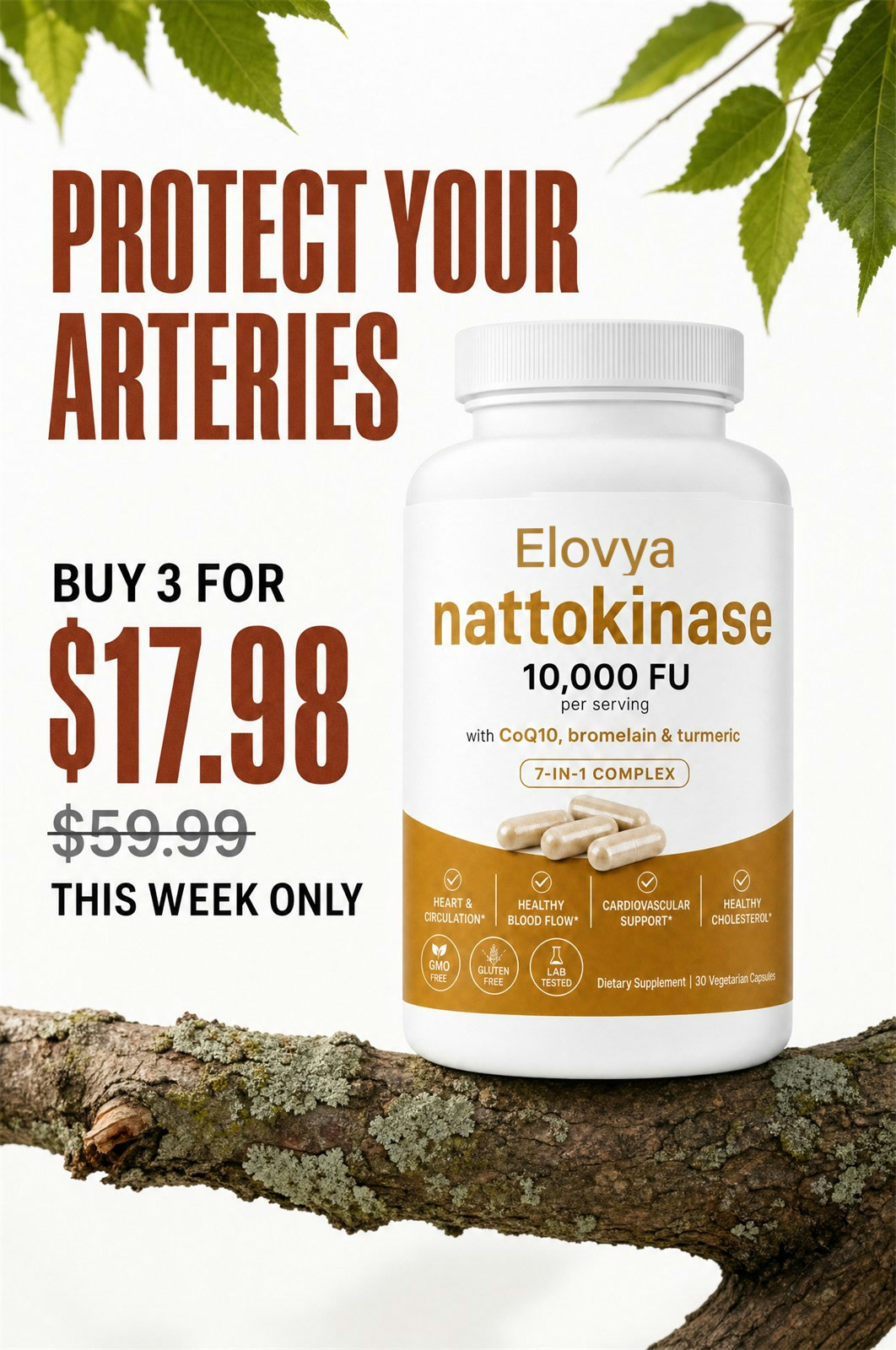
If your cholesterol numbers won't move — even though you cut the red meat, even though you walk after dinner, even though you've been on a statin for three years — it's not because you need more discipline. It's because you've been treating one half of the problem. Plaque isn't just cholesterol. Cholesterol is only the raw material. What actually holds plaque together — what lets it stack, harden, and stay — is a protein mesh inside your artery wall called fibrin. Think of it as a wall being built inside your artery. Cholesterol is the bricks. Fibrin is the scaffolding. Cut the brick delivery and the wall stops getting taller — but every brick already laid stays exactly where it is, because the scaffolding is still holding it up. That's what a statin does. It reduces the bricks. And it works, as far as it goes. But a physician went viral recently for saying out loud what the trial data actually shows: in the coronary arteries, high-dose statins reduced plaque by 0.015 millimeters. The best results in any study, 0.04 millimeters. A fraction of a millimeter. His words: "In essence, it didn't reverse — it just stopped the progress. It was basically the car's in neutral. The plaque's in neutral. Not growing, and not really reversing." That's a medical doctor describing the drug roughly half of American adults over 55 are on. Neutral isn't nothing. If you're 72 with existing disease, neutral may be exactly what you want. But if you're 54, watching the same numbers your father had at 54, neutral is not a plan. It's a holding pattern that lasts the rest of your life. So why has nobody offered you the other half? Because the other half isn't a drug. Japan has one of the lowest heart disease rates on earth and one of the highest life expectancies. America's number one killer is heart disease — over 700,000 deaths a year. The difference isn't genetics and it isn't luck. For a thousand years, Japanese households have eaten a fermented soybean dish called natto, and in 1980 a researcher isolated the enzyme responsible for what it does to blood: nattokinase. Nattokinase is fibrinolytic. It breaks down fibrin. It takes down the scaffolding. And you have never heard of it from your doctor for the same reason nobody has ever advertised it to you: you cannot patent an enzyme that occurs in food. No pharmaceutical company will spend a billion dollars taking a fermented soybean extract through FDA approval for something they can't own exclusively. There's no sales rep walking into your cardiologist's office. Most of the research is published in Japanese and Chinese journals. Your doctor isn't hiding it — nobody is paid to bring it up. A large retrospective study followed 1,062 people over a year. In the nattokinase group, carotid plaque size and arterial wall thickness dropped by up to 36%, with improved lipid profiles alongside it. From neutral — to a 36% improvement. Not a drug that stops the wall getting taller. An enzyme that takes down what's holding it up. Now, if you've already tried nattokinase and felt nothing, there's a specific reason. It was the dose. In the research, reversal only showed up at high doses. Below roughly 6,000 FU, studies found nothing at all. The clinical dose is 10,000 FU. And almost every bottle on the shelf — the $18 ones on Amazon, the ones in the vitamin aisle — sits under 2,000 FU. That isn't a weaker version of the same thing. It's a different product wearing the same name. You didn't try nattokinase and fail. You took a fifth of a dose and correctly concluded it did nothing. Elovya Nattokinase is 10,000 FU. The clinically studied amount, in a single vegetarian capsule. Stacked with CoQ10 for the heart muscle, plus bromelain, turmeric, aged garlic, pine bark and grape seed — a 7-in-1 complex built around the enzyme rather than sold as a token amount of it. No prescription. No muscle aches. No fatigue. One capsule with breakfast. And a 90-day guarantee: take it daily, get your bloodwork done, and if your numbers haven't moved you pay nothing. Empty bottle included. We're not asking you to believe us. We're asking you to test it. There's a moment you've probably already played in your head. You're sitting on the paper-covered table. The doctor opens the printout. He pauses. He looks up — and instead of reaching for the prescription pad, he asks you what you've been doing differently. Japanese households have been getting that moment for a thousand years without knowing why. Now you know why.
Engagement over time
Not enough history yet to show a trend.