Better Health Institute
for every parkinsons survivor
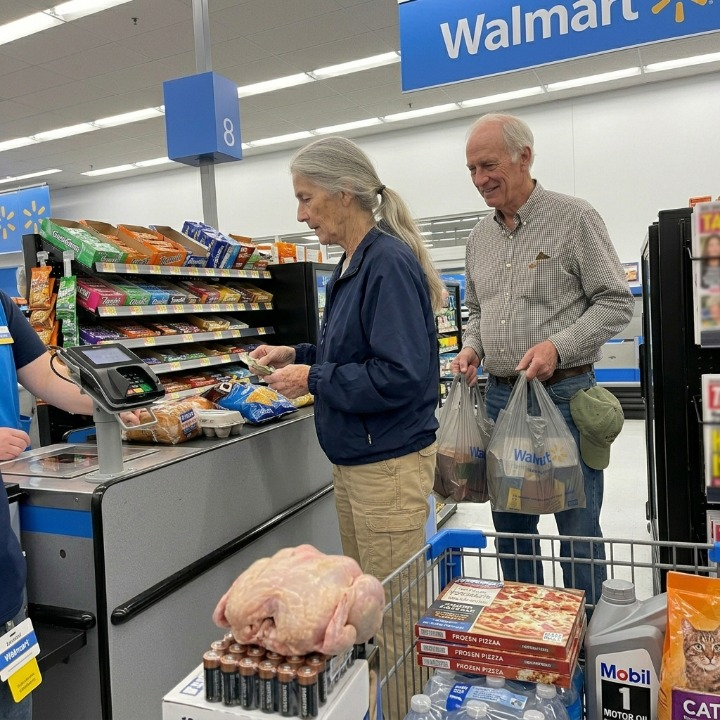
I went to Walmart for cat litter and a rotisserie chicken. I came home with a folded receipt I couldn't stop thinking about. Three words on the back. A product name I hadn't heard before that afternoon. And underneath it, a sentence that made me realize how much I had been doing for my husband without asking what he wanted me to do. I'll tell you what it said in a minute. First, you need to understand what my evenings had started to look like. Dinner dishes in the sink. Television murmuring in the next room. A cup of coffee beside my laptop that I would remember only after it had gone cold. And me, reading. Another article. Another discussion. Another person describing something that sounded a little like what was happening in our house. Sometimes I would look up and discover an hour had gone by. Sometimes two. My husband would call from the living room, asking whether I was coming to watch our show, and I would say, "Just a minute." I said that so often it began to feel like the title of our marriage. Just a minute. One more page. One more thing to understand before I could close the laptop and sit beside him. My name, in this story, is Elaine. My husband is Martin. We have been married for thirty-two years, which is long enough to disagree about how to load a dishwasher without either person expecting to win. He puts the bowls on the bottom rack. I move them. He puts them back. Some couples have a song. Apparently, we have this. Before Parkinson's became part of our lives, I would have told you we were ordinary people with an ordinary routine. He liked working in the garage. I liked knowing there was at least a possibility that the car might fit inside it someday. He collected pieces of wood he was certain he could use. I collected plastic containers whose lids seemed to leave the house independently. We had children who called when they wanted advice and grandchildren who called when they wanted to show us something immediately, usually with the camera pointed at the ceiling. We had plans. Nothing extravagant. A few trips. A kitchen drawer we were going to repair. More afternoons with the family. Less rushing. Then his diagnosis entered the conversation. And for a while, it felt as though every other subject had to move over and make room. There were appointments to arrange and questions to remember. There were things we needed explained twice because the first time we heard them, we were still thinking about the sentence before. We had people who meant well. People who asked how he was doing. People who sent links. People who said they knew someone who knew someone. I became the person who kept the folder. Appointment information in one section. Medication details in another. Notes on the back of envelopes that I meant to copy somewhere more sensible. I became good at remembering what we needed to ask. I became less good at remembering to ask him what he wanted to talk about that evening. That didn't happen all at once. It happened through a hundred small, sensible decisions. I would notice him taking longer with something and step forward before he asked. I would hear an invitation and start calculating how difficult the day might be before he had answered. I would ask how he felt when what I really wanted to ask was whether I should be worried. He could hear the difference. After thirty-two years, of course he could. One morning, he was standing at the kitchen counter with his coffee. I watched his hand around the handle instead of listening to what he was saying about the neighbor's new fence. He stopped halfway through his sentence. "Elaine. The fence." "What?" "I'm talking about the fence." I apologized. He waved it away. But I thought about it later. He had been making a joke, and I had been looking for a sign. I loved him. I was frightened. Both things were true. Neither one meant that every breakfast needed to become an assessment. There was a little chair in the garage that he had started for our granddaughter, Lucy. It was meant to have a heart in the back and a seat low enough for her to reach the floor. She had requested purple, then yellow, then purple again with "sparkly parts." Martin had told her the design committee would consider her suggestions. She had told him she was the committee. The unfinished chair became something I noticed every time I went into the garage. It was easy to turn it into a symbol. Too easy. I would see the pieces and think about everything I couldn't predict. How our plans might change. Whether I was overlooking something. Whether the next idea I read about would finally give me a clear answer. Meanwhile, to Martin, it was also a chair with a joint he hadn't figured out to his satisfaction. That detail mattered. I was starting to write a sad story around objects he was still living with. I didn't understand that yet. I just knew I was tired of being frightened, and frightened that being tired meant I wasn't trying hard enough. That was the version of me who went to Walmart on a Tuesday afternoon. Cat litter. Dinner. Coffee if the price was reasonable. I had written the list on the back of an envelope because we owned three shopping-list pads and naturally I couldn't find any of them. Martin had asked for the rotisserie chicken. "The one with the seasoning," he said. "That narrows it down beautifully." "You'll know it when you see it." It was such an ordinary exchange that I nearly missed how much I enjoyed it. No question I needed to take to an appointment. No answer I needed to research. Just my husband sending me on a chicken mission with insufficient instructions. The store was busy. A child was negotiating passionately for a cereal box. Someone had parked a cart sideways across an entire aisle. I forgot the coffee and had to go back. By the time I reached checkout, I wanted to be finished. The self-checkout area had a line of its own, so I joined a regular lane behind a woman with silver hair and a canvas handbag worn soft at the corners. Her cart held potting soil, a loaf of bread, and a selection of things that suggested she had come for one item and made several additional decisions. She saw me trying to lift the cat litter. "Give yourself some room," she said, moving her cart forward. "I think this gained weight between the shelf and the register." "They all do. It's how they get you." I laughed. A real laugh. The kind that arrives before you have time to decide whether you're in the mood. She noticed the photograph on my keychain when I reached into my bag. "Granddaughter?" "Lucy. Six. In charge of everything." "Mine's eight. She's already reorganized my kitchen." We talked about grandchildren for a minute. How they could ask a question so direct you needed the rest of the afternoon to recover. How a drawing made on ordinary printer paper could become something you wouldn't trade for anything. She said her granddaughter had recently asked whether people had refrigerators when she was little. I told her Lucy had asked me whether I remembered dinosaurs. "Well," she said, "did you?" Behind her, a man was looking at the candy display. He picked up one bar, put it down, considered another, and went back to the first. She glanced over her shoulder. "You don't have to submit a report. Pick one." "I'm comparing value," he said. "You've been comparing value for seven minutes." I smiled at the familiar rhythm of it. Not because I knew anything about their health or their marriage. I didn't. Because it sounded like two people who had been having versions of the same conversation for years and still enjoyed the company. She turned back to me. "Yours retired?" "A little while now." "How's that going?" I could have given the short answer. Fine. Keeping busy. You know how it is. Instead, I said, "He's living with Parkinson's. We're figuring things out." She didn't reach for a story about somebody who had beaten it. She didn't tell me she knew exactly how I felt. She simply waited. And because she waited, I found myself saying more. About trying to be useful. About the reading. About wanting to find something practical without knowing which claims deserved our attention. About how exhausting it could be to finish an evening of searching with a longer list than the one you started with. "I just want to help him feel better," I said. She nodded. Then she asked me a question I wasn't expecting. "What does he most want help with?" I started to answer with the things I noticed. She listened, then asked gently, "And what does he say?" There was no criticism in it. That was probably why it got through. I knew what worried me. I knew what I tracked. I knew what questions I had copied into the folder. But I couldn't remember the last time I had asked Martin that without already having a suggestion ready. The cashier called the woman forward. She moved her things along the belt and mentioned a supplement brand she had been reading about: Xara. I asked her to repeat it. "Xara. They have a ten-in-one gummy. You can look at the label and what customers have written." I asked whether she was recommending it for Parkinson's. "yes," she said. She had given me a lead without giving me a diagnosis, a guarantee, or a lecture about what our doctor had supposedly missed. "Have you got a pen?" I had three, of course. None in the pocket where pens were meant to live. I eventually found one underneath a peppermint wrapper and the envelope with my shopping list. She turned over her receipt. Wrote the product name. Then paused and added a second line. Her husband returned with his candy, looking satisfied with the outcome of his research. "Ready?" She handed back my pen. "Good luck with the six-year-old supervisor," she said. Then they collected their bags and left. I paid for the cat litter. The chicken. The coffee I had nearly forgotten twice. Outside, I put everything in the car and sat down behind the wheel. The receipt was creased across the middle. A line of small printed prices on one side. Her handwriting on the other. Three words: Xara 10-in-1 Gummies. Underneath: Ask him first. I read that second line more than once. It wasn't an instruction to give up looking. It wasn't an accusation that I had done something wrong. It was a reminder that the person I wanted to help was still the person who should be part of the decision. I had been so busy collecting possible answers that I had stopped leaving much room for his questions. I drove home. Martin looked into the grocery bag. "That's the chicken." "An impressive achievement, considering the briefing." He laughed. I put the groceries away. Left the receipt beside the kettle. Made dinner. Normally, that was the point in the day when I would begin running through what needed doing tomorrow. This time I told him about the woman in the checkout line. About the potting soil. The candy. The granddaughter reorganizing a kitchen. Then I showed him the note. He read it. "She writes more neatly than you." "That is what you took from this?" "It's a very clear receipt." I smiled. Then I asked him the question. "What would you most like help with right now?" He didn't answer immediately. I tried not to fill the silence with suggestions. Eventually, he said he wanted us to make plans without treating every plan like a promise he would be letting someone down by changing. He wanted to see people without feeling obliged to give them a complete update. He wanted me to ask before taking over something he was still working out how to do. And he wanted room to say he was tired without seeing my face turn into a problem-solving meeting. I listened. Not perfectly. A few times I started to explain why I did those things. Then I stopped. He already knew why. He had been married to me for thirty-two years. He knew I loved him. He knew I could organize a drawer, a holiday, or an entire household when I was worried. What he needed in that moment was a chance to finish his sentence. We stayed at the table longer than usual. The dishes waited. The folder stayed closed. We talked about what he wanted our week to contain, alongside the things it needed to contain. There was a difference. Later, we opened the laptop together. The product name from the receipt took us to Xara's 10-in-1 Gummies. Before reading anybody's story, we looked at the Supplement Facts panel. The serving size shown was two gummies, with thirty servings per container. The ten listed ingredients were shilajit, ashwagandha, ginger, black musli, tribulus, mucuna pruriens, black pepper, akarkara, maca, and tongkat ali. Some names were familiar. Others weren't. We didn't assume that ten ingredients meant ten proven benefits, or that a familiar plant name told us how the finished product would affect him. We saved the label so we could ask about the actual formula. Then we read the reviews. A customer named Jonathan described being doubtful when he first saw the ads. That part was easy to understand. There is a particular kind of skepticism that comes from having already spent time and money hoping something will be worth it. Another customer, Christina, wrote, "I have more energy during the day." A customer named Kimmi included a small sentence that caught my attention: "I even smile more." I read it aloud. Not because it proved anything about what would happen to Martin. It didn't. Because it expressed something so ordinary that it was easy to understand why someone would want to share it. Feeling better in your day can mean something personal. A conversation you enjoy. A plan you're interested in making. A moment you want to describe to someone else. But those were the reviewers' accounts, not promises we could borrow for our own future. The reviews also contained statements about symptoms and named diagnoses. We didn't take that as evidence that the gummies treated those conditions. An individual's report cannot tell you what caused a change, what else was happening at the time, or how someone with a different medical history will respond. We weren't going to turn an encouraging sentence into a conclusion it couldn't support. Martin leaned back from the screen. "So what do we actually need to know?" That was a better question than the one I had been asking myself during all those late evenings. Not, could this be the thing? What do we need to know to decide whether this belongs in his routine? We started a short list. Was the full formula appropriate alongside his current medications? Were there ingredients his neurologist or pharmacist would want him to avoid? What did the amounts and extract descriptions on this particular label mean? Would a gummy format be appropriate for his own needs? And if the answer was no, could we accept that without feeling we had failed to try hard enough? That last question was mine. I wrote it down anyway. We noticed mucuna pruriens on the label. It is a plant that can contain levodopa, and the label did not state its levodopa content. That was a specific reason to have his care team review the product rather than assume it was harmless because it was sold as a supplement. We did not replace a medication, change a dose, or treat a serving suggestion as individualized medical advice. We saved the information and prepared our questions. That was our next step. No secret order placed at two in the morning. No bottle slipped into breakfast. No waiting until the next appointment to mention something he had already started taking. It was less dramatic than the stories I sometimes read online. It was also a decision we could make together. When we closed the laptop, I expected to feel unfinished. I hadn't found a final answer. I hadn't solved the future. The questions were still questions. But I had stopped making the search something that happened around Martin instead of with him. He pointed toward the living room. "Are we finally watching that episode?" "I don't remember what happened in the last one." "Neither do I. You were researching and I fell asleep." For once, that made us both laugh. That night, after the dishes were done, Martin asked whether I remembered the first table we bought together. One leg had been shorter than the others. We had kept a folded envelope underneath it for years and called it repaired. I remembered. I also remembered how little we had owned, and how much we had talked. We sat at our newer table telling the same story, correcting each other's details. For a few minutes, neither of us needed to be the expert. We only needed to be there. The next morning wasn't a transformation scene. There was no dramatic change to report. We had not even decided whether to buy the gummies. The kettle needed filling. The cat insisted breakfast was late. Martin put a bowl on the bottom dishwasher rack, and I made a conscious decision to let the world continue turning. But I did ask whether he wanted help before reaching for something he was holding. Sometimes he did. Sometimes he didn't. I could learn to hear both answers. A few days later, our daughter called about the weekend. Usually, I would have started working out whether it was a sensible time for a visit before handing Martin the phone. This time, I handed him the phone. He and Lucy discussed the chair. She had updated the design. Purple was still required. The sparkly parts remained under consideration. Now she wanted somewhere to put a stuffed rabbit. Martin told her that sounded like a separate piece of furniture. She told him the rabbit was part of the family. After the call, he asked whether I wanted to look at something in the garage. I followed him out. He showed me the pieces of the chair and explained the problem with the joint. I had seen an unfinished project. He was looking at two possible ways to make it sturdier. Neither of us touched a supplement bottle that morning. There wasn't one in the house. The conversation had nothing to do with a product effect. It was a conversation I might have missed while searching for one. He held up a piece of wood. "Do you see what I mean?" I didn't, entirely. But I asked him to show me again. We sat out there for a while. Talked about the chair. Talked about whether Lucy would still want purple by the time it was finished. We didn't finish it that day. That was all right. I had to stop making the unfinished chair stand for everything I feared. It could be a project. A conversation. Something we could decide to work on, change, get help with, or leave alone. It didn't have to become a test of whether our family was doing well enough. I tell you that because stories about health products can move very quickly from a bottle arriving to a door opening, a person smiling, or a family embracing. You can find yourself assuming one caused the other before anyone has actually said so. I don't want to do that here. The receipt introduced us to a product we could investigate. The conversation changed how I listened to my husband. Those are separate things. Xara's 10-in-1 Gummies are a dietary supplement. The customer reviews we read described individual experiences. They did not establish that Xara treats Parkinson's, ALS, or tremors, and they could not tell us whether it would be suitable for Martin. That distinction didn't make the information useless. It helped us use it for what it was: a starting point for questions. We could look at the ingredients. We could keep the claims in perspective. We could ask someone who knew his treatment history to review the actual label. We could decide together without treating a purchase as proof that I loved him enough. Because love wasn't measured by the number of tabs open on my laptop. It wasn't measured by whether we had tried every product somebody mentioned. And it certainly wasn't measured by whether an advertisement made me frightened of waiting another day. Love was also asking whether he wanted company. Remembering the story he had been telling me before I interrupted with a question about how he felt. Making room for an ordinary evening when there wasn't anything new to report. The receipt stayed beside the kettle for a few days. Then I put it on the fridge, underneath a drawing Lucy had made of us with unusually long arms. The three words were still there. Xara 10-in-1 Gummies. And the sentence below them. Ask him first. Sometimes I thought about how easily I could have gone through a different checkout line. I might never have heard the product name that afternoon. I might never have had that particular conversation. But I didn't imagine that missing a stranger would have doomed our future, or that buying a supplement was the dividing line between a good life and a bad one. That is too much weight to put on a receipt. And too much weight to put on someone who is already doing their best. What I took from it was smaller and more useful. You can be curious without being certain. You can read someone else's experience without assuming it will become your own. You can explore a product while keeping your medical care and your own priorities at the center of the decision. Most of all, you can ask the person beside you what matters to them before deciding what the next step should be. If you're interested in Xara, start with the product information. Read the full label. Review the ingredients and serving information. Read customer accounts as personal accounts, not clinical evidence or guaranteed outcomes. If you have Parkinson's, ALS, another medical condition, or take prescription medication, ask your clinician or pharmacist to review the formula before using it. You don't have to turn curiosity into an immediate purchase. And if you're helping someone you love, you don't have to carry every decision alone. Put the information in front of them. Ask what they think. Let the answer be theirs, too. Explore Xara's 10-in-1 Gummies and ingredient information: https://www.xarashilajit.com/products/xara-shilajit%C2%AE-pure-shilajit-wellness-formula Here's where I got the bottle. 👉 https://www.xarashilajit.com/products/xara-shilajit%C2%AE-pure-shilajit-wellness-formula P.S. The 90 day money back guarantee is real. I asked. You order it, you try it for 90 days, and if it doesn't do anything for the person you love, you send it back and they refund you. I'd never had a supplement company offer me that. Most of them want a credit card on file and a subscription you have to call to cancel. Alevia just sells you a bottle. You either keep buying it because it works for you or you don't. That's the whole transaction. That meant something to me. P.P.S. I went back to that Walmart three weeks later. I stood in the same checkout line at the same time of day, hoping I'd see her. I wanted to tell her about Wendell. I wanted to tell her about the chair for Caitlin. I wanted to ask her name. She wasn't there. I went back the next Tuesday too. Still wasn't there. I think about that a lot, that the only thing I have of her is three words on the back of a Walmart receipt and the sound of her husband saying "Ready, sweetheart?" in a parking lot. Sometimes the people who change your life are people you only meet once. P.P.P.S. If you do this, please write me a note one day. I won't see it but somebody will. Tell them about the workshop door opening. Tell them about the chair. Tell them about the moment your person came back to themselves. Pay it forward the way that woman paid it forward to me. That's the only thing I'm asking. Don't wait on it. The version of your life where you didn't try is not a version you want to live in. I know because I almost lived it. 👉 https://www.xarashilajit.com/products/xara-shilajit%C2%AE-pure-shilajit-wellness-formula
Engagement over time
Not enough history yet to show a trend.