Dr. James Walker
Get your Sugar under control
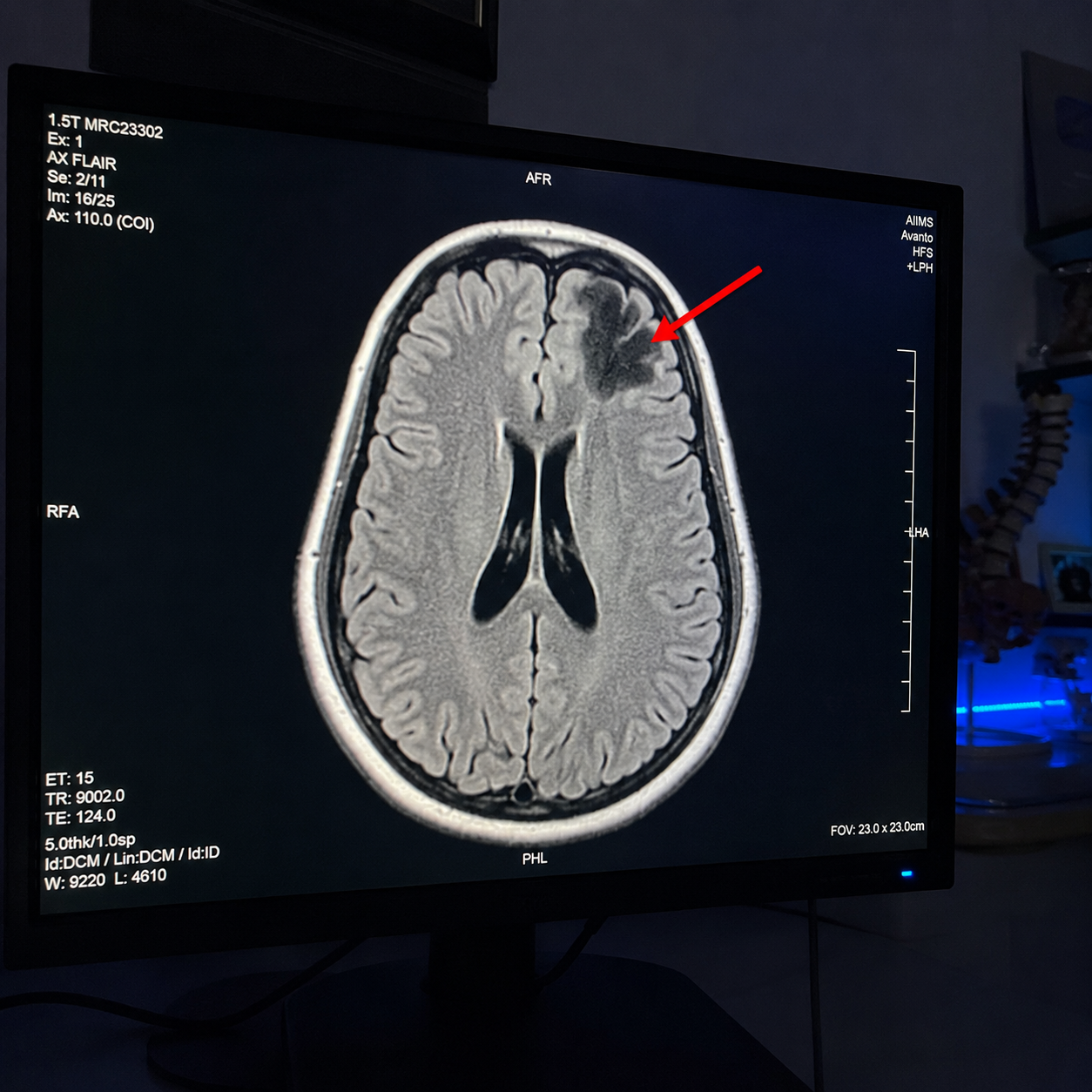
My neurologist showed me this brain scan and asked me to sit down. I thought it was mine. It wasn't. But it could have been. I'm 54. I've been pre-diabetic for seven years. A1C of 5.8. Fasting glucose that bounces between 118 and 132 depending on the day. Not high enough for medication. Not low enough to stop worrying. For seven years, that's what I thought pre-diabetes was — a sugar problem. A pancreas problem. A "watch what you eat" problem. I was wrong. The scan my neurologist pulled up was from a 58-year-old patient with type 2 diabetes. The dark area the red arrow points to? That's where brain tissue has been damaged by years of elevated blood sugar. Not a stroke. Not a tumor. Glucose toxicity — silent, cumulative, irreversible once it progresses far enough. She showed me six more scans. Same pattern. Different patients. Different ages. Same story. "This is what chronic blood sugar elevation does to the brain," she said. "The blood-brain barrier weakens. Inflammation builds in the microvasculature. Neurons lose function. The cognitive symptoms start years before anyone connects them to glucose." I felt my hands go cold. Because for the past three years, I'd been losing words. Not big words. Simple ones. Standing in the kitchen telling my wife about my day and the word just... wouldn't come. It would be right there, behind my eyes, and I couldn't reach it. I'd be in a meeting at work and someone would ask me a question and there'd be this gap — this half-second of silence where my brain was buffering like a bad internet connection. I always had an answer. I just couldn't get to it fast enough. I thought it was age. Stress. Not enough sleep. My doctor thought the same. "You're 54," she said. "Some cognitive slowing is normal." Normal. That word followed me around like a diagnosis I never agreed to. Nobody thought to connect it to a fasting glucose of 124. "The brain uses more glucose than any other organ," my neurologist said. "About 20% of everything your body produces. When blood sugar is chronically elevated, the brain is essentially sitting in a bath of excess glucose around the clock. It's like leaving a wire in salt water — the corrosion is slow, invisible, and by the time you notice the damage, years have passed." She pulled up a chart — a meta-analysis from 2019 covering over 14,000 patients. "The research is clear. Pre-diabetic glucose levels — not diabetic, pre-diabetic — are associated with measurable cognitive decline. Memory. Processing speed. Word retrieval. Executive function. The exact things people write off as getting older." I stared at the brain scans on her wall and thought about every time I'd walked into a room and forgotten why. Every time I'd read a page of a book and retained nothing. Every time my wife had to finish my sentence because the word wouldn't come. Seven years of a number on my bloodwork that nobody treated like an emergency. Because that's the problem with pre-diabetes. Nobody treats it like an emergency. Your doctor circles a number on a printout, says "watch your carbs," and sends you home until the next annual physical. Meanwhile that number is doing things to your body that nobody mentions until it's too late. I'd tried to manage it. God knows I tried. Berberine capsules from Amazon. $32 a bottle. I read every review. 4.5 stars. "Changed my blood sugar!" Took them for five months. Fasting glucose went from 124 to 119. Then back to 122. Then back to 126. Five months of chalky capsules three times a day for a net change of exactly zero. Cinnamon supplements. $18. Three months. Nothing. Chromium picolinate. $24. Four months. Nothing measurable. Apple cider vinegar pills. Bitter melon extract. Alpha-lipoic acid. Each one a separate bottle. Each one a separate hope. Each one a separate disappointment sitting in my medicine cabinet collecting dust next to the bottle before it. $640 in supplements over three years. I counted. I sat down one weekend and added up every receipt, every Amazon order, every "this time it'll be different" purchase. $640. For a fasting glucose that hadn't moved. I tried keto for four months. Strict keto — under 20g of carbs a day. Lost 14 pounds. A1C went from 5.8 to 5.6. I told everyone who would listen that I'd finally cracked it. Then I went to a birthday party and had a piece of cake. Then pasta the next night because the discipline dam had cracked. Within six weeks my A1C was back to 5.8. Four months of no bread, no pasta, no rice, no fruit — for a temporary dip that evaporated the second I ate like a normal human being. My wife stopped talking about it. She could see it was wearing me down. She'd just quietly cook low-carb meals and not say anything about the bread she'd stopped buying. She did that because she loves me. And somehow that made it worse. My doctor's advice at the annual check-up? "Keep doing what you're doing. Your numbers are stable." Stable. At 5.8. The number that was quietly eating my brain. How much more time did she want me to give it? After the neurologist appointment, I couldn't sleep. I kept seeing those brain scans. The dark patches where tissue had died. The areas where neurons had stopped firing because years of glucose exposure had corroded the connections. I kept thinking about the word retrieval problems. The brain fog at 2pm. The way I used to be able to hold three ideas in my head at once and now I could barely hold one. I called my buddy Rich the next morning. He'd been pre-diabetic too, years ago. Then at some point he mentioned his numbers were normal. I'd never asked him how. "I spent $5,400 at a metabolic health clinic in Austin," he said. "Four weeks. CGM monitoring. Full metabolic workup. Endocrinologist, nutritionist, the whole deal." "And?" "My fasting glucose went from 128 to 99 in eleven weeks." I sat up. "What fixed it?" He was quiet for a second. "That's the thing. I thought it was the CGM data and the meal timing. They had me eating protein first, fiber second, carbs last. Walking ten minutes after every meal. Specific food combinations to blunt the spike. And all of that helped — my post-meal spikes dropped from 185 to 162 in the first two weeks." "But?" "But the doctor told me at the end of the program that the meal protocol was maybe 30% of what was happening. The other 70% was two capsules they'd been giving me every visit." "What capsules?" "I didn't even notice them at first. There was a small tray in the consultation room. Water and two capsules. I took them every time because they were part of the routine. Never asked what they were." He laughed. "When I finally looked at the card, I almost lost it." "Why?" "Berberine. Chromium. Ceylon cinnamon. Bitter melon. Alpha-lipoic acid. All in one formula. Clinical forms, clinical doses." I almost hung up on him. "Rich. I've taken every single one of those. Separately. For years. They never did anything." "That's exactly what I said to the doctor. Word for word. And he asked me — did you take them all together? In the right forms? At the right doses?" He explained what the doctor told him. And it was one of those explanations that makes you angry because it's so simple and nobody ever said it. Your body doesn't process glucose through one pathway. It processes it through five. Insulin sensitivity — how well your cells respond to insulin's signal. Glucose uptake — how efficiently cells actually absorb sugar from the bloodstream. Liver glucose production — how much sugar your liver dumps into your blood between meals. Carbohydrate absorption rate — how fast sugar enters your bloodstream after a meal. Inflammatory response — the chronic low-grade inflammation in the pancreas that makes everything worse over time. Five pathways. All interconnected. All malfunctioning in pre-diabetes. Berberine supports insulin sensitivity. Chromium supports glucose uptake into cells. Ceylon cinnamon supports liver glucose output. Bitter melon supports carbohydrate absorption rate. Alpha-lipoic acid supports the inflammatory response. Five ingredients. Five pathways. That's why a single ingredient helps a little at first and then stalls — it's supporting one pathway while four others are still struggling. Like fixing one flat tire on a car that has four. And here's the part that made me want to throw something. Most people who try these ingredients buy cheap forms at random doses. The berberine from Amazon — was it berberine HCl at 500mg per serving? Or was it a "berberine complex" at 300mg with rice flour as the first ingredient? The chromium — was it chromium picolinate at a clinical dose, or chromium chloride at a maintenance dose that's barely above a multivitamin? I didn't know. I'd never checked. I just bought whatever had good reviews and a green label. "What's the brand the clinic uses?" I asked. "YOLO Daily Sugar Control. All five ingredients. All clinical forms. All clinical doses. Two capsules. Not five separate bottles from five separate brands at five separate doses that may or may not actually contain what the label says." I ordered it that night. Not because I believed it would work — I'd burned through $640 of belief already. I ordered it because I kept seeing those brain scans. Because the neurologist told me every month of elevated glucose is another month of silent damage. Because I was 54 and I couldn't find the word "refrigerator" last Tuesday. Week one, my fasting glucose dropped from 124 to 116. Could've been noise. Could've been what I ate. I wrote it down and didn't trust it. Week two, 112. Three readings in a row. That hadn't happened in seven years. Not once. Not on keto. Not on berberine. Not on anything. Week three, something changed that I didn't expect. The words came back. I was telling my wife about a meeting at work — a complicated thing, multiple people, competing ideas — and I didn't pause once. Didn't search for a single word. The sentence just came out — complete, fluid, exactly what I meant to say. Then the next sentence. Then the next. I stopped mid-sentence and looked at her. She said, "What?" I said, "Nothing. I just — that was easy." She didn't understand. But I did. For three years, every conversation had this invisible friction. This slight delay between thinking a word and reaching it. Like trying to grab something through a pane of glass. And suddenly the glass was gone. By week four, the 2pm crash disappeared. I realized it at 4:30 on a Wednesday — I'd been working for hours without the fog rolling in. Without needing the third coffee. Without reading the same email three times to absorb it. By week six, my fasting glucose was 101. One-oh-one. A number I hadn't seen since my early forties. My A1C at the follow-up was 5.3. My doctor looked at the chart and said, "What changed?" I went back to the neurologist. Showed her my numbers. Told her about the supplement. About the five pathways. She nodded. "The cognitive symptoms improve because the brain isn't sitting in excess glucose anymore. The inflammation drops. The microvasculature starts to heal. The blood-brain barrier tightens back up. It's not just a blood sugar number — it's what that number is doing to every organ in your body while it stays elevated." She pointed at the brain scans still hanging on her wall. "Those patients all had years of pre-diabetic numbers that nobody treated urgently. By the time they were diagnosed with type 2, the cognitive damage was already significant. The fasting glucose wasn't just a metabolic risk factor. It was slowly, silently remodeling their brain tissue." I sat there staring at those scans. Seven years. Seven years of being told my numbers were "not that bad." Of hearing "borderline" like it was something safe. Of taking individual supplements that each covered one pathway out of five while the other four kept deteriorating. Seven years of losing words I blamed on aging. Two capsules. Five pathways. Eleven weeks. My wife made pasta last Friday. The real kind. Rigatoni with marinara and Italian sausage. I ate a full plate. Tested two hours later. 134. She looked at me from across the table and said, "You haven't paused to find a word in weeks. You know that, right?" I know. I'm sharing this because pre-diabetes isn't just a sugar problem. It's a brain problem. A cognition problem. A "why can't I think clearly anymore" problem that nobody connects to a number on bloodwork that doctors keep calling borderline. If your fasting glucose has been "a little elevated" for years and nobody's doing anything about it... If you've tried berberine, chromium, cinnamon — separately — and nothing ever held... If you're losing words mid-sentence, losing focus by early afternoon, losing the sharpness you used to have and blaming it on age... If a doctor has ever shown you a number and called it "borderline" and sent you home... I'm not telling you that you definitely have the same problem I had. But I spent seven years watching a number that was quietly damaging my brain while four doctors told me it wasn't urgent enough to treat. The brand is YOLO Daily Sugar Control. Five ingredients, five pathways, clinical forms, clinical doses. Two capsules a day. They have a 365-day money-back guarantee. A full year to see if it changes anything. But honestly — look at those brain scans one more time. Then ask yourself how many more years of "borderline" you're willing to risk. 🛡️ 50% Off + Free Shipping right now. 365-day money-back guarantee. I've sent this to everyone I know because I'm still angry nobody showed me those scans seven years ago.
Engagement over time
Not enough history yet to show a trend.