Rachel Porter
Get your Sugar under control
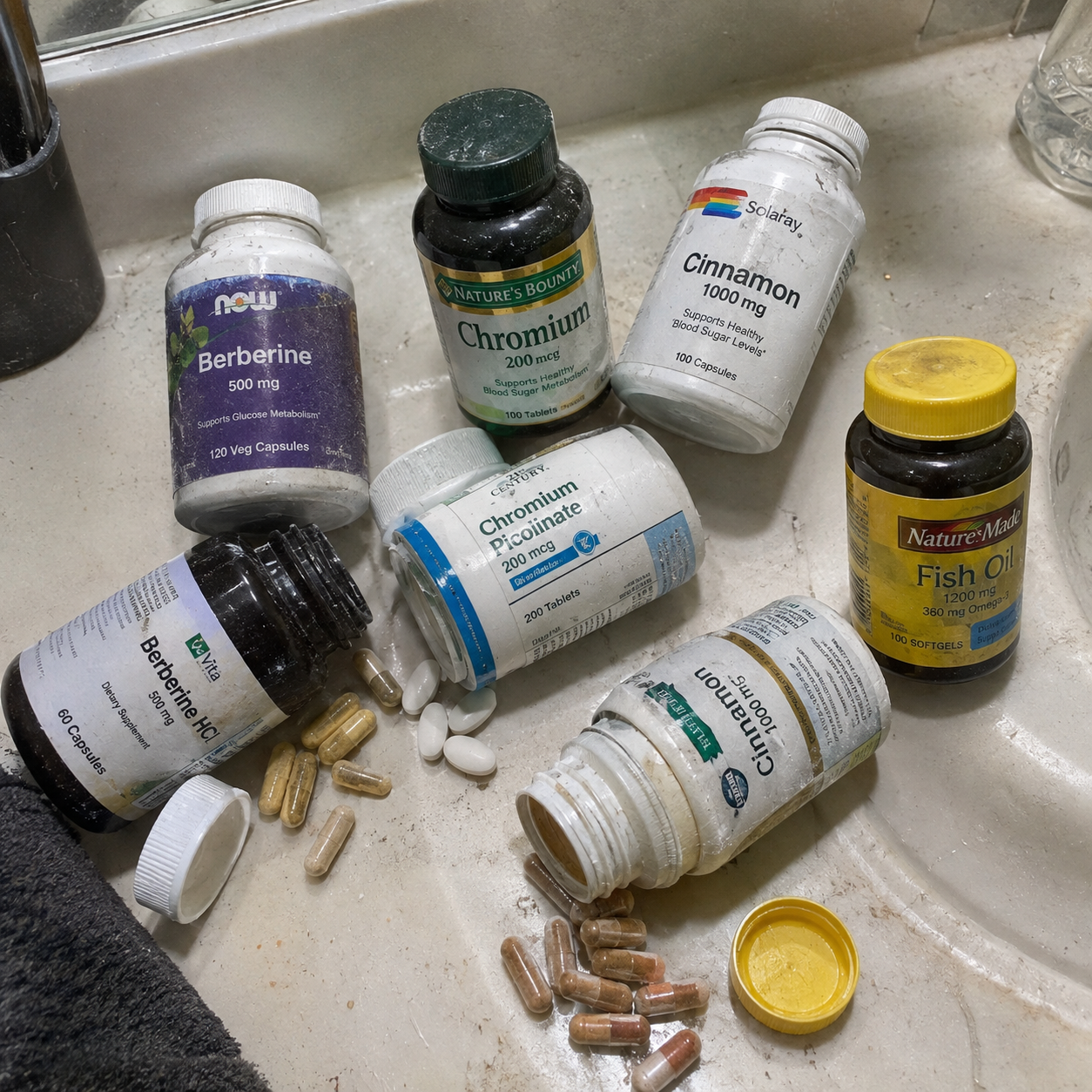
Two women, four miles apart, same age, same doctor. I drew both of them at their kitchen tables every six months for three years. One had a fasting glucose of 98. Her doctor was so pleased. The other had a fasting glucose of 132 and kept asking what else she could do, and her doctor said "just watch the carbs" on the report every time. The one with the beautiful number is on insulin now. Injections every morning, a sharps container on the kitchen counter, and a look in her eyes I've seen too many times. The one with the number the doctor worried about met me in the driveway this morning, ten pounds lighter, with her walking shoes on. I'm a mobile phlebotomist. I've filled over 30,000 tubes. I'm the only person in the whole chain who sees the number and the house, and I'm going to tell you what I saw that the number never once had a line for — and what a retired endocrinologist in a recliner told me it was. My name is Trish. I live outside Zanesville, Ohio. I drive a 2014 Corolla with a cooler in the back seat and a tackle box full of tubes. Private homes, two farms, an assisted-living place called Maple Court. Two hundred-some kitchens across three counties. One son in the Navy. A dog who rides along on Fridays. I'm not a doctor. I'm not a nurse, technically, though most of my people call me one. I'm the one who finds the vein. Here's the thing about my job that nobody above me in the chain understands. The doctor sees the number. The lab sees the tube. The family sees the person. I sit in the kitchen and see all three. I see who answers the door. I see how fast they get up from the table. I see what's in the fridge when it opens and how many pill bottles are on the windowsill and how many times the husband looks at her before he answers for her. Then I fill the tube and drive it to the lab, and six months later I come back and see what's changed. Nobody trained me to count things. I taught myself. There's a spiral notebook in the bottom of my tackle box that I'm not supposed to have. Draw date. Address. What I saw between the car and the vein. I started it eleven years ago because I couldn't carry it all in my head anymore, and it's got 340 addresses in it. And I taught myself what the notebook was for on Margaret. Her name was Margaret Novak. She was 52 when I started drawing her. Elementary school secretary. Walked to work every morning for twenty-three years. Packed her own lunch. Did everything right. Her doctor had put her on metformin the year before I came. Her A1C had been 6.4 — just over the line into type 2. On my first tube it came back 5.7. Her husband Bill called me a week later to tell me how pleased the doctor was. Visit one, spring. She held her arm out flat on the table and said, "Take what you need." Talked the whole draw. Showed me photos of her granddaughter's recital. Walked me to the door and she was quick about it. Visit two, fall. Bill answered the door. Margaret was in the kitchen. She got up to greet me and it took her a moment — she grabbed the counter edge. Coffee was poured. She said the metformin was making her stomach hurt. Tube came back 5.6. Visit three, spring. The lunch box was in the cabinet, not on the counter where it always sat. Margaret said she'd stopped walking to work because her feet tingled in the mornings and she didn't trust the sidewalk anymore. She was driving now. She'd gained eleven pounds since fall. Bill said it was the metformin. She said it was everything. 5.7. Visit four, fall. There was a blood glucose monitor on the kitchen table that hadn't been there before. Not the annual draw — the daily kind. Strips everywhere. A logbook with numbers written in Bill's handwriting because Margaret said the small writing was getting hard for her. I want you to sit with that the way I did. A woman who'd walked to work every morning for twenty-three years couldn't read her own glucose logbook. And the tube I filled at her kitchen table that morning came back at 5.6, and Bill called to say the doctor was so pleased. Here's what made it worse. The other woman — the one from the driveway — is Donna Kessler. Four miles away, same Tuesday route, same age, same doctor. Donna's fasting glucose was 132 when I started and has been 128-135 on every tube since. Pre-diabetic. Not on medication because her doctor said she wasn't "there yet." Donna was frustrated. Her doctor was concerned. Donna meets me in the driveway. In her walking shoes. Three years running. Two houses, four miles apart, same three years, same doctor. The one with the number the doctor loved got the tingling feet, the weight gain, the glucose monitor on the table. The one with the number the doctor worried about is in the driveway before I've turned the engine off. I sat in the Corolla in Margaret's driveway that morning and I opened the notebook and added a column. On metformin. And what the fasting insulin line said. And I understood that I'd been watching this for two years and I did not have a single word for it. Let me tell you what I've learned since about the tube I fill. Because for nineteen years I filled it without thinking about what it could and couldn't say. The test your doctor orders for blood sugar has a handful of lines. Fasting glucose. A1C. Sometimes fasting insulin if you're lucky. I know exactly what's in the tube — I'm the one who fills it. And what's in it is a snapshot. How much sugar is floating in the blood at the moment I draw it. That's all a glucose panel has ever measured. What it can't tell you is what that sugar has been doing while it sits there. Whether the insulin is actually working or whether the cells have stopped listening to it. Whether the pancreas is straining to produce more and more insulin just to get the same result. Whether the five separate pathways your body uses to process glucose are all working or whether four of them shut down years ago. The snapshot doesn't know. There is no line on the report for it. Margaret's snapshot was 5.6. Margaret's feet were tingling. Donna's snapshot was 132. Donna was in the driveway. And once I'd seen it, I saw it everywhere. Because I don't see one house. I see two hundred. The farm past the county line where the husband opens the fridge and it's all diet food and she's still gaining weight. Maple Court, where I draw thirty people on Tuesdays and can tell you which ones have stopped doing the crossword because the brain fog's gotten too thick. Afternoon crashes that start earlier every visit. Feet that tingle, then go numb. Wounds on arms that haven't healed since last draw. Skin tags multiplying. Hair thinning. And on every one of those kitchen tables, a printout that says stable. I read the reports when they come back. I'm not supposed to care, but I'm the one who has to face the house next time. And I started filling in my new column. Fasting insulin. Not everyone gets it tested, but when it's there, I write it down. On the metformin patients, the ones with the beautiful A1Cs, that line was climbing, visit after visit. Never flagged. Just up. More and more insulin being produced to chase the same number. The pancreas working harder and harder to force a result the body's cells had stopped cooperating with. Pretty glucose number. Exhausted pancreas. Same tube. Same house. I did what I could, which wasn't much. A phlebotomist can't prescribe. She can mention. So I started mentioning berberine to wives at the door — I'd read it helped insulin sensitivity. And cinnamon supplements, because every wellness blog I'd ever seen recommended them. Three families tried it — the same three I'm going to tell you about. Six weeks. I drew them again. Nothing had moved on paper, and nothing had moved in the house. The afternoon crash was still there. The feet still tingled. I was out of ideas. And then a man in a recliner asked me a question. Dr. Amsel is 84. He lives at Maple Court, room 114, and he's the sharpest person in the building. He was an endocrinologist for forty years, and he won't let anyone but me draw him — says the aides dig. I'd been drawing him every three months for two years, and every time he'd hold out his arm and read the paper and not say much. Two months after Margaret started driving instead of walking, in December, with my needle in his arm, he set the paper down and said, "Trish. How many of your pre-diabetics are actually getting better?" I didn't have to look at the notebook. I knew. "None of them." He nodded like he'd been waiting two years for me to say it. "Let me tell you why your tube keeps saying stable while the house keeps getting worse. And then I'm going to tell you what the tube can't see." I finished the draw. I sat down. Nobody at Maple Court cares if you're late to room 116. "Your body doesn't process glucose through one pathway. It processes it through five. And almost every person you draw — and every doctor reading that report — is treating it like there's one switch. Sugar high? Flip the switch. But there are five switches. And in pre-diabetes, all five are breaking down at different rates." He counted on his fingers. "One — insulin sensitivity. How well the cells respond when insulin says open up and take in this glucose. That's the first thing to go, years before the glucose number moves. The cells stop listening. The pancreas compensates by making more insulin. The glucose stays normal on paper while the system burns out behind it." "Two — glucose uptake. Even when insulin works, the transport mechanism that moves sugar from the blood into the cell needs chromium as a cofactor. Most Americans are deficient. The door is unlocked but nobody's carrying the sugar through it." "Three — liver glucose production. Between meals, the liver dumps stored sugar into the blood to keep levels steady. In pre-diabetes, it dumps too much. You wake up with a fasting glucose of 124 even though you haven't eaten in twelve hours. That's the liver, not the dinner." "Four — carbohydrate absorption rate. How fast sugar hits the bloodstream after a meal. When it hits fast — a spike — the pancreas scrambles to respond. Every spike is a fire drill. Five fire drills a day, seven days a week, fifty-two weeks a year. The firefighters get tired." "Five — inflammatory response. The pancreas itself gets inflamed from overwork. Chronic, low-grade inflammation that doesn't show up on a standard panel. It reduces insulin production capacity, which makes everything else worse. A vicious cycle that the A1C never sees." He let that sit. Then: "Five pathways. Your metformin patients — what does metformin do?" "Helps with insulin sensitivity." "One pathway. It's a good drug. Helps pathway one. Pathways two through five keep breaking down behind it. The A1C comes down just enough for the doctor to say stable. The fasting insulin creeps up because the pancreas is compensating harder and harder. The feet tingle because the spikes are still happening, the inflammation is still building, the liver is still dumping. And every six months, the paper says great while the house says something else entirely." "That's Margaret." "That's Margaret. And every berberine capsule you told a wife to buy works on one pathway — same one as metformin. And the cinnamon works on a different one, but the dose in those store bottles is a maintenance dose, not a clinical dose. And neither one of them touches the other three." "I tried them. On three families. Nothing moved." "Of course it didn't. You were fixing one flat tire on a car with five." I stared at him. "So what fixes all five?" "All five ingredients exist. They've been studied for decades. Berberine HCl — not a berberine complex, the clinical form — at 500mg, for insulin sensitivity. Chromium picolinate at a clinical dose for glucose uptake. Ceylon cinnamon — not cassia, which is what 90% of store brands sell — for liver glucose output. Bitter melon extract for carbohydrate absorption rate. Alpha-lipoic acid for the pancreatic inflammatory response." "I've seen every one of those in the supplement aisle." "In the wrong forms, at the wrong doses, in separate bottles, bought on Amazon based on star ratings written by people who took them for two weeks. Berberine that's 300mg of a complex with rice flour as the first ingredient. Chromium chloride instead of picolinate. Cassia cinnamon sold as ceylon. Random doses of everything, because there's no certification required." He opened the drawer of the tray by his chair. "I've been on this for three years. All five. Clinical forms. Clinical doses. Third-party tested. In one formula, because the five pathways don't work in sequence — they work simultaneously, and you either address all of them or you watch the ones you missed eat the progress the others made." He set a bottle on the tray. YOLO Daily Sugar Control. "I was an endocrinologist for forty years. I prescribed metformin thousands of times. It's a tool. A good one. It addresses one pathway while four others degrade, and we call the result stable. This addresses all five, and the result is the number I see on my own lab work every three months — which you've been carrying to the lab and never asked about." I went home that night and did what I do. I looked at the label. Then I looked for the ingredient forms. Then I checked the doses against the published research. Berberine HCl, 500mg. The clinical form at the clinical dose. Not a complex. Not diluted. Chromium picolinate. Ceylon cinnamon — and they specify it on the label, which most don't, because cassia is cheaper. Bitter melon extract. Alpha-lipoic acid. All at research-backed doses. I ordered one. My rule is my rule — I don't say a word to a patient about anything I haven't drawn a before and an after on. I started taking it at my own kitchen table. Week one, I noticed the 2pm crash was gone. I drive all afternoon — I know exactly when the wall hits because I'm alone in the car and the road gets long. It didn't hit. Not Tuesday. Not Thursday. Not the following Tuesday. Week two, the fog lifted. I don't mean I felt sharper in some vague way. I mean I was at Maple Court, drawing room after room, and I realized I was charting faster because I wasn't re-reading my own handwriting three times to make sure I hadn't made a mistake. The handwriting was the same. The brain reading it had come back online. Week three, I stepped on the scale because my scrubs were loose. Four pounds down. I hadn't changed a single thing about how I ate. Not one thing. I drew myself at the lab on week eight. My fasting glucose had been 108 — "a little elevated, nothing to worry about" — for five years. It came back 91. My doctor pulled up the old numbers, went quiet, and said, "What are you doing differently?" I told him. He wrote it down. I mentioned it. That's all a phlebotomist can do. To the same three families who'd tried the berberine for me and gotten nothing, I said: there's something a retired endocrinologist at Maple Court has been on for three years, here's the label, here's the research. Talk to your doctor. I'll draw you again in eight weeks. Dot Petersen, out on the farm, whose husband had started sleeping through breakfast. She read the label at the table with her glasses on. She ordered it that night. Put the capsules next to his coffee the next morning and said, "Just take these. For me." He took them. She called me that afternoon. "He was awake at lunch for the first time in I don't know how long. Clear awake. Not the groggy kind." Mrs. Oyelaran, who lives alone since her husband passed, whose feet had gone from tingling to numb, who'd stopped walking to her own mailbox because she couldn't feel the curb. She ordered it herself. Ray and June Kessler at Maple Court, married fifty-one years, both pre-diabetic, both on metformin. June does everything for both of them now because Ray can't stay awake past noon. June ordered two bottles. I drew all three before the first capsule. Then I drove my route through the winter. And I counted. Week three, the farm. Mr. Petersen answered the door. Not from the recliner. Standing, in his boots, with the dog. He'd made his own breakfast. Eggs and toast. Dot was behind him with her hand over her mouth. Week five, Mrs. Oyelaran's. I turned in and she wasn't home. I sat in the Corolla and waited, and ten minutes later she came up the road from the mailbox in her walking shoes with the mail in her hand, and when she saw the car she held the envelopes over her head like she'd won something. She said the tingling had stopped at week four. She could feel the sidewalk again. Week six, Maple Court. Ray Kessler was awake. Not just awake — he was doing the crossword. His own crossword, not June's. Bottom half filled in, in his own handwriting, which I hadn't seen in a year. Week eight, all three. No afternoon crashes. Not one. And then I drew the afters. I'm going to tell you exactly how this went, because I filled the tubes and I won't tell you a single number I didn't carry to the lab myself. Mr. Petersen's doctor called Dot. His fasting glucose had been 118 for two years on metformin. It came back 94. His A1C went from 5.9 to 5.3. His fasting insulin — the number I'd watched climbing — dropped for the first time. The doctor asked what had changed. Dot told him. He said, "Well. Keep doing it." Mrs. Oyelaran's doctor pulled up her old labs and went quiet on the phone, she told me. Fasting glucose from 126 to 99. A1C from 6.1 to 5.4. He asked her to come in, and he said he wanted to see if the metformin dose could come down over the next few months. Ray Kessler's doctor did the same. June's too. Two people, married fifty-one years, both stepped down by their own doctor in the same month. June told me that at the table, and then she couldn't talk for a minute, and I held her arm out for her and drew it anyway because that's what I'm there for. Three doctors. Three printouts I didn't write. Every one of them moved further in eight weeks than two years of metformin alone had moved them after the initial drop. That was March. I had my afters. And Margaret's fifth draw was on my calendar for April. Here is the part I've been driving toward, and it's the part I'm sitting in this driveway because of. Visit five, spring. Margaret was at the kitchen table with a sharps container and an insulin pen. The metformin had stopped being enough. Her A1C had crept back to 6.8 at an unscheduled draw her new endocrinologist ordered. She was on insulin injections now. Every morning. Bill was measuring her doses because her eyes weren't good enough anymore to read the pen. I had the bottle in my bag. I had three printouts in my head. I had a retired endocrinologist's phone number. I had everything I have right now, sitting in this car. And at the door, Bill said, "Her A1C came down on the metformin. The doctor was pleased for two years. The new endocrinologist says the insulin will handle it now." Of course it would. Handle it. Manage it. Stabilize it. All the words for not fixing it. And I watched him decide to believe it. And I let it stop me. She had an endocrinologist. She had the insulin and the sharps container and a husband who had decided. Who was I. I fill the tube. I said, "That's good, Bill," and I carried her tube to the lab, and it came back managed, and he called to say the new doctor was pleased. I told myself I'd say it at the sixth draw. In the fall. When I'd had more time with the other three. When it wouldn't be one phlebotomist's opinion against an endocrinologist's. Margaret lost two toes before the sixth draw. Diabetic neuropathy. The tingling she'd mentioned a year and a half ago — the tingling that made her stop walking to work — had progressed to nerve death. A wound on her foot she couldn't feel. An infection she didn't catch in time. Bill called the lab to adjust the schedule, and the lab put it on my route like any other Tuesday, right after Donna, and I turned in this morning, and Margaret was in a wheelchair at the table, and I already knew. She still poured the coffee. She still had me draw her. She asked me, at the table, if I thought she'd ever walk to work again. I told her I had something to tell her, and that I should have told her a year ago, and that I was going to sit in the car first because I couldn't say it yet. So I'm sitting in the car. And I'm writing it down for you first, because you might still have time. I bring the others bottles now. Not to sell — I don't sell anything. When a family's been on it a couple months and I've drawn the after and I've seen the changes in the house, I leave a bottle on the table next to the tubes, the way I leave a cotton ball on the arm. It's the one thing in nineteen years I've been able to hand somebody besides a bandage. I never left one on Margaret's table. I had it in the car. So here's what I need you to hear, and I need you to hear it today, because I'm the one who waited for a better time. If your fasting glucose has been "a little elevated" for years and your doctor calls it borderline and sends you home with a pamphlet about carbs. If you've tried berberine, or cinnamon, or chromium — one at a time, from Amazon, based on star ratings — and nothing moved. If the metformin brought the number down on paper but the crashes still come, the fog still rolls in, the feet still tingle, and the house keeps changing while the printout says stable. If there's a glucose monitor on the kitchen table that wasn't there last year. If the walking shoes have moved to the back of the closet. If she's asleep at two in the afternoon and the doctor says it's just fatigue. The tube will say stable. I've filled thousands that said stable. I'm the one who carries it to the lab, and I'm telling you the tube is answering the wrong question. It measures a snapshot. It cannot see whether the five pathways are working or whether four of them shut down years ago while one drug covered for them on paper. That's the glucose that damages you — the spikes, the inflammation, the liver overproduction, the cellular resistance — and the test was never built to find it. Five pathways. All breaking down simultaneously. And almost everything your doctor has prescribed or you've bought in a store addresses one. What addresses all five is YOLO Daily Sugar Control. Berberine HCl at the clinical dose. Chromium picolinate. Ceylon cinnamon — not cassia. Bitter melon extract. Alpha-lipoic acid. All in the forms the research used. All at the doses the research tested. Two capsules. Not five separate bottles from five separate brands at five separate doses that may or may not contain what the label says. Not a berberine complex with rice flour. Not cassia cinnamon in a ceylon bottle. Not a dose chosen by a marketing team instead of a researcher. Two capsules. Five pathways. Every morning. They have a 365-day money-back guarantee. A full year. If the tube hasn't moved and the house hasn't changed, every dollar comes back. No questions. Think about that. Nobody offered Bill a refund on two years of a drug that kept Margaret's paper beautiful while her feet went numb. A company willing to stake its own money on what your next tube says told me more than thirty years of pharmaceutical printouts ever did. If you click through and it's there, don't sit on it. I waited for a better time. I sat in a driveway and said "that's good" and drove the answer away in my cooler. Every day you wait is another day four pathways keep breaking down behind a number that says stable. Another day the feet tingle a little more. Another day the fog gets a little thicker. Another day somebody like me sits at your kitchen table with a bottle in her bag and says, "That's good," and drives it away. 🛡️ 50% Off + Free Shipping right now. 365-day money-back guarantee. I've been carrying tubes for nineteen years. This is the first time I've been able to carry an answer. — Trish, nineteen years, three counties, two hundred kitchens P.S. — I need to say this clearly. Three of my patients had their metformin reduced in this story, and that happened because their own doctor looked at the after-draw — a tube I filled — and made that call. If you're on metformin or any other medication, bring your printout to your doctor and let your doctor decide. The point isn't to replace anything. The point is to address the four pathways the medication was never designed to cover.
Engagement over time
Not enough history yet to show a trend.