Holistic Health with Dr. Oliver
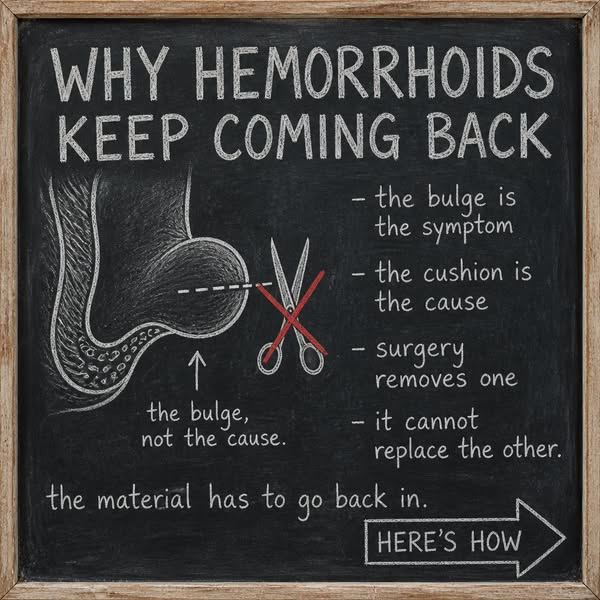
Hemorrhoids Are Collagen Failure?
I don't give a damn if this upsets my colleagues. I'm going to say something that nobody living with chronic hemorrhoids wants to hear. I performed my 2,847th hemorrhoidectomy on March 14, 2024. Nine weeks later, on May 22 at 4:12 a.m., I was the one being wheeled into the OR with an acute thrombosis. A colleague and former trainee had to operate on me. I was 60 years old. I'm a board-certified colorectal surgeon. Twenty-eight years in practice. During a 90-minute emergency procedure, two external thromboses were excised and one internal Grade III hemorrhoid was banded. At the same hospital where I'd spent years training younger surgeons. They got me back in the OR eight weeks later. My career survived. My reputation survived. But I will never perform another hemorrhoid procedure without remembering what it felt like to be lying on that table myself. Because everything I'd been doing for my own hemorrhoids for more than a decade hadn't stopped them from progressing. I'm writing this because I know exactly what some of my colleagues would say if they read it. I don't particularly care anymore. If you're over 50 and you've been dealing with hemorrhoids for more than a year — or someone you love has — please read the whole thing. I know it's long. I know you're scrolling. I know you've got other things to do. But eighteen months ago, I would have given almost anything for someone with my training to sit me down and explain what I'm about to explain to you. Nobody did. I was first diagnosed with mild internal hemorrhoids at 49. Grade I on anoscopy. My primary care doctor, a colleague I trusted, told me it wasn't unusual for someone my age who'd spent two decades standing in operating rooms for hours at a time. She recommended fiber. Plenty of water. And a topical cream during uncomfortable flare-ups. The diagnosis didn't surprise me. My father had lived with chronic hemorrhoids for the last fifteen years of his life. He used hemorrhoid cream twice a day. Took warm sitz baths. And switched to a donut cushion in his late sixties. He never had surgery. He died at 79 from an unrelated heart condition. But during the final decade of his life, he stopped joining us on family trips that involved more than a few hours in the car. I watched my father gradually make his world smaller because of a condition my own profession kept describing as "manageable." So I followed the same advice I'd given countless patients. I added psyllium fiber to breakfast. Cut down on coffee. Bought the same over-the-counter hemorrhoid cream I'd recommended after banding procedures. During flare-ups, I used topical hydrocortisone. I walked three miles a day. Stopped sitting for longer than 45 minutes at a time. Ate a high-fiber, Mediterranean-style diet. Lean protein. Olive oil. Leafy vegetables. Minimal refined carbohydrates. Plenty of water. I checked every box. By 55, Grade I had become Grade II. My doctor suggested a stool softener and annual monitoring. She wasn't overly concerned. I was, in her words: "Managing well." Managing. That word again. At 58, another anoscopy showed that the internal hemorrhoids had progressed to Grade III. I also had two small external skin tags prone to irritation. My doctor suggested speaking with one of my own colleagues about possible banding. I made the appointment. Then canceled it. I want to tell you why. Because sitting in my office at 7 p.m., staring at my own report, I realized I was following the same path I'd watched my father follow. Fifteen years of "managing." Creams. Cushions. Changing where he went and how long he stayed. His hemorrhoids hadn't killed him. But they had slowly taken away parts of his life. And now I was watching the same thing happen to me. Nine months later, I woke my wife at 3 a.m. The pain had started at 2:38 a.m. I remember because I looked at the bedside clock and immediately knew: This wasn't another ordinary flare-up. The pain was sharp. Throbbing. Increasing by the minute. My wife is a retired nurse. She sat upright before I'd even finished explaining. She'd listened to me describe this exact type of presentation over dinner for twenty-five years. She drove me to the hospital. The surgeon on call happened to be someone I'd previously trained. She walked into the exam room, saw me on the stretcher, and stopped. "I need an excision and internal banding," I told her. She nodded. They wheeled me into the OR. I stared at the ceiling tiles. I'd walked that same hallway thousands of times going in the opposite direction. Now I was the patient. Two external excisions. One internal banding. A procedure I'd performed on other people more times than I care to remember. I spent several hours in recovery and went home later that day. But the real recovery took weeks. For two weeks, sitting was extremely uncomfortable. For several weeks, driving was difficult. Warm baths, topical care, and patience became part of my everyday routine. Once I'd recovered, my colleagues suggested a more comprehensive assessment. I didn't particularly want one. I did it anyway. Because I wanted to understand why my hemorrhoids had progressed despite doing everything I normally recommended. And that's where my thinking began to change. The follow-up examination made me start looking beyond the visible hemorrhoids themselves. I began reviewing research into the connective tissue that helps support the hemorrhoidal cushions. Collagen. Elastic fibers. The structures that help hold normal anal cushions in position. That sent me back into medical literature I'd overlooked for years. Not the surgical technique papers. Not postoperative protocols. The tissue biology. And what I found made me rethink the condition. Researchers have described changes involving collagen and elastic fibers in hemorrhoidal tissue. Hemorrhoidal cushions aren't simply swollen veins. They're normal anatomical structures supported by connective tissue and blood vessels. As that supporting tissue changes, prolapse and other hemorrhoidal symptoms may become more likely. That doesn't mean hemorrhoids are simply a "collagen deficiency." They're more complicated than that. Bowel habits, straining, aging, pregnancy, pressure, and other factors can all contribute. But it made me realize that I'd spent most of my career concentrating almost entirely on what happened after the supporting structures had already changed. Creams can help soothe symptoms. Fiber can support softer, more regular bowel movements. Stool softeners may reduce straining for some people. Banding treats prolapsing internal hemorrhoids. Surgery can remove severely affected tissue. All of those approaches can have an appropriate place. But I became interested in whether nutritional support for connective tissue and vascular health could form another part of the picture. That's when I started reading more closely about cacao flavanols. Real cacao contains naturally occurring compounds including procyanidins and epicatechin. These plant compounds have been studied for their potential roles in vascular function and biological processes associated with connective tissue. That's not the same as proving they can cure hemorrhoids or rebuild damaged anal tissue. They can't honestly be marketed that way. But the research was enough to make me interested in the nutritional side of the equation. A few weeks later, one of my longtime patients came in for a follow-up. I'll call her Rosa. She'd previously had Grade II hemorrhoids with recurring symptoms. I'd discussed banding with her. She chose not to have it. At her latest appointment, she told me she'd changed her daily routine and had started using a supplement built around cacao extract and psyllium fiber. She told me her symptoms had become considerably less troublesome. I asked her what she'd been taking. That's how I first came across RectaFix™. The formula combined: Standardized cacao extract Providing naturally occurring flavanols such as procyanidins and epicatechin. Psyllium fiber To support normal bowel function and help reduce unnecessary straining. And selected plant ingredients traditionally used to support healthy circulation. I was skeptical. Naturally. But after everything I'd experienced, I wasn't interested in dismissing something simply because it didn't come from an operating room. So I looked into it. And eventually, I incorporated RectaFix™ into my own daily routine. Two capsules with breakfast. Nothing complicated. I continued eating well. Continued drinking plenty of water. Continued following sensible bowel habits. I didn't expect some overnight miracle. Over the following weeks, though, I personally felt that the residual discomfort following surgery became less noticeable. I found myself reaching for topical products less often. Sitting through long procedures became more comfortable. And eventually, something happened that seems incredibly small until you've lived with chronic hemorrhoids: I stopped thinking about where I was going to sit. My wife noticed before I did. One Sunday evening, we finished an entire dinner while I sat on a wooden dining chair. No cushion. No shifting every few minutes. Nothing. She looked at me and said: "You haven't moved once." And she was right. That moment mattered more than any number on a chart. That's my personal experience. It doesn't guarantee what another person will experience. Today, I still practice colorectal surgery. I still recommend medical treatment when it's appropriate. I still believe severe bleeding, thrombosis, prolapse, and other complications can require procedures or surgery. None of that has changed. What has changed is the way I think about the wider picture. Hemorrhoids aren't simply "bad veins." Hemorrhoidal cushions are complex structures involving blood vessels, collagen, elastic fibers, and supporting tissue. And that means long-term support may involve more than repeatedly soothing the surface. For me, the fundamentals now look like this: Enough fiber. Adequate hydration. Avoiding unnecessary straining. Regular movement. Appropriate medical evaluation. And nutritional support designed with connective-tissue and vascular health in mind. That's where RectaFix™ fits into my own routine. It isn't a medication. It isn't a substitute for surgery when surgery is genuinely needed. And it doesn't promise to "cure" hemorrhoids. But it offers a different approach from another cream or temporary surface-level product. RectaFix™ includes: 🍫 Standardized cacao extract with naturally occurring flavanols 🌾 Psyllium fiber to support regular bowel function 🌿 Selected botanical ingredients traditionally used to support circulation 💊 Simple daily capsule format The recommended program is designed around consistent daily use rather than expecting results overnight. And RectaFix™ comes with a satisfaction guarantee, so you can review the current terms on the official website and decide whether the approach feels right for you. If you've been dealing with hemorrhoids for months or years... If you're repeatedly reaching for creams... If you've already changed your diet... If you've tried baths, cushions, or other approaches... And you still find yourself organizing your day around whether sitting will be comfortable... Don't assume you're simply destined to live that way. Learn more about what supports the hemorrhoidal cushions and discuss persistent or worsening symptoms with your doctor or specialist. Because sometimes asking a different question changes what you notice. It certainly did for me. — Dr. Harrington Board-Certified Colorectal Surgeon
Engagement over time
Not enough history yet to show a trend.