Listen Library
To find out, listen to the audio series 'Assasin Actress' (FREE for a limited period of time) Click on the link below to download the Pocket FM app, now!
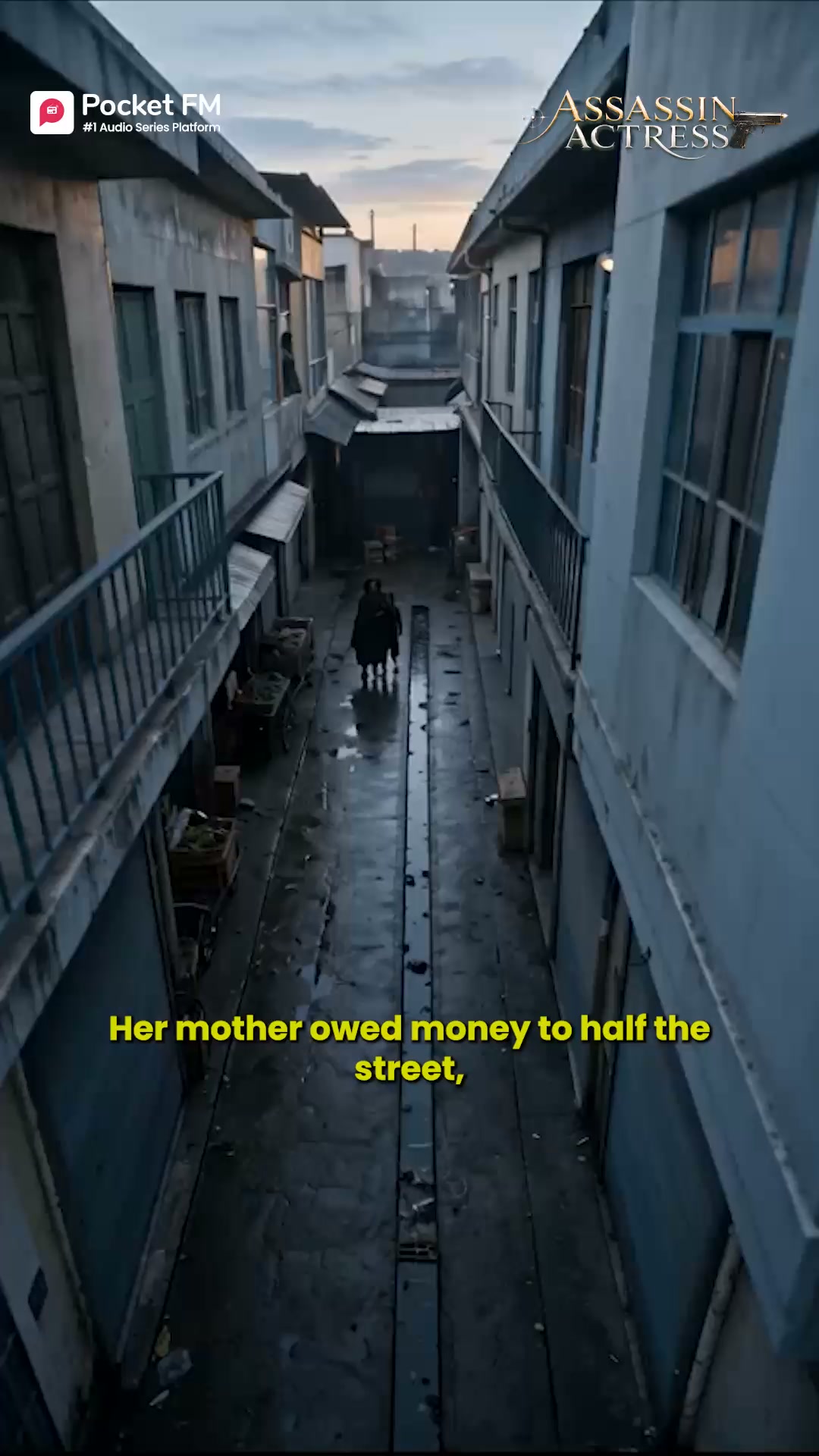
Her mother owed money to half the street. So the street collected from the daughter. They shaved her head in the market. Publicly. Like a ceremony. Then they made her stand outside the school gate every morning for a month — sign around her neck, head shaved — so every kid walking in could see exactly what debt looked like. She stood straight. She didn't cry once. That made them angrier. Then her mother overdosed in a drain. Face down. Three days before anyone reported it. The police didn't come. The man who ran that street did — Amos Joyce. He was the one who identified the body. He found the girl still sleeping next to it. Waiting. He didn't ask questions. He just picked her up and walked. For the first time in ten years, she felt safe. She saw a father in him. He had taken her in as a child with nothing. Built her into the most dangerous instrument he had and aimed her at everything that needed to be destroyed. She killed for him. She learned piano so she could sit beside his targets at concerts. She learned to cook so she could infiltrate their kitchens. She mastered hacking, marksmanship, combat, five languages, and field surgery. She gave him everything. One mission more, he promised. Then she would finally be free. So she completed it. Twelve guards, one drug lord. She killed them all. Bleeding in the silent plaza, she heard clapping. Amos Joyce, her godfather, stepped over the bodies in a perfect suit. "twenty-eight years," he said. "You worked so hard." "Yes, sir. Now it is time for me to leave," she said with a genuine smile on her face. He sighed. "Yeah, time to leave this world… my child!" Before she could react to what he said, a gunshot rang out. The heat tore through her chest before her brain caught up. She looked down. A dark stain bloomed from her heart and spread fast, unstoppable, absolute. Her legs gave out. She hit the flagstones on her knees and watched him draw the handkerchief from his pocket and wipe a trace of blood from his cheek with it. "Goodbye, Evelyn." So, that was what twenty-eight years was worth. She wanted a life of her own, but her reward for loyalty was death. Or so she thought…. Nine hundred miles away, at the exact moment she closed her eyes for the last time, a twenty one-year-old actress named Evelyn Hawthorne was being held underwater from behind. She was an excellent swimmer. Everyone agreed on that….. She had gone into the water at a private villa party willingly and confidently, the way good swimmers go into water. Someone had kept both hands on her efficiently, calmly, until the fighting stopped. The scratch marks along their arm told the real story. The alibi told a different one. The defibrillator fired. The line stayed flat. They increased the power, fired again, a twitch, then another, then a rhythm, uncertain at first, steadying into something that would hold. The room breathed out. But the soul that opened its eyes in that hospital bed was not the one the doctors had been fighting to save. It was hers. The first thing she did when she opened her eyes was take a hostage. She had no memory of where she was. The ceiling was wrong. The body was wrong, soft-armed and pale. A stranger's hands at the ends of her arms. Her instincts had no interest in that distinction. She yanked the IV needle free, grabbed the nearest person by the hair, and pressed the sharp end against his carotid artery. "Don't move if you want to live," she rasped. The man she had pinned, Ethan Hawthorne, though she didn't know his name yet, went completely still, reflexively, correctly. The older man across the room raised both hands without being asked. She scanned the room. Hospital, no guards, no weapons beyond the needle she was holding. Two men, no military bearing, no threat posture, but good instincts, both of them. And they were looking at her with an expression she was unaccustomed to receiving. It took her a moment to identify it. It was grief. A door opened. Nurses, a doctor, the ordinary machinery of a medical response. A firm-handed older nurse marched over and guided her back onto the mattress before she'd fully processed a counter move. She let her. She needed time to assess. The doctor found nothing wrong with her head. Possible disorientation from oxygen deprivation, he said. Short-term memory disruption. The family should be patient and gentle. So she sat and let them be patient. She catalogued what she had. A name — Evelyn Hawthorne — and a face that stared back at her from the window glass like a stranger's reflection. Pale, wide-eyed, fragile in a way she had never been in any life she remembered. The older man was Richard Hawthorne, the father. The young man whose hair she'd pulled was Ethan, the brother. There was a mother who had fainted in the hallway and been put to bed in the next room. There was significant money, the quiet, embedded kind, that showed itself in the quality of everything around it. She told them she had amnesia. It wasn't entirely a lie. She knew nothing about the life she had just inherited, and she was not ready to explain the one she had left behind. She used the phone carefully. One search, two words. Amos Joyce. Top result, four days old, California governor's race. The man credited with organizing the takedown of a major drug cartel had jumped five points in the polls overnight. His numbers were still climbing. There was a photo of him shaking hands with federal agents in front of a seized shipment. He was smiling. He was celebrating. Somewhere in the world she had just left behind, Amos Joyce was celebrating a mission that she had completed and then died completing — a mission he'd sent her on, knowing exactly what he was going to do when she finished it. She set the phone down. She had no weapons, no money of her own, no connections in this life. The body she was occupying had soft hands, weak arms, and a public reputation that could be summarized by the comment she found in the first ten minutes of scrolling her social media. "I'm tired of hating on Evelyn Hawthorne every day. From now on, I'll just carve the insults on her tombstone." She had forty-thousand followers across all platforms combined, and the positive ones had been purchased by her family's PR budget. Amos Joyce was the governor-elect of California. He had resources she couldn't imagine from where she was sitting. But she had time, and she had every skill he had spent twenty-eight years forcing her to build. First, rebuild this body into something usable. Train it. Second, money, connections, a public platform. Third, Amos Joyce. The plan had no timeline yet, but she had been planting things in difficult soil her entire life. She knew how to wait for the right conditions. EPISODE 2: PREPARATION She picked the phone back up and kept reading. The woman who had drowned Evelyn Hawthorne was named Cassidy Reed. She was an actress, a real one. Actual credits, actual fans, the kind of industry position that felt solid until you understood whose protection was underneath it. Her protector was a woman named Scarlett Vance, her superior, the daughter of a family so embedded in military and political infrastructure that her name appeared in no press coverage at all, which was itself a kind of power. Cassidy had held Evelyn Hawthorne underwater from behind, face hidden, hands steady, until the fighting stopped. She'd had reasons. Evelyn had witnessed something at the villa she shouldn't have. When the paramedics arrived and shocked Evelyn back to life, Cassidy had already confirmed with the right people that no one had seen anything. The kayak and wet suit were gone. The alibi held. But Evelyn Hawthorne had survived. Scarlett’s response when Cassidy reported this was careful and unhurried. "Test her. If she has genuine amnesia, she's no threat. If not, let me know before she becomes one." Cassidy passed the message along and lit a cigarette. A watch was placed on her before she left the hospital. She didn't know that yet. What she knew was that she had nearly drowned, that the police report called it accidental, and that the woman at whose villa it happened had walked out of the hospital the moment the flatline became a pulse without looking back. She filed that away, and she kept reading. She had one month before filming began, and she used every hour of it that she could take without attracting attention. She ran before the household woke up — four miles, then five, then six as the weeks progressed — and this body began to remember what bodies were capable of when asked seriously. She worked out after midnight when the house was quiet. Push-ups until her arms gave out. Planks until the timer she'd set in her head reached its limit. Grip exercises with whatever she could find in the kitchen. The muscles the original Evelyn had never used were there, dormant, wrapped in years of inactivity, indignant at being woken, and she coaxed them back the same way she had always trained new recruits. Systematically, progressively, without apology or accommodation. After the first four-mile run, her entire body staged what could fairly be called a mutiny. She ran again the next morning, faster. The family's chef received a new meal plan: two eggs, half a pound of beef, a large glass of whole milk, and a high-protein salad at every main meal. Her mother and sister stared at the portions across the breakfast table as if she had developed a second personality, which, in the most literal sense available, she had. The family thought the original Evelyn was preparing for a television show. They were not wrong. They simply didn't understand what she was preparing for. In the quiet hours, she worked on other things. Ethan's company had suffered a sophisticated cyber attack while she was still in the hospital. Someone on the inside had leaked defense protocols to an external actor and the damage was significant. She fixed it overnight from the computer system she'd had installed in her room. Patched the vulnerabilities, embedded a new defensive core that could write its own countermeasures in real time, and while she was already inside the architecture, cleaned up a constellation of legacy bugs that the tech department had been collectively afraid to touch for years because they couldn't predict the cascade failure risk. Ethan received a call from his tech director at five in the morning saying that the company's security system had apparently upgraded itself overnight and the app was running ten times faster. He spent the morning convinced he'd had a stroke of genius in his sleep. She let him keep thinking that. He was going to be useful to her eventually, and it didn't hurt for him to feel confident. Meanwhile, she studied the other contestants. Kyle was the one to take seriously. Solo expeditions in the Amazon, months alone in the Gobi Desert, survival records that read like field operations reports rather than adventure travel. Maya Sutton was a decorated competitive athlete. Cody Nash moved through terrain the way people move through rooms. Any of the three of them, in a real survival situation, would be a resource. The mystery guest was Julian Donovan. He returned from studying abroad five days before filming launched, walking through the airport in sunglasses and a mask, an entourage of eight behind him. Security footage she found online showed him stopping in front of the promo poster for the show. He looked at each photo in turn. He stopped at hers for a moment that was longer than the others, though not long enough to draw conclusions from, and then moved on without a word. His manager was quoted in a fan account shortly after: "If you must do this show, stay as far from Evelyn Hawthorne as you can. She's a walking disaster." Julian's reported response was a slow smile. "She'll learn to stay out of my way." She read that, set the phone down, and thought about it. Interesting. EPISODE 3: The Show Begins September sixteenth. The show launched at eight-o-clock in the evening, but the cameras started rolling that morning. The production crew collected every phone before they boarded the bus. She didn't argue. She had already studied everything she needed. She had a plan for the first hour alone in the wilderness, the first night, the first three days. She was more prepared for this than anyone watching her live feed would ever believe. And the gap between what they thought they were seeing and what was actually happening was something she intended to maintain for as long as possible. On the bus, the host made the introductions. Each of them waved at the camera. The comment section under her personal live channel — three-lakh viewers, most of them there to see her fail — sent a wave of vomiting emojis when she smiled. Somewhere in the third row, Julian Donovan said four words to the camera. "I hope everyone supports me." His channel was already at twenty-one million and still climbing. She assessed the other contestants without appearing to. Kyle gave nothing away at all, a blank antisocial stillness that she found instantly reassuring because it was the posture of a man who didn't need anyone else and knew it. Maya and Kyle were barely containing excitement. Boone, in a blindingly orange jacket, was trying very hard not to be seen looking at her. Then the partition rose between the driver's cabin and the passenger section. The host and camera crew pulled on gas masks. A thick white mist hissed from the back of the bus. Everyone around her was unconscious within ninety seconds. She had taken a full breath the moment she saw the host reach for his mask. She had held it. She had let her body go completely limp and played dead while the production medics checked her pupils with a pen light and found nothing but a convincingly insensible actress. They tied her wrists, blindfolded her, and loaded her into a separate vehicle. She slowed her breathing, kept her face slack, and let the genuine thrill of anticipation rise through her chest. This show was already more interesting than she'd expected. They untied her after they placed her. She heard the vehicle leave. She waited until the engine noise was fully absorbed by the trees. Then she opened her eyes and took inventory. One backpack, a pop-up tent, a lighter, disinfectant wipes, a water bladder, two protein bars — the barest possible start. She noted what she didn't have and began moving. Two million people were watching her personal live feed through cameras hidden in the trees and brush around her. She was aware of the cameras. She factored them in the way she factored in any variable she couldn't remove — as a constraint to work around, not a problem to solve. The operators were good at staying hidden. She'd seen enough surveillance equipment deployed in the field to recognize the signs of professional concealment. She gave them the acknowledgement of not acknowledging them and got to work. The first thing she needed was water. She found a stream within the hour, small, clear, threading between smooth stones, fed from the mountain above. That solved the problem immediately. Water was everything. Hydration, fire suppression, cooking, hygiene, and a navigation tool if you understood how mountain water ran. She checked the current, traced it downstream, found a bend with flat ground, and began setting up camp. She built the fire with controlled airflow and minimum smoke. The viewers watching, she learned much later, couldn't quite reconcile what they were seeing. The actress who had been publicly mocked for years, the internet's favorite punching bag, the girl they'd shown up to watch fail — was moving through the wilderness like she'd been there her entire life. They kept watching. She was already thinking about food. Her stomach had been growling for two hours when she found the solution. The squirrel was fat and gray and had three chestnuts stuffed in its cheeks like a small, confident accountant managing reserves. It was working through a larger haul on the exposed root of an enormous old tree, completely untroubled by the world. She pursed her lips and made a series of short rhythmic clicking sounds. The squirrel tilted its head. She clicked again, steady, patient. The squirrel hopped toward her. When it was close enough, her hand shot forward. She caught it by the scruff of its neck, flicked its nose once, and the chestnuts it had been holding tumbled free. She looked it in the eye for a moment. "I'm borrowing a few of your snacks," she told it. "Your meat is probably too tough anyway to be worth the trouble." She let it go. It fled up the nearest tree and stared down at her from the highest branch it could reach, vibrating with indignation. She didn't stop there. Squirrels were meticulous foragers. Anything worth hiding was worth finding. She tapped the ground around the tree roots with a stick until the sound shifted from solid to hollow. She knelt, lifted a piece of bark, and found the full cache — acorns, chestnuts, pine cones, dried wild fruit, more than a pound and a half of carefully selected late-season stores. She wrapped the haul in a clean leaf and moved on. The comment count on her live feed tripled in the next thirty minutes. She didn't know that yet. She was already looking for a rabbit warren. The rabbit burrow announced itself to anyone who knew how to listen. The grass along the approach path was worn thin and angled in a consistent direction. The tunnel entrance was oriented correctly — uphill, sheltered f adult animal, healthy and well-fed. She pulled the drawstring from her jacket hood — three feet of strong cord — and tied it into a slip knot that required a very specific understanding of load distribution and release dynamics to get right. The kind of knowledge you accumulated after someone stood over you in the rain and made you restart from the beginning every time the tension was wrong. She set the snare on the rabbit's uphill path home, propped it with a Y-shaped branch cut from the thicket, ran a trigger line back to a tree she climbed to wait in. The viewers on her live feed had been drifting away for twenty minutes. She didn't move. Twenty minutes, thirty. The forest breathed around her. Then she heard footsteps and voices. Julian Donovan and Boone were walking directly through her setup, arguing about cryptids. The rabbit bolted from the noise they made straight down its path and directly into the snare. She yanked the rope from twelve feet up. The slip knot cinched clean around its hind legs. The animal dropped to the ground. Aiden screamed. He launched himself off the earth with the full body commitment of a man who had decided something large and prehistoric had just attacked him, and he grabbed Julian around the shoulders with the grip of a drowning person finding something to hold. Julian's face went through five distinct expressions before settling on one that could most charitably be described as trapped. Trapped, and also developing a headache. She slid down from the tree with the rabbit. "It's a rabbit," Julian said to no one in particular. Then, louder: "You can jump that high? You should have been an athlete." Aiden said he had tried but hadn't passed the exam. He said it with genuine earnestness. She looked at the two of them and made the calculation. Three was harder to manage than one, but both of them had zero survivable options alone in this terrain, and she had already decided somewhere in the last few seconds that she was responsible for them whether she'd agreed to it or not. She kept the rabbit. She kept them, too. EPISODE 4 New Friends They ate better that night than either of them had expected. The rabbit was gutted, rubbed down with Hawthorne Foods seasoning she'd brought in her pack — a brand partnership she had inherited from the original Evelyn, along with the contract, the deposit, and the complete online reputation — and roasted over a fire she built with controlled airflow and minimum smoke. Julian ate more than half of it without speaking for the first ten minutes. Aiden ate whatever Julian left and kept making small involuntary sounds of gratitude. After dinner, Aiden fell asleep immediately. Julian held on longer, fighting exhaustion the way overtired people do when their nervous system can't distinguish between tired and threatened. His breathing was uneven, his eyelids working overtime. There had been a spider incident earlier in the day. He wouldn't tell her the details, but the effect on his nervous system was obvious. She gave him twenty minutes to sleep on his own. He didn't. She told him she could help. He covered the back of his neck with both hands immediately. "I'm afraid of pain," he said. "Have you been watching too many action movies?" she said. He considered this. Probale told him to lie down. He lay with his head facing out of the shelter, eyes turned up. She squatted at the entrance and held her right hand above his face — index finger first, then middle, ring, pinky — a slow, continuous wave that she kept perfectly even. The kind of technique she'd used on injured teammates in the field who couldn't quiet their own thoughts enough to lose consciousness. You needed to be steady. You needed to clear your own head entirely while you did it, so there was nothing in the motion but the motion itself. Julian's eyes stayed open for ninety three seconds. Then they didn't. He was in deep, even sleep within two minutes. The comment section, she was told later, went briefly and completely silent. And then the messages began flooding back in. “ What kind of actress knows how to do this?” “ What is she?” “ I need to know everything about this woman immediately.” She adjusted the backpack she'd set beside him so Aiden's feet couldn't reach his head during the night. She added sticks to the fire and listened to the forest. Three hours later, the drone arrived. She had been waiting for the drone. She had worked out within the first hours of the show that the production crew would send missions this way — midnight drops, dramatic timing, no warning, just the hum of rotors through dark trees. Supplies, task cards, a contained moment that the viewers would find thrilling. She had prepared for it the moment Aiden and Julian fell asleep. She rolled her jacket tight around a fist-sized stone she'd set aside that afternoon and waited by the fire. When the drone hovered directly above the campsite and its camera found her face, she looked up at it and smiled. The production director, watching from the mobile command center, said afterward that the smile was immediately recognizable as the same one he'd seen before she robbed the squirrel. He lunged for the walkie-talkie. Too late. She swung the jacket in a long, powerful arc overhead and released it. The weighted end hit the drone's rotors with the flat crack of a stone on water. The machine lurched sideways, tipping hard. She was already moving — three bounding steps, a foot planted against a tree trunk, launched upward, caught a branch at fifteen feet, bolted higher, and snatched the falling drone out of the air with both hands before it could strike the ground. The camera steadied. A completely calm face filled the operator's monitor. "Thanks for the drone," she said. "Don't mind if I do." Aiden's voice woke Julian. Julian said later that he'd slept more soundly than he had in years. He lay on his back for a few seconds, registered the canvas above him, registered that he was in the wilderness, and then looked at the pile of components on the ground with the expression of a man encountering something that required a moment before responding. "You took it apart," he said. "The propellers can be sharpened into knives," she said without looking up from what she was working on. "The motor rods become tent supports, fishing spears, or grill skewers. The camera lens will concentrate sunlight for fire starting when the lighter runs out. The landing struts are grill material. The signal wire can be braided into a stronger rope. The battery housing is waterproof storage." He stared at her. "You knew they were going to send it," he said. She didn't answer. He sat down across the fire from her. He was quiet for a long time. And during that quiet, she noticed the thing she had started noticing the night before. The cool, performative distance he carried as reflexively as other people carried keys was giving way to something more honest underneath. Something that looked like a man discovering that a problem he'd thought he understood was considerably more complex than he'd assumed. When he asked how she knew any of this, she told him, "Books." He looked at her hands. She was pressing the edge of a propeller blade against a rough stone in long, careful strokes. His eyes stayed on her palms for a moment. She knew what he was seeing. The calluses were faint — a new body working to rebuild what the original Evelyn had never built — but they were there, and they were wrong for an actress who spent her life in front of cameras. He filed it away and didn't say anything about it. They were both, she realized, in the habit of collecting information and spending it carefully. She went hunting because she was hungry and because she needed to think. The camera operators assigned to her feed were good at their jobs within the constraints of stationary concealment. They were less good at keeping pace with someone who had spent years moving through hostile terrain while generating as little sensory output as possible. She let them fall slightly behind and did not wait for them to catch up. In a small clearing, she stopped. Coiled around a branch above her head, bright green against the bark, was a snake. Someone clipped the footage later — the three seconds before she moved. The perfect stillness, the walking stick already lifting — and captioned it: Every creature in this forest is a resource to her. The clip ran to twelve million views before the week was out. She didn't know that yet. She was already preparing the snake where it fell, burying what couldn't be used and moving on. Further into the forest: five fat quail in a scrub nest, their eggs warm and abundant in the leaf litter below. A cluster of edible mushrooms under an old tree that she identified on site and harvested correctly, tapping the caps first so the colony would continue. Wild gooseberries, wild chives she'd been collecting since the first day. She came back to camp with five quail tied to her belt, the snake hanging from one hand by its tail, a bag of eggs cushioned in her pack, and foraging pouches full enough to make a real meal. Julian looked at everything she was carrying and did not speak for a moment. Then she handed him the snake reflexively, the way she would have passed equipment to a teammate. And he took it before he'd registered what it was. He looked at it, he looked at her, and then Julian Donovan — a man who had been composed on camera for the better part of a decade — screamed and flung it away from himself with full body revulsion, frantically wiping his hands on his pants, his voice loud enough to startle birds out of the canopy above. Aiden refused to come down from his rock for eight minutes. "Does your agent have your voice insured?" she asked Julian when he'd managed to stop making sounds. "With a scream like that, you'll blow your vocal cords." "Why didn't you warn me?" he said. "I assumed it was obvious what I was holding," she said. "It's a headless snake," he said. She considered this. "Yes." She built the grill from the drone — six landing struts, eight propeller blades repurposed as skewers, the whole structure over a fire pit she dug to manage airflow. The quail went on first. Marinated in Hawthorne Foods all-purpose seasoning, sesame oil, liquid smoke from a small bottle in the bottom of her pack, minced garlic, chili powder, wild chives, white vinegar — all of it rubbed inside and out by hand and left to rest while she got the flame to temperature. Quail eggs into the stainless steel bowl from the supply package, boiled, tapped to crack the shells, then soaked in a second marinade of salt and seasoning until they turned dark and rich. Mushrooms on separate skewers brushed with barbecue sauce. The snake for her, over the hottest part of the flame. Julian ate two whole quail without speaking for the first ten minutes. Aiden ate everything else and kept producing small sounds of involuntary gratitude that he seemed unable to suppress. Neither of them mentioned the snake. She watched them from across the fire and thought: this is genuinely the strangest thing she had ever done. In twenty-eight years of covers, she had cooked for drug lords, arms dealers, and politicians in kitchens that cost more than most houses. She had always been performing a function — gathering intelligence, building access, making herself useful to someone who would eventually need to be taken apart. No one had ever looked at her food the way these two were looking at it. With uncomplicated happiness. With the straightforward gratitude of people who had simply been hungry and been fed. Julian set down a finished quail bone and looked at her across the fire. "I had you completely wrong before this show," he said. "I know," she said. He held her gaze. The expression on his face was one she had started cataloging — the cool, practiced distance that came with his level of celebrity slowly giving way to something more genuine underneath. The look of someone who had encountered a significant discrepancy between their model of a situation and the actual data, and was deciding quietly, and without announcing it, to take the discrepancy seriously. He came from money — the kind that showed itself not in what he spent but in the automatic expectation that the world would arrange itself appropriately around him. He had spent years under a degree of public scrutiny that would have hollowed most people out, and he had learned to operate within it with the self-containment of someone who decided early that exposure was more dangerous than distance. He was, in most observable ways, the opposite of Aiden, who generated noise and warmth and nervous chatter with the emotional transparency of someone who had never learned to hide anything because he'd never needed to. Julian was watching her the way she watched targets — methodically, carefully, filing details rather than reacting to them. He had noticed the calluses on her hands. She had seen the moment he noticed. He hadn't said anything. He had kept eating and kept watching. And somewhere behind those watchful eyes, he was quietly running an inventory of everything since the show began. The squirrel, the snare, the drone, the hypnosis, the snake, the grill assembled from components no actor should have known how to repurpose. He was building a picture. He wasn't close to the actual answer yet. And the actual answer was one she had no intention of giving him. But he was the kind of person who kept looking until he found something. She added a stick to the fire and changed the subject. He let her. EPISODE 5: A New Mission The mission card called it the outfitter's cabin. The task: reach a remote structure before sunset. Persuade the owner to surrender a map and a fortune. Simple reality show theater. The kind of challenge designed to feel difficult while being safely contained. The kind of thing she would have worked out in thirty seconds on any mission briefing. But she had already been working something else out. "How do you think a place gets a name like the wilderness?" she said. Aiden and Julian looked at each other. "Boars," Julian said after a moment. "A lot of boars," she confirmed. "The name is the warning. The production crew scouted this forest and found animals that were actually dangerous. So they built the warning into the brief in a way that passes as atmosphere. We move in the afternoon window. We move efficiently. We make no noise after dark. The animals are real." Aiden's pace picked up immediately. She was right about most of it. She was not right about the cabin. The chemical stench hit her the moment she stepped through the door. Not decay, not old wood or mildew. Something sharper, specific. She knew that smell the way she knew the smell of cordite — involuntarily, permanently, coded into memory before conscious thought had a chance to process it. The smell of pharmaceutical precursors being cooked under inadequate ventilation. The pots and pans stacked under a military green tarp in the corner. The haphazard pile of containers along the far wall. The syringe she'd spotted in the grass outside before entering and kicked under a pile of fallen leaves before the cameras caught it. This was an active drug production site. Not a historic one, not a cleaned-out shell of a former operation. The equipment under the tarp was recent. The chemical smell was current. The syringe she'd spotted in the grass outside had not been there long enough to rust. The production crew had done their location scout without understanding what they were standing in. They had brought seven contestants and a live feed broadcasting to two million viewers into the operational territory of a working criminal organization, and they had no idea. They had filed the location permits, arranged the hidden camera network, designed the treasure hunt, and walked entirely past the evidence of what the cabin was actually being used for. They were guests at a drug operation's main site, and the people who ran that operation would eventually come back to check on it. She processed this in approximately three seconds. She stood in the doorway and looked like a girl who was simply surprised by a gruff man with a theatrical prop. Chase, locally sourced by the production crew, good stage presence, had been given instructions to be difficult and entertaining. He was doing his job. What was in the corner under the tarp was not part of anyone's job description. Chase jabbed the handle at her. "Turn around and leave." She was thinking about the tarp, about the syringe, about the distance between this cabin and the nearest access road, and what kind of people chose this location for this purpose, and how far away they currently were. Chase jabbed the handle again. One problem at a time. She shot forward — left hand on the end of the handle, right hand coming down in a short, sharp chop across Chase's wrist. The nerve pathway she'd struck sent a spike of numbness through his entire hand. His fingers opened. The handle hit the floor. Before his expression had finished registering surprise, it was in her hands. Chase stared. Julian stared. Aiden, in the doorway behind her, stared. She looked down at the hardwood in her hands. Dense, well-made. The kind of material that didn't flex when you directed force through it correctly. "Persuade," she said calmly. "Fine." She gripped it with both hands, planted her feet, and drove her palms toward each other in opposite directions. The crack filled the cabin like a rifle shot. The handle broke into two clean halves. She set them both down on the floor. The room was absolutely silent. The comment section, she was told later, recorded five seconds of dead air before anyone typed anything. What broke the silence was someone's attempt to describe what they just watched. She just — she just snapped it like a twig. What? "Was that persuasive enough?" she said, looking at Chase. "Are you going to give us the supplies?" Chase gave them everything. And she stood in the doorway holding a bottle of water that one of the show's actors had just handed her, thinking about the smell under the tarp and the number of people who would eventually come back to check on their operation. Something was wrong with the production crew's signal. She noticed it in their movement first. Small tells — camera operators making eye contact with each other in the way people do when they've received instructions they aren't sharing. Two of them excused themselves from their area within twenty minutes of each other. A walkie-talkie crackled and was immediately muffled. Chase eventually explained what he'd been told. Two contestants, Maya Sutton and Cody Nash, had gone off course after disturbing a hornet's nest. Their personal tracking signals were offline. The production crew was mobilising a full search, and to cover the range required, they needed to move the satellite vehicle. The satellite vehicle. Everything on the set ran through that truck — the live feed, the camera network, the GPS trackers, the entire remote monitoring system. The moment it moved beyond effective range of their sector, every camera in the area would lose its network connection. The broadcast would go dark. The viewers at home would see static and a message asking for their patience. They would be invisible. They would be unreachable. They would be entirely on their own. She heard the diesel engine of the satellite truck turn over somewhere beyond the tree line. She processed what that meant before the sound had fully faded. No satellite feed meant no camera network. No camera network meant no live broadcast. No live broadcast meant no witnesses. It meant no one watching from the outside could see what happened next. It meant the production crew's search team, wherever they were in the forest, was operating in a communications dead zone that was about to get worse. It meant that if something went wrong in this cabin, the evidence of it would only exist if someone inside the cabin survived to report it. EPISODE 6 The Showdown She did not react. She kept her face steady and asked Chase to locate the remaining water bottles, because that was exactly what an actress on a reality show would ask in that moment. A girl worried about supplies. A girl who had no idea that the situation she was standing in had just undergone a fundamental change in character. Inside, she was counting the distance to the nearest road, the time between now and full dark, and the variables she still didn't have numbers for. The feed had been stuttering for twenty-two minutes. The comment section, visible later in a compilation someone made from screenshots, had descended into a particular flavour of chaos. “Is the production crew's Wi-Fi powered by a hamster on a wheel?” “Something's happening. Why isn't anyone saying anything?” “I'm switching between streams, and they're all going bad at the same time. Someone just knocked.” “Did anyone catch that?” “Who was at the door?” She heard the knock before any of them said a word. Three sharp raps on the wood. Not a contestant, not a camera operator doing a check-in. Not the sound of someone who had been walking all day and was relieved to find shelter. Deliberate. Confident. The knock of someone who was entirely certain they had the right to be standing on the other side of that door. Aiden, nearest to the entrance, started to stand. Her voice cut through the room. "Stop. Don't open it." He froze. The three of them looked at her. She had spent two days being the capable, sharp-tongued, occasionally alarming person they'd learned to trust. The one who handled things. The one who was calm when circumstances called for panic. What they were seeing now was different. They could feel the difference even without being able to name it. Something in the quality of the room's stillness had changed the moment those three knocks landed. She was not calm in the way she'd been calm before. Her nostrils flared once. Blood. The thick, copper-heavy smell of it rolling in under the door. Unmistakable to anyone who knew it. Not a trace, not a hint — a person-sized amount of fresh blood, and it was still wet. Someone standing just outside that door was soaked in it, and it was not theirs in the sense of being accidental. She let her gaze move to the cameras on the wall. The red recording lights that had been burning continuously for two days — the lights she had factored into every single decision she made since stepping through the door — were dark. Every one of them, simultaneously. Was the network really down, or had it been cut? The answer to that question mattered, because if it was the former, it was a production failure. If it was the latter, someone outside that door had made a specific choice to remove witnesses before knocking. The knocking came again, harder. The door shuddered in its frame. One set of knuckles. Impatient. She pressed a single finger to her lips. Julian and Aiden understood immediately — they had learned in two days that when she moved to stop something, there was a reason, and the reason was usually better than whatever felt natural to do instead. Chase had learned it in one afternoon. He looked confused for exactly two seconds, then nodded. The fierce, locked-down quality she'd been wearing dissolved. In its place came something she had spent twenty-eight years building. The face of a person who was simply glad to see you. "Coming," she called out, her voice warm and light and entirely unbothered. She swung the door open. The man filling the frame was built like something that predated furniture — a body assembled rather than grown, every surface of it carrying the evidence of long service in circumstances that were not gentle. Seven or eight jagged scars mapped his face, heavy brow, eyes that were cloudy and flat in the particular way that came from years of chemical exposure. He smelled of alcohol and of blood, and the blood was not old. Beyond him, in the clearing that had been empty an hour ago, the silhouettes of seven more men stood in the fading light. Beyond them, the forest, and the forest gave back nothing. She blinked her wide, clear eyes up at him. "Oh," she said, with a small, startled smile. "Who are you?" He didn't answer immediately. His gaze moved past her into the cabin — across Julian's face, which he clearly recognized, across Aiden and Chase, and then back to her. She watched the calculation begin. The slow, dangerous accounting that men like this ran on every new situation: who these people were, how much they knew, what the cost of the wrong answer would be. She kept her expression perfectly open, perfectly harmless. The face of a girl who had never in her life needed to be afraid of anything that knocked on a door. Behind her, she was running her own accounting. Eight men visible, unknown number in the trees. The man in the doorway was muscle, not command. His posture was the posture of someone who had been sent, not someone who had decided. The decision-maker was positioned with distance between himself and first contact. That was careful. That was institutional. The kind of caution that came from operating at scale for a long time without being caught. Then her eyes found the equipment. One of the men in the clearing was carrying a black box — compact, matte-finished, the antenna array folded down for transport. A PTH-EIGHT-SEVEN-NINE-FOUR. She recognized it before she'd consciously processed what she was looking at, the way you recognized a weapon you'd been trained to dismantle for years. The PTH-EIGHT-SEVEN-NINE-FOUR was a military-grade signal jammer, originally designed to interfere with missile guidance systems, later adapted for communications blackout. It could silence every phone, GPS, satellite uplink, and radio within a mile and a quarter of its position. You could not buy it through any criminal supply channel. You could not source it on any black market that operated below a certain level of government penetration. Drug operations in remote terrain used consumer-grade radio jamming — cheap, disposable, cash-purchased through gray importers. Military-grade guidance interference technology meant a supply chain that ran through contacts with clearance. It meant someone behind this organization who moved between government infrastructure and criminal infrastructure the way most people moved between rooms — easily, without ceremony, because they had been doing it long enough that the distinction had stopped meaning anything to them. She had spent twenty-eight years in that world. She had built operations for the man who ran it. She didn't know if this specific organization was connected to Amos Joyce. She had no evidence of that. The forest, the cabin, the operation — she had been here for fourty-eight hours and she had no thread to pull. But she recognized the architecture underneath it, the way you recognized a grammar you'd been forced to speak since childhood. The shape of the power structure. The deliberate invisibility. The particular way serious institutional backing chose to disguise itself as local criminality so that local law enforcement would keep filing local reports, and no one would ever look at the vertical line running upward. Amos Joyce had been building that vertical line for twenty-eight years. He'd been using her to protect it. She'd eliminated every person who looked too closely at what sat at the bottom of it — not because she'd known what she was protecting, but because she had trusted him. She had believed she was working toward something legitimate. She had believed in the mission. And when she had finally gotten close enough to see the full shape of what he was — when she had accumulated enough operational knowledge that she could have drawn the entire network from memory — he had walked through a plaza in a tailored suit and shot her through the heart. "You know too much," he'd said. Standing in the doorway of a drug operation in the wilderness, she understood for the first time what that had actually meant. It hadn't been a precaution. It had been a confession. He hadn't killed her because she was dangerous. He'd killed her because she was evidence. The man in the doorway was still waiting. His eyes had moved to her hands, looking for a weapon, finding none. The unconscious cataloguing of a person as unthreatening. The specific way large, violent men dismissed small, pretty women who smiled at them. Good. Let him keep doing that. Behind her: Julian, who had good instincts and some physical capability, but no combat training. Aiden, who was afraid of rabbits and spiders and the concept of large animals existing in forests. Chase, who had lasted thirty seconds against her when she was being careful about it. Eight men outside. Unknown numbers in the trees. A military-grade jammer running somewhere in the clearing, killing every radio and phone for a mile and a quarter in every direction. The cameras on the walls dark. The satellite truck… gone. The production crew's search team unreachable. And under the tarp six feet to her left, an active drug operation that she was now standing inside of with four civilians she was responsible for and no backup coming. Amos Joyce had spent twenty-eight years building her to walk into rooms exactly like this one. He had trained her to assess them, control them, and walk back out of them carrying whatever he needed her to carry. He had built this weapon. He had aimed it at everything he needed destroyed. And then, when it became inconvenient to keep the weapon alive, he had tried to bury it. The man in the doorway was still looking at her. She was still smiling. And the thing she was thinking — the thought that was sitting just underneath the expression she was wearing like a second skin — was this: Amos Joyce shot her in a narco compound plaza and called it a clean ending. He has no idea she is standing in one right now. He has no idea she survived. The decision she made in the next thirty seconds would determine whether he ever got the chance to find out. Does she walk out of that cabin alive and reach Amos Joyce? Whose blood is on the man at the door? Does Scarlett Vance already know where she is?
Engagement over time
Not enough history yet to show a trend.