SciFi Adventures
Crazy Old Man Was Right
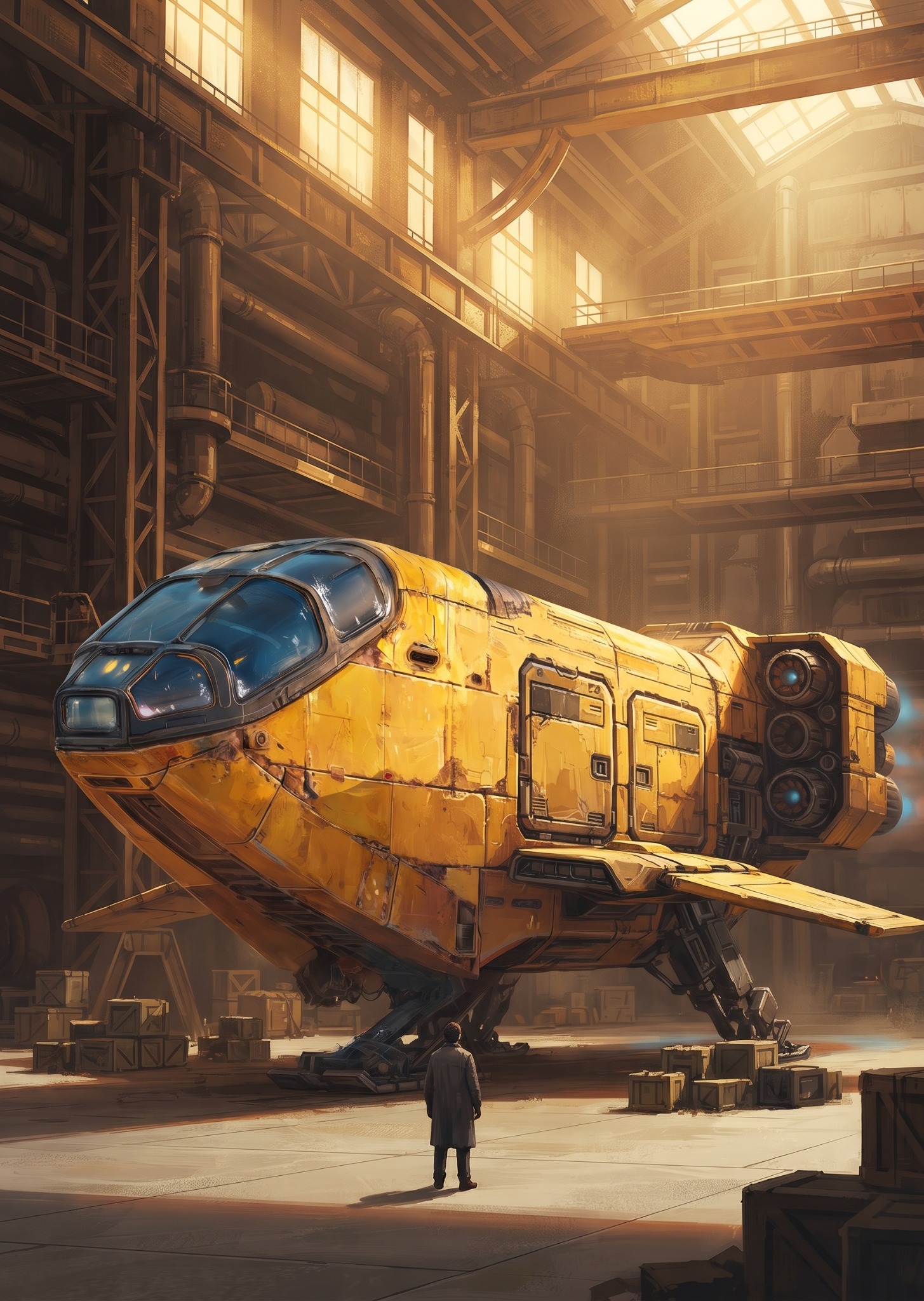
I argued with myself for the entire thirty-eight minutes of the drive. The sensible part of my brain, the part that had gotten me through twenty-six years of a thoroughly unremarkable life with no major incidents, was making an interesting case for turning the car around. The truth, when you looked at it from the outside, was that I was driving to the middle of nowhere at five in the morning because a dead psychiatric patient left me coded instructions in a shoebox. Think about that sentence. Read it back to yourself. Does that sound like the decision a stable person makes? No, it doesn't. It sounds like the opening scene of a documentary about people who disappear in rural areas, narrated by someone with a very serious voice. The other part of my brain, the part that was apparently driving the car, didn't have a counterargument. It just kept driving and making good time, though the drive felt faster than it should have, the way drives always do when you're heading toward something you're not sure you want to find. County roads emerged after the suburbs, and then these roads gave way to vast emptiness. The houses that initially began on both sides of the street eventually thinned out and then disappeared entirely. The state forest crept in from the left side of the road, dense and dark, the tree cover that doesn't let the early light through until the sun is more than a few degrees above the horizon. On the right, the industrial lot the satellite map had shown came and went, a fenced-off rectangle of cracked concrete and rusted structures that hadn't been operational in years. The entire area felt like something the rest of the county had quietly agreed to completely forget about while itself moving on with life. The GPS told me to turn right onto what it generously called a road, but it was far from it. It looked to be more of a suggestion of one, two tire-worn ruts through overgrown grass that led away from the pavement and toward a tree line maybe a quarter mile back. I turned onto it because the female voice on my phone told me to, and because I had already committed to being the person who follows coded instructions from dead men at five in the morning. Turning onto some random dirt road didn't seem like the place to draw the line. The ruts ended at a clearing. I stopped the car, turned off the engine, and sat there staring out across the barren space, wondering what the hell I was doing there. It didn't surprise me one bit to find that there was nothing there. No sign that anything had been there, in fact. I don't mean nothing interesting, or nothing unusual. I mean nothing. Nothing in its absolute form. A flat stretch of ground, maybe two hundred feet across, bordered by trees on three sides and the dirt track behind me. The grass appeared long and untouched, free from any form of maintenance that might have kept it under control. No structures, no equipment, no signs, no fencing. Not even litter. Just earth and grass and the early morning air carrying the faint smell of pine from the state forest. I checked my phone just to be sure. The blue dot sat directly on top of the coordinates. This was the place. According to a dead man's handwritten manual, decoded at three in the morning using a cipher hidden inside memory games played in a psychiatric facility, this was supposed to be the spot where I would find a spaceship called The Lost Princess. I sat on the hood of my car for a long time, the cooling engine ticking occasionally beneath me. A bird I couldn't see began singing in the trees to my left, something rhythmic and repetitive. Above me, the sky continued brightening, the thin band of color along the eastern edge spreading into something less intense than the pre-dawn brilliance as I wondered again. Disappointed wasn't exactly the right word for what I was feeling. You can only be disappointed if you expected something, and I'd been careful not to expect anything. I'd told myself during the drive that this was about closure, about honoring the old man's last wish, even if the wish turned out to be the product of a broken mind. I would drive to the coordinates, find nothing, accept that Nelson Tuckey had been exactly what his file said he was, and go home. The box would go in the trash. The ball would stay in my pocket. And I'd go back to changing sheets and redirecting Mr. Poole away from fire exits. That would be that. Except I didn't feel like that was that. Something about the clearing bothered me, and it took me a minute to figure out why. I realized when I looked at the grass again. It appeared too uniform, too clean. In every direction, the growth reached the same height and simply stopped growing. It was the same density, the same shade of green. Natural clearings didn't look like that. They normally have patches where the soil is different, spots where water pools, areas where animals have worn paths through the undergrowth. This looked like a lawn that nobody had mowed for months or years. I slid off the hood and strolled toward the clearing. The morning air remained cool, and I could feel the dew soaking into my sneakers before I'd taken three steps. Not sure why, I stepped carefully, taking my time as I walked toward the center of the clearing with my phone in my hand, watching the blue dot hold steady on the coordinates. When I reached the spot, I stopped and looked down at my feet. Grass. Dirt beneath the grass. Nothing anywhere else. The bird song had stopped at some point, but I barely noticed. That was when I remembered something. The manual had said to use the sequence. The seven words from Tuesday's game, the one after the rainstorm. They were to be spoken in order with the rhythm Tuckey had taught me. I'd whispered them at my kitchen table a couple of hours earlier while piecing them together from a memory I didn't fully trust. Now I was standing in an empty field in the middle of nowhere, and remembered the manual telling me to say them out loud. I looked around and grinned, suddenly feeling more foolish than ever. There was nobody here. There was nobody within a mile of here, and yet I couldn't shrug off the feeling of absolute absurdity. I think even the birds in the trees had stopped to watch me, an audience holding its breath to see just how far I was prepared to go. The only sound I heard was the faint rustle of the grass in a breeze so light I could barely feel it on my face. "This is insane," I muttered under my breath. "You are standing in a field talking to dirt." And then, without thinking about it, I said the words. I said them in order, in the rhythm Tuckey had drilled into me, tapping my leg with each one the way he'd taught me during that afternoon session. Seven words. A specific cadence. My voice sounded unsure of itself, lacked any hint of confidence, but I continued anyway. What did I have to lose, right? For about three seconds, nothing happened. I stood there after finishing the sequence and felt like the punchline to a joke nobody was around to laugh at. I pictured Dale standing next to my car, pointing and laughing at me, saying something about how delusional I must be to have believed the possibility of the stories being true. "Sign yourself into a room, Tyler, my boy," I could hear him say. "It's the fourth floor for you." And that was when the ground changed. It didn't move, exactly. Nor did it open up or anything. It just…changed. The air above the clearing shifted, like the way heat shimmers above a road surface on a hot day. A ripple of energy seemed to pulse outward, looking like a pebble thrown into water. The grass flickered. That's the only word I have for it. It flickered, the way a television screen flickers when the signal hiccups. For a fraction of a second, I saw something underneath it that wasn't grass and wasn't dirt, just…something else entirely. Then, as if a switch had been flipped, the concealment dropped, and the ship just appeared. My knees went first. Not dramatically, the way you might imagine watching on TV. Just that sudden looseness you get when your legs forget their purpose because of your brain's total focus turning somewhere else entirely. I took a step backward without meaning to and felt the wet grass slide under my sneaker. My mouth hung open, which I know because I could feel the cool air on my teeth, and my hands were at my sides doing absolutely nothing useful. I must have remained that way for ten seconds, maybe fifteen, just standing in the middle of a clearing at dawn with my jaw hanging open and my legs deciding whether to continue holding me up. I'm going to describe what I saw, but I want you to understand that I still hadn't developed an appropriate vocabulary for what I experienced. When a person's entire understanding of reality shifts dramatically within two seconds, the recording equipment takes a lot longer to catch up, if you get my meaning. Some details are sharp, others are blurred, and the order of things gets shuffled around by a mind that's trying very hard to process a flood of information it was never designed to receive. It was big. That's the first thing I'll say. Not airplane big, but bigger than anything I'd expected to find sitting in a clearing in the middle of that vacant spot. It filled most of the open space, its hull curving upward from the ground in a shape that wasn't quite like anything I could compare it to. Not a plane, not a helicopter, not a rocket. Not even the UFOs you might see in fake sightings. It had elements of all of those things and none of them, like someone had taken the concept of a vehicle and redesigned it from scratch without ever having seen an Earth-made machine. The surface looked smooth, but dark, not metallic exactly, but not anything else either, a material that absorbed the early morning light instead of reflecting it. The first word that came to mind when I tried to categorize it was…fake. There was no way it could be real, right? It looked old. Not broken and not neglected. Just old in how certain things take on age as a kind of appearance. There were marks on the hull, subtle variations in the surface that could have been repairs or could have been scars. The underside rested on the ground without visible landing gear, as if the ship had simply settled into the earth and the earth had grown around it, which, looking at the slight depressions in the soil near its edges, might have been exactly what happened however many years earlier. I stood there for a long time, my mouth still hanging open. The bird started up again in the trees somewhere behind me. The sound of it was so ordinary, so perfectly normal, that it was the strangest part of the complete experience. Nothing had changed in the world. Even so, the forest was still a forest. The abandoned lot was still an abandoned lot. The morning was still morning. Everything around this thing was exactly as it had been thirty seconds earlier, and yet for me, everything had changed. I walked toward it. Slowly, at first, as if I were afraid that I might frighten it away if I moved too fast. The hull grew larger with every step, more intricate details coming into focus that I hadn't been able to see from a distance. Small panels set into the surface, seamless joints between sections, a row of what might have been vents or sensors running along the lower curve. Everything looked closed, tucked away. The entire ship had the look of something that had folded itself into the smallest version of itself and then simply gone to sleep. When I got close enough, I paused for a moment before I reached out and touched the side of it. The tips of my fingers hesitated for the smallest second before I felt the smooth texture of the craft brush across my skin. The surface felt cool, but not the same as the surrounding air. Smooth, but with a faint texture underneath, like running your fingers across very fine sandpaper. And when my palm pressed flat against it, I felt something that I can only describe as awareness. Not a vibration, not any kind of mechanical feedback. A sense, somewhere between my hand and my brain, that the thing I was touching knew I was there. Naturally, it didn't react, and that was expected. It also didn't light up. It just knew, the way a sleeping dog knows when someone sits down next to it. I pulled my hand back and stood there breathing, my brain spinning as it struggled to work out what to do next. The manual. I needed the manual, and I remembered the shoebox still sitting in the passenger seat. I jogged back to the car, grabbed the shoebox from the seat, and carried it to the ship. My hands were shaking enough for me to notice, and I had to hang onto the shoebox tight so as not to drop it. Once back at the ship's outer hull, I pulled off the rubber band, ripped off the lid, and I pulled out the pages I'd decoded overnight. I took a moment to sort through the specific ones I figured I'd need, the ones that talked about systems and procedures and docking protocols. I flipped through them impatiently, looking for anything that I assumed described how to get inside. Most of the technical sections were still locked, encoded in layers I hadn't cracked yet, but I found a passage near the end of what I'd decoded that was written in clear English, as if Tuckey had known this would be the part where the code would be too slow. My eyes did the work as I stood silently in place, almost glued to the spot. Walk along the port side until you find the seam that doesn't match the others. It's lower than you'd expect, about waist height. Press your palm flat against it and hold. She takes a second to think about it. Don't rush her. Don't rush her. I wondered about those words and the relationship the man had with the craft, the years he must have spent with it before referring to it as her. I didn't know which side was port, given the shape of the ship, and so I walked left. It turned out to be the right direction, a choice made either by luck or by some instinct I didn't have time to question. The hull curved around me as I followed it, close enough to touch, and I ran my fingers along the surface as I went, feeling for the seam. Most of the joints between the panels were uniform, barely perceptible lines in the material that ran in consistent directions. But about thirty feet along, at roughly waist height, I found one that was different. Wider. Slightly recessed. Angled against the grain of the others, like it had been added later or had always stood apart. Taking another deep sigh and trying to convince myself that I wasn't expecting anything, I pressed my palm flat against it and held. One second. Two seconds. Three. I was about to pull away and try a unique spot when I felt it. A warmth spread under the palm of my hand, not suddenly but gradually, as if the surface was waking up from the outside in. A sound came from deeper inside the hull, a low tone that I felt in my chest more than I heard with my ears, and a section of the hull that I would have sworn was solid moved. It didn't slide or swing the way I had imagined. Instead, it folded, panels rearranging themselves in a sequence that looked organic, like a flower opening its petals in fast-forward, until a doorway stood where a wall had been just moments earlier. I took a step back in surprise, moved much too fast for my legs to keep up, and tangled my feet enough to send me sprawling. My butt hit the grass hard, and a second later, I felt the cold dew soak into the seat of my pants. I barely noticed, my eyes still fixed on the opening. I could see a corridor of some sort. Inside looked dark, but not empty. Small lights ran along the floor of a short hallway, faint and blue, like the emergency strip lighting on an airplane. The air that came through the opening patted me in the face, cool and stale, feeling like a breath from a closed space that hadn't been open in forever. There was something else, too. An unfamiliar smell, something resembling a faint electrical stink, clean and sharp, perhaps the scent of systems that had been idling for many years. I pushed myself back onto my feet and stood at the threshold while continuing to take inventory. The corridor led inward and curved to the right, the blue floor lights tracing the path. Somewhere deeper inside, I could hear the hum from my dream. Not a memory of the hum. The actual sound, the same pitch, the same quality, the same sense of something vast and patient running beneath everything else. It was quieter than the dream had made it, muted by years of sleep, but it was unmistakable. Tuckey's voice came to me then, from an afternoon that felt like a hundred years ago. "She's a good ship, kid. Smarter than she lets on. Treat her right, and she'll take care of you." I remember thinking that he was talking about a yacht. How wrong I had been. I'm not sure how I mustered up the courage to move, but eventually I did; my brain screaming for me to turn around and run, and yet my legs never considered leaving. They took me to the very edge, and after another brief hesitation, I stepped inside. The first step was the hardest. Not physically, although that part took considerable effort in itself. No, I found it took more effort to convince myself to take that first step than to command the rest of my limbs to obey. To put it simply, I was a nobody. I changed bed sheets. I ate microwave burritos and drove a car with a hundred and forty thousand miles on it. People like me did not walk into spaceships hidden in rural clearings. People like me didn't even see spaceships, let alone have one to climb into. And yet my feet kept moving, one after the other, because apparently my feet had made up their minds about what kind of person I was before the rest of me caught up to them. The corridor wasn't wide at all, narrow enough that I could touch both walls if I stretched my arms out. The ceiling hung low enough to make me conscious of my height in a way I normally wasn't, and I wasn't exceptionally tall. It felt like a space designed for function rather than comfort, every surface smooth and purposeful. The blue lights intensified slightly as I moved, as if the ship was adjusting to my presence, figuring out how much visibility I needed and providing exactly enough. The curve led me to a second doorway, this one already open, and beyond it, I found a room that I understood immediately as the one where the pilot sat. Not because of any specific feature I could identify, but because of the chair itself. It sat at the center of the space, facing a wide panel that wrapped around the front wall, and it looked exactly like the chair from my dream. The same shape, the same angle. Tuckey's chair. Not the faded blue one from Room 14, but the real one. I walked to it, feeling almost drawn to it. The floor beneath my feet sounded solid, and the hum sounded stronger in the cockpit, coming up through the soles of my sneakers like a heartbeat. The panel in front of the chair was dark, its surface covered in markings and sections that I couldn't read, but the layout had a logic to it that felt navigable even without understanding. Primary controls at the center, secondary systems fanning out to either side, displays above, inputs below. It was a cockpit, in the same way that a concert piano is a keyboard. The basic concept was familiar. The execution, however, was something else entirely. I sat down in the chair and immediately felt something shift, something with no earthly reason or method to do so. The seat adjusted beneath me, around me, subtle movements that I felt more than saw, and when I leaned slightly back, the headrest met the back of my skull at exactly the right point. Tuckey had sat here. For years, for decades maybe, this was where he had lived his life, and the chair had still carried the memory of him in its engineering, the same way his chair at Sunningdale carried it in a worn cushion. And now, it had readjusted itself to me. The panel in front of me suddenly flickered. Not all at once, but in sections, like a city seen from a distance turning its lights on block by block. Characters appeared on displays I hadn't noticed, scrolling through sequences in a language that looked nothing like anything I'd ever seen. Something clicked to my left. Something hummed to my right. The ship seemed to come to life all around me, responding to the person in the chair the way a house responds to someone opening the front door and turning on the lights. I sat there in the pilot's chair of a spaceship in complete awe, a ship that had hidden in a clearing in the countryside. Systems surrounded me; I couldn't read, couldn't operate, and couldn't understand, and I did something that surprised even me. I smiled. Not because I understood what was happening, or because I had any idea what to do next. I smiled because Nelson Tuckey, the old man from Room 14, the crazy patient with the crazy stories, the man I'd listened to because it seemed like the kind thing to do, had been telling the truth the entire time. Every story. Every description. All civilizations, all-star systems, and all deliveries to every impossible place. All of it had been true. And he'd left it to me. "If only you could see me now," I mumbled under my breath as I imagined Dale's face if he had been watching from a distance. As if needing something familiar in my hand, I reached into my pocket and pulled out the rubber ball I still had. It sat in my palm, small and ordinary, the most unremarkable object in a room full of things I couldn't name. I squeezed it once, the way he used to, and then set it on the console in front of me. "Okay, Mr. Tuckey," I whispered to the empty ship. "Now what?" The panel in front of me brightened, as if it had heard the question and was thinking about the answer. And somewhere behind me, my question had already been heard, calculated, and the answer entered the system of a ship my friend had called The Lost Princess. https://www.amazon.com/dp/B0HF8WCHQ2
Engagement over time
Not enough history yet to show a trend.