Based Supplies
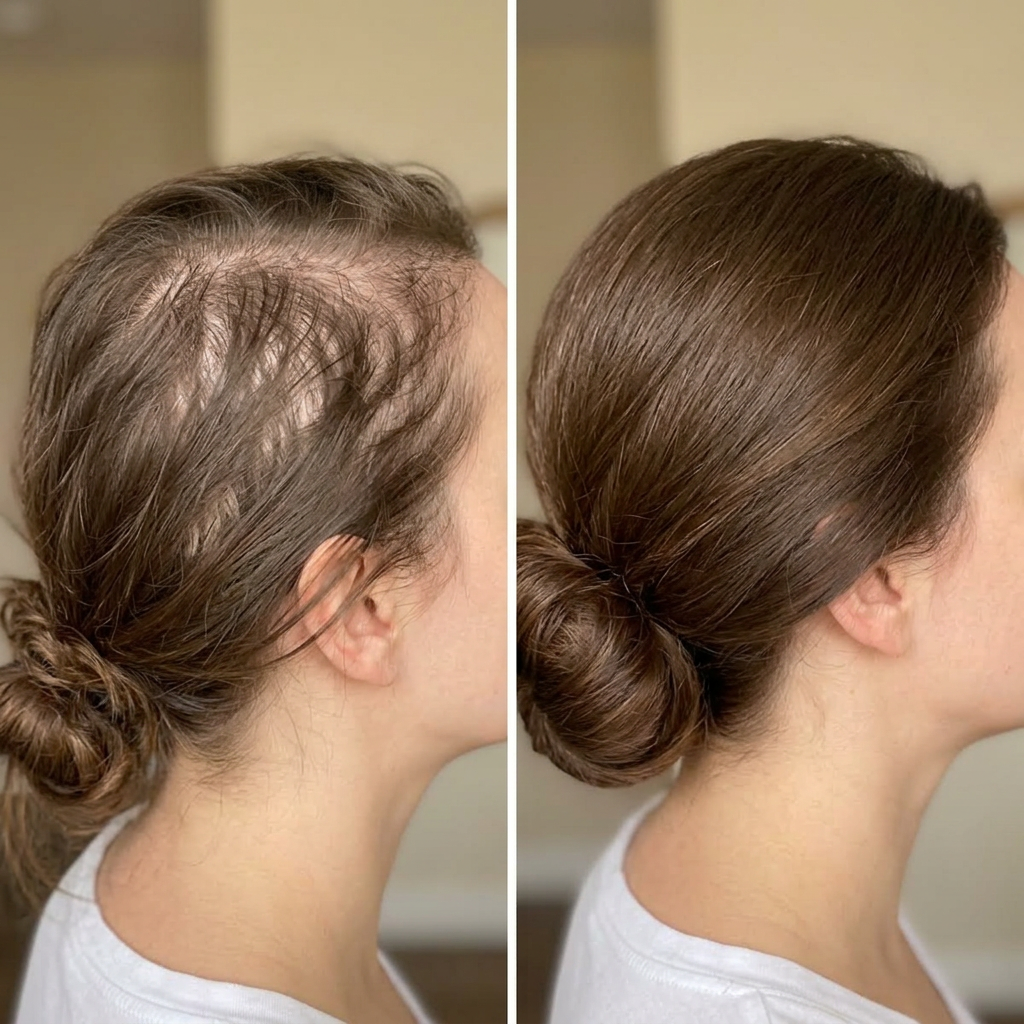
Get Your Thick Hair Back!
I am standing in front of the bathroom mirror at Kingsley Hall, reapplying my lipstick, when my twelve-year-old daughter walks up behind me and says, "Mom. Your hair looks really pretty tonight." I freeze with the lipstick halfway to my mouth. She has not said that sentence to me in almost three years. I look at her in the mirror and I say, "Thank you, baby." I do not cry, because I am not going to ruin my mascara in a middle-school bathroom forty minutes before she has to slow-dance with me to a Taylor Swift song. But in the car on the way home, after she has fallen asleep against the window with her shoes off, I cry for eleven minutes straight on I-485. This is Week 8. Eight weeks ago I could not put my hair up in a half-pony without strategizing around the thin spot on my crown. Tonight I put it up in the parking lot with a single clip, no angling, no hairspray camouflage, no little prayer before the mirror. I just did it. Like a woman who has hair. I want to tell you what happened between then and now. I especially want to tell you if you are a woman in your forties whose part has been widening, whose pillow in the morning looks like a small animal molted on it, who has spent more money than she wants to admit on "hair growth" products that did nothing. I want to tell you because eight weeks ago I was you, and fourteen months ago I was you worse, and if somebody had sat me down then and told me what I am about to tell you, I would not have lost $1,140 and most of a year of my life being quietly ashamed of my own scalp. So let me rewind. The lowest moment, since we're being honest, was Halloween the year before. We were walking back to the car from trick-or-treating and we passed under a streetlight and my daughter, who was nine at the time and who did not mean any harm at all, looked up at me and said, "Mommy, your head looks pink." I said, "What?" She said, "Right here," and she pointed at my crown. "Your skin is showing. Like, the pink part." I laughed the way you laugh when you are going to cry in the car. We got in the car. I told my husband I forgot something at my sister's house. I drove around the block twice and cried in a CVS parking lot with the engine running. That night, after everyone was asleep, I sat on the closed toilet lid with a hand mirror and a bathroom mirror and I counted the strands on the pillow. Forty-seven. I counted them twice because I did not believe it the first time. Forty-seven strands on a single pillow from a single night. That was the night I started spending money. Over the next fourteen months, here is what I bought. Biotin, 5,000 mcg, the big bottle from Costco. Collagen powder I stirred into my coffee every morning even though it made the coffee taste, and I quote myself from a text to my cousin, "like a dusty garage." Rosemary oil from Whole Foods. Castor oil from Amazon. A Nutrafol subscription at $88 a month, auto-renewing on the 14th, which I know by heart because I used to set a reminder to cancel it and then not cancel it. Saw palmetto capsules after I read about DHT on a forum at 1 AM while my family slept. A scalp massager shaped like a little plastic octopus. A derma-roller that I was too scared to actually use. And the centerpiece of the whole operation: a $79 "clinically proven thinning hair system" in a bright blue bottle that promised visible regrowth in ninety days. I used it twice a week for the "intensive treatment." I used the maintenance version every single morning. I stayed loyal to it for almost a full year because the bottle said "clinically proven" and I wanted so badly to believe something was going to work. I added it all up once, in a spreadsheet, the week before Thanksgiving. Eleven hundred and forty dollars. On my hair. In fourteen months. With nothing to show for it except a part that had kept widening the entire time and a bathroom cabinet that looked like a GNC had exploded in it. I went to a dermatologist in month nine. I waited six weeks for the appointment. She looked at my scalp for approximately ninety seconds, said the words "female pattern hair loss," handed me a sample of Rogaine, and told me that if I started it I would have to stay on it for the rest of my life or everything I regrew would fall out again. I left crying. I never opened the sample. It is still in a drawer in my kitchen. My doctor did not tell me what was actually happening to my hair. The blue bottle did not tell me. Nutrafol did not tell me. The biotin did not tell me. The internet did not tell me, because the internet was too busy selling me more products. My cousin Rachel told me. At Thanksgiving. Over wine. After I finally broke down and admitted what was going on. Rachel is a cosmetic chemist. She spent six years formulating shampoos for a brand you have almost certainly bought, which I am not going to name because she has asked me not to and because her lawyer has also asked her not to. She left the industry in 2022. She will tell you, if you ask, that she left because of "a thousand small things." She will not usually tell you the specific thing. I am going to tell you, because she told me, that Thanksgiving night, sitting cross-legged on my kitchen floor with a glass of pinot in her hand. She said, "Mer. Can I see your shampoo." I went and got the blue bottle. I was a little embarrassed to show her because she is a chemist and I had the feeling I was about to be graded. I handed it over. She read the ingredient panel. She closed her eyes for about four seconds. She said, "Oh, honey." She did not say anything else that night. She said she wanted to come over Saturday morning, just the two of us, and "show me something." I said okay. She showed up at 9 AM with two coffees and a tote bag. Here is what was in the tote bag. I am going to tell you because I want you to be able to do this yourself tonight, for free, in your own kitchen, and see what I saw. My blue bottle shampoo. A bottle of Dawn dish soap from under her sink. A bottle of Tide laundry detergent from her laundry room. And a bottle of engine degreaser she had taken out of her husband's garage that morning without telling him. She lined them up on my kitchen island. She turned them all around so the ingredient panels faced me. Then she said, "Read the first five ingredients on your shampoo." I read them out loud. Water. Sodium Laureth Sulfate. Sodium Lauryl Sulfate. Cocamidopropyl Betaine. Fragrance. "Now the Dawn." Water. Sodium Laureth Sulfate. Sodium Lauryl Sulfate. Two more surfactants. "Now the Tide." Water. Sodium Laureth Sulfate. I stopped reading. "Now the engine degreaser." I turned the bottle. My hand was shaking a little, which I did not understand at the time and I understand completely now. Sodium Lauryl Sulfate. Third ingredient. I looked up at her. She did not say anything. She was letting me sit in it. Then she said, very evenly, the sentence that rearranged my entire understanding of the last fourteen months of my life. "Sulfates are surfactants, Mer. Their entire job, chemically, is to strip oils and sulfur compounds. That is why they are in dish soap. That is why they are in laundry detergent. That is why they are in engine degreaser. And that is why they are the second ingredient in the shampoo you just paid seventy-nine dollars for to save your hair." I said, very quietly, "Have I been making it worse?" She said, "Yes, Meredith. Every morning. For almost a year." I cried at my own kitchen island for about ninety seconds. Rachel did not try to stop me. She poured more coffee. She waited. Then she explained the mechanism, which I am going to explain to you now, because this is the piece nobody told me and this is the piece that changes everything. Your hair is made of a protein called keratin. The thing that makes keratin strong and thick and elastic is a bond called a disulfide bond. Those bonds are sulfur bonds. Structurally, your hair is a sulfur protein. Your scalp produces sulfur on its own. Your follicles take that sulfur and use it as raw material to build new keratin, which is how new hair grows in and existing hair stays strong. Sulfates strip sulfur. That is not an opinion. That is what the molecule does. It binds to sulfur compounds and rinses them down the drain. Wash with a sulfate shampoo once, and your body replaces what was lost in a few days and you are fine. Wash with a sulfate shampoo every single morning for years (which is what I had been doing since I was sixteen, which is what most of us have been doing since we were sixteen) and your scalp cannot keep up. Your follicles start producing thinner, weaker strands. Some of them stop producing hair at all and go dormant. It is not aging. It is not hormones. It is not bad genes. It is a sulfur-depleted scalp. Mechanically. Caused by a product that was marketed to me as restorative, and then, the part that still makes me furious, marketed to me AGAIN, at a premium, as a solution "for thinning hair." Rachel told me, and I'm just going to quote her here, "The sulfate base in your thinning hair shampoo is identical to the sulfate base in the regular shampoo on the shelf next to it. They charged you extra for a splash of biotin at under one percent, and the splash is not there to do anything. The splash is there to make the claim legal." I said, "Rachel. I am going to be sick." She said, "I know." Then she told me what to do, and here is the part I want you to actually pay attention to, because this is the whole protocol and it is embarrassingly simple. The scalp has two needs and they are sequential. Not simultaneous. Sequential. The order matters. Need one: Stop the stripping. You cannot fix a depleted scalp while you are actively depleting it every morning. If your shampoo lists Sodium Lauryl Sulfate or Sodium Laureth Sulfate in the first five ingredients (go look, right now, I'll wait), you are stripping sulfur every time you wash. No supplement can out-pace that. No Nutrafol. No biotin. No collagen powder. No rosemary oil on the crown at 11 PM. Rachel put it this way at my kitchen island and I have never forgotten it. "Picture a bathroom sink with the drain wide open and the faucet on full blast. You can pour water in all day. It will never fill. That sink is your scalp. The drain is your shampoo. You cannot out-pill a drain, Mer." I had spent $1,140 trying to out-pill a drain. Need two: Feed what's starving. Once the drain is closed, the scalp needs two things, delivered topically, at the follicle. Not swallowed. Not metabolized through digestion. At the site. Sulfur, to rebuild the raw material for keratin. Rachel told me the best-researched topical source of bioavailable sulfur for scalp and hair is onion extract, specifically onion hydrosol at a real concentration. There is peer-reviewed work on this in the Journal of Dermatology. Actual regrowth. Actual photographs. Not "may support." Regrowth. And circulation plus anti-DHT support, to help the follicle actually use what is being given to it. Rosemary oil applied topically has performed comparably to minoxidil in controlled studies, without the lifetime-dependency problem the dermatologist warned me about. Nettle extract is a gentle, natural DHT blocker (DHT being the hormone that quietly miniaturizes follicles in women over 35). Peppermint oil increases scalp circulation. Topical biotin, delivered at the follicle rather than swallowed and diluted, can actually get used where it is needed. Close the drain. Feed what's starving. That is the entire protocol. Rachel said the reason the industry has buried this is not complicated. Sulfate-free formulations with real concentrations of real botanicals cost more to make, lather less, and cannibalize the premium "specialty" lines that make up the margin. So instead they sell us the blue bottle, and the serum, and the supplement subscription, and let us blame our bodies when none of it works. She warned me, before I went shopping, about the onion shampoo wave on Amazon. "Most of them are theater, Mer. They put onion on the front of the bottle, add one-tenth of a percent of onion extract, and leave the sulfate base completely intact. You'll use it for six weeks, nothing will happen, you'll conclude onion shampoo doesn't work, and you'll go back to the blue bottle. Onion shampoo works. Onion marketing does not." She told me the bar. Fifteen percent onion hydrosol minimum. Genuinely sulfate-free. Genuinely paraben-free. Genuinely silicone-free. Supporting botanicals in the same formula, not sold separately at an upcharge. She had already found one, because she had already been researching this for her friends and her sister. Made by a small family business, not a conglomerate, not one of her former competitors. She wrote the name on the back of a grocery list and slid it across my kitchen island. She said, "If you use this for eight weeks the way I am going to tell you to use it, and your hair does not change, I will PayPal you the money back myself." On the smell, because I know what you are about to ask. It was the first thing I asked her. It does not smell like onions. I promise you. I was braced for it, I opened the bottle in my bathroom with the fan on like I was defusing something, and what I actually smelled was herbal. Slightly minty from the peppermint. Clean. My husband, who once wore the same cologne for nineteen years and only switched because they discontinued it, walked into the bathroom a week in, sniffed, and said, "Are you wearing a new perfume?" It was the shampoo. My daughter, the one who told me my head looked pink, smelled it and said it smelled "like a spa." Which brings us back, in order, to the eight weeks. Week one. My scalp stopped feeling tight after washing. Rachel had warned me the lather would be lighter than I was used to. Real shampoo does not foam like Dawn because real shampoo is not Dawn. (Her line. She is full of these.) Week two. Less hair in the drain. Not zero. Less. I estimated about a third of what I had been losing. I texted Rachel a photo of the drain catch. She sent back three crying-laughing emojis and "PROGRESS IS PROGRESS, MER." Week three. I was blow-drying and I stopped because the brush felt heavier. Not tangles. Resistance. Volume. Week four. Baby hairs. An actual halo of new growth along my hairline, at my temples, and most importantly on the crown where my daughter had seen the pink. I saw them in the morning light at my bathroom window and I made my husband come look. He squinted. He said, "Huh. Yeah. Those are new." He is not a man given to overstatement. Week six. My mother, who has not complimented my hair since my wedding, complimented my hair. Week eight. The mother-daughter dance. The half-pony with one clip. My daughter in the bathroom mirror. It has now been about seven months. I use the shampoo and the matching conditioner every day. I stopped the biotin. I stopped the collagen (the coffee tastes better). I cancelled the Nutrafol, which, by the way, was not a one-click cancellation; I had to call and talk to a retention specialist named Brad who tried three separate times to put me on a "pause." The $88 a month that was going to Brad is going into my daughter's 529. My hair is not my twenties hair. I am 44. But it is thicker and fuller and denser and visibly present in photographs in a way it has not been in three years. My part is a line, not a delta. The pink is gone. Here is why I am telling you all of this instead of keeping it to myself, which is what a more private person would do. I am telling you because I spent fourteen months and $1,140 of my own money and most of my emotional bandwidth being quietly ashamed of something that was being done to me. I blamed my hormones. I blamed my stress. I blamed my age. I blamed my genetics. I blamed the fact that I had two kids in three years. I blamed my diet. I blamed myself. It was none of those things. It was a $4 bottle of surfactants that I had been pouring over my scalp every morning since high school because a commercial in 1996 taught me that lather meant clean. If you are reading this and you have already turned your shampoo bottle around in your head (you know which one, the one in your shower right now), and you have already seen Sodium Laureth Sulfate in the first five ingredients, I am begging you to not do what I did. I am begging you to not spend fourteen months on the biotin and the Nutrafol and the derma-roller and the rosemary oil and the $79 blue bottle before somebody's cousin finally sits you down at your kitchen island and tells you the truth. The truth is: your body is not broken. Your follicles are not dead. You are being depleted, every morning, by a product that was sold to you as a solution. Stop stripping. Start feeding. In that order. The shampoo and conditioner Rachel sent me to, and that I have now sent at least nine of my own friends to, is made by a small family business. It is not a brand Rachel ever worked on. It is not one of her former company's competitors. It is an outsider product, which, she says, is the only kind of product in this category she currently trusts. Fifteen percent pure onion hydrosol. Rosemary oil. Nettle extract. Peppermint oil. Topical biotin. Aloe vera. Hydrolyzed vegetable protein. Zero sulfates. Zero parabens. Zero silicones. A matching conditioner with onion extract, castor oil for visible thickness, argan oil for shine, and biotin for breakage. It smells like herbs. My husband thinks it is perfume. It comes with a 30-day money-back guarantee. You try it. If you do not love how your hair feels and looks, you email them, you get your money back. No forms. No phone tree. No retention specialist named Brad. I want to be very specific about why the guarantee matters to me, because it would not have mattered to me fourteen months ago and I want to explain why it should matter to you now. Every single thing I bought during my $1,140 year was either non-returnable, auto-renewing, or both. The Nutrafol auto-renewed. The biotin was opened, so, non-returnable. The $79 blue bottle system was "final sale because of hygiene." Every one of those transactions was built to keep the risk on me. This one isn't. The risk is on them. Go look at your bottle tonight. Right now, if you can. Turn it around. Read the first five ingredients out loud. If Sodium Lauryl Sulfate or Sodium Laureth Sulfate is in there, throw the bottle out. Or give it to someone you don't like. Or pour it down the drain it was basically already going down. I don't care what you do with it. Get it out of your shower. Then replace it with something that closes the drain and feeds what is starving. Eight weeks from now you might be standing in a bathroom mirror somewhere reapplying your lipstick, and someone you love might say something to you that they have not said to you in three years. I hope they do. I hope you cry on the way home. I hope it is a different kind of crying. Meredith P.S. If you had told me, at my lowest, sitting in that CVS parking lot on Halloween, that eight weeks of a real shampoo would undo what fourteen months of "clinically proven" systems could not, I would have laughed in your face. I almost didn't try it. I almost put the link Rachel sent me into the same pile as the derma-roller and the castor oil and kept going. The only reason I clicked was that she said she would PayPal me the money herself if it didn't work. She didn't have to. It's now seven months later, I have my crown back, and I am telling you the same thing she told me: try it. The risk is on them, not on you. P.P.S. On the smell, one more time, because I know at least half of you are scrolling back up to check. It is herbal and slightly minty. My husband thought it was perfume. My daughter said it smelled "like a spa." Not one person in seven months has ever asked me why my hair smells like onions, because it doesn't. I promise. P.P.P.S. If you have a bathroom drawer right now with an unopened Rogaine sample in it, or a half-empty bottle of biotin, or a Nutrafol box you forgot to cancel, I see you. I was you. I am so sorry nobody told you sooner. I'm telling you now. Go turn the bottle around.
Engagement over time
Not enough history yet to show a trend.