Rachel Porter
Fix yourself at the cellular level
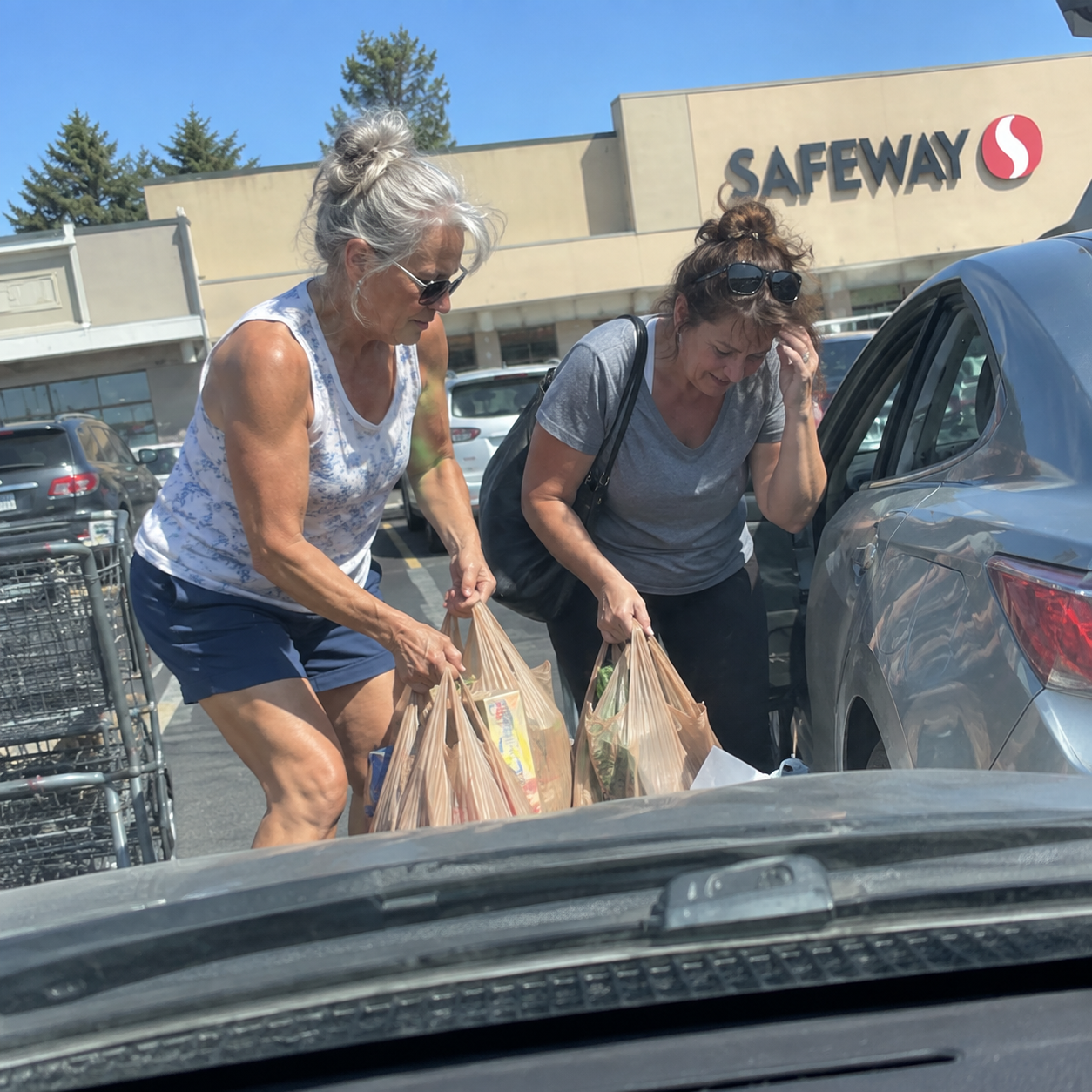
A stranger caught my grocery bags mid-fall in the Safeway parking lot. Lifted them with one arm like they weighed nothing. Then she looked at my shaking hands and asked me a question that changed my life: "When did you stop being able to carry things?" I need to tell you the whole story. Because the question was only the beginning. What she told me over coffee the next morning is the reason I can carry my own groceries again. My name is Linda. I'm 54. Married to Steve for twenty-six years. Two kids — one in college, one still home. I work part-time at a medical office. Normal life. Normal woman. Normal everything. Except my body stopped being normal three years ago and nobody told me why. It started with the grocery bags. I've been doing the Thursday Safeway run for twenty-two years. Same store. Same route through the aisles. Same system — load the bags in the trunk, drive home, carry them in, two in each hand, up the three porch steps, into the kitchen. Four trips max. Three years ago I started needing five trips. Then six. Then I started leaving the heavy bags in the trunk and waiting for Steve to get home. I told myself I was just tired. Work. Kids. Perimenopause. The catch-all excuse that explains everything and nothing. But it wasn't tired. Tired is when you rest and recover. What was happening to me didn't recover. The strength was leaving my body like water draining from a tub — slowly, quietly, and by the time I noticed, the tub was mostly empty. The jars were first. I used to open everything in this house without thinking about it. Then one Tuesday I was making pasta and I couldn't open the sauce. Both hands. Full grip. Twisting with everything I had. Nothing. I ran it under hot water. Tried again. Nothing. I wrapped a rubber band around the lid. Tried again. The rubber band snapped and I stood in my kitchen holding a jar of Prego with both hands and tears running down my face. Not because of the jar. Because of what the jar meant. My seventeen-year-old son walked in, took it from me, opened it with one hand, and handed it back without looking up from his phone. I stared at his retreating back and thought: I used to carry that boy up the stairs with one arm. After the jars came the stairs. Our bedroom is on the second floor. Fourteen steps. I've climbed them ten thousand times. Two years ago I started stopping halfway. Not to catch my breath — to let my legs regroup. They'd start burning by step six. By step ten, my thighs felt like they were filled with sand. Steve noticed. He didn't say anything. He just started carrying the laundry upstairs himself. Put the heavy things on the lower shelves. Moved my winter coat to the hall closet because the bedroom closet required the stairs and the stairs required legs I didn't have anymore. He was rearranging the house around my decline. Quietly. Lovingly. The way you accommodate something you've accepted. I hadn't accepted it. But I didn't know what else to do. My doctor ran bloodwork. Everything within normal range. Thyroid fine. Iron fine. Vitamin D slightly low. "Appropriate for your age." Appropriate for my age. I was 54, not 84. The fall happened on a Thursday in September. I was loading grocery bags into the trunk. Four bags. Maybe fifty pounds total. I'd done it a thousand times. I picked up two bags in my right hand. My fingers held for about three seconds. Then they just — opened. Like someone had switched off the connection between my brain and my hand. The bags hit the pavement. A jar of olives shattered. Marinara sauce splattered across my shoes. I stood there in the Safeway parking lot looking at my hand. Opening and closing it. The fingers worked. They moved. But they couldn't hold. That's when I heard her voice. "Honey. Let me get those." A woman. Maybe sixty. Maybe older. Silver hair pulled back. Tank top. Arms that didn't make sense on a woman her age — defined, solid, the kind of arms that came from using them every day for something harder than grocery shopping. She picked up my scattered bags with one hand. Scooped the broken jar into the trash bag she had in her cart. Loaded everything into my trunk. Quick. Easy. No strain. She was at least ten years older than me. And she'd just done with one arm what my arm couldn't do with two. She looked at me. Not at the bags. At my hand — the one still opening and closing like it was trying to remember what holding felt like. "When did you stop being able to carry things?" Nobody had ever asked me that directly. "About three years ago," I said. "It just — went." She nodded. The slow nod of someone who's heard this exact answer before. "Come get coffee with me. I need to tell you something, because nobody else is going to." Her name was Marie. We sat in the Safeway café with two cups of terrible coffee and she told me everything. "Five years ago I was exactly where you are. Couldn't carry bags. Couldn't open jars. Couldn't climb stairs without my legs burning. I was 57 and my body felt like it belonged to someone twenty years older." "What happened?" "My daughter happened. She's a physical therapist. She came home for Thanksgiving and watched me struggle to get out of a chair. Just a regular dining chair. And she sat me down the next morning and told me something no one — not my doctor, not my gym, not a single wellness blog I'd ever read — had ever said." She leaned forward. "After forty, women lose muscle at 3-5% per decade. That's the baseline. But at perimenopause — which starts mid-forties for most of us — estrogen drops. Estrogen is protective of muscle tissue. When it goes, the rate of muscle loss accelerates. By fifty-five, most women have lost enough lean muscle that it's affecting their grip strength, their bone density, their metabolism, their balance, their ability to do basic things like carry groceries and climb stairs." "I knew that," I said. "I've read about it. That's why I—" "You tried protein shakes. Maybe a resistance band. Maybe a gym membership you used for two months." I stared at her. "I know because I did all of it," she said. "And none of it worked. Because nobody told me the missing piece." She held up her hand. "Your muscles can't build if they don't have fuel. Every cell in your body — muscle, brain, bone, skin — uses a molecule called creatine to produce ATP. ATP is the actual energy currency that powers every contraction, every repair, every function. Without enough creatine, your muscles literally cannot respond to the signal your brain sends." "That's what's happening when my hand drops the bag?" "Exactly. Your brain says grip. The signal arrives at the muscle cell. But the muscle cell doesn't have enough fuel to execute the command. So the grip fails. The bag falls. And you think you're weak. But you're not weak — you're depleted." She set her coffee down. "Women produce 70-80% as much creatine as men naturally. After menopause, production declines further. By your fifties, you're running your muscle cells on a fraction of the energy they had at thirty. The muscle can't respond. The strength leaves. And every doctor you see says 'appropriate for your age' because they're measuring your blood, not your cells." "The grip is actually a survival metric," she continued. "Below 44 pounds of grip strength in women is associated with increased all-cause mortality. Not just frailty — mortality. It predicts falls. Fractures. Loss of independence. It's the single most studied biomarker in aging research. And nobody measures it. Nobody mentions it. You could walk into your doctor's office unable to open a jar and she'd check your thyroid and send you home." "So you took creatine? Like the gym stuff?" She shook her head. "I tried the powder first. The gym stuff. Mixed it in water. It was gritty, it tasted like chalk, and within three days I was so bloated I looked six months pregnant. I quit after a week." "My daughter told me that's why most women quit creatine. The powder sits in your stomach and pulls water before it absorbs. The bloating isn't the creatine — it's the form. Powder plus stomach equals water in your gut instead of your muscles." "She found me YOLO Creatine + Electrolytes. Gummies. Five grams of creatine monohydrate — the clinical dose, same as the research — in a gummy form that starts absorbing in your mouth and upper GI. No stomach. No bloating. Plus electrolytes, which creatine needs as cofactors to work." "Two gummies. Every morning. With my coffee." She held up her arm. The one that had just carried my grocery bags with one hand. "This arm couldn't hold a blow dryer five years ago. I'd stand in front of the mirror drying my hair and have to switch hands every thirty seconds because my arm would burn out. I thought my blow dryer was too heavy." She almost laughed. "My blow dryer weighs fourteen ounces." "How fast did it work?" "Energy first. End of week one. Not caffeine energy — deep energy. Like someone plugged me back into a power source I'd been disconnected from for years. I woke up on day five and my body was just ready. Not wired. Ready. The way it used to feel before whatever was draining me started." "Week two, the stairs changed. I was climbing the stairs at my house — fifteen steps — and I got to the top without stopping. Without the burn. My legs just carried me. I stood at the top and thought — oh. That's what it feels like to have fuel." "Week three, the grip came back. I was at the grocery store — this store, actually — and I grabbed two bags in one hand and walked to the car without thinking about it. It wasn't until I was driving home that I realized what I'd done. I'd carried the bags. One hand. The way I used to." "Week four, my daughter tested my grip strength. She has a dynamometer at work. I'd been at 38 — below the danger threshold. Four weeks later, 56. She tested it twice because she thought the device was wrong." "Month two, my bone density scan improved. First time in six years. My doctor ordered it again because she thought there was an error. There wasn't." "Month three, I stood in front of the mirror drying my hair. Same blow dryer. Same fourteen ounces. I held it above my head for the entire time without switching hands." She looked at me. "The blow dryer didn't get lighter. My arm got stronger. Because the cells finally had fuel." I ordered it that night. In bed. Phone under the covers because Steve was already asleep and I didn't want to explain another supplement that probably wouldn't work. Two gummies with my coffee the next morning. They tasted like candy. No grit. No shake. No prep. Day three. The heaviness in the morning — that gravity-got-worse feeling I'd been waking up with for three years — was lighter. My body felt like it had somewhere to go. Not wired. Not caffeinated. Available. Day five. I went for a walk. Not because I made myself. Because my body wanted to move. Three miles. I came home and I wasn't winded. My legs felt solid underneath me. Week two. I was at the Safeway. Thursday. Same store. Same run. I loaded four bags into the trunk and picked up two to carry inside. My hand held. Not shaking. Not straining. Just — holding. The signal went from my brain to my fingers and my fingers answered. The gap was gone. The quarter-second between command and failure where the strength used to disappear — it was filled in. Reconnected. I carried all four bags in two trips. Up the three porch steps. Into the kitchen. Like I used to. Steve was in the kitchen making coffee. He watched me set the bags on the counter and something in his face changed. Not surprise — recognition. Like he was seeing someone he remembered. "You carried all of those?" "I carried all of those." Week three. I climbed the stairs. Fourteen steps. No stop halfway. No burning. My legs just went. Step after step. The way they used to before the sand filled them up and the tub drained out. I stood at the top of my own staircase and I cried. Not sad crying. The kind where something that was lost comes back and you didn't realize how much you'd missed it until it's standing in front of you again. Week four. Steve came home from work. I was in the kitchen making dinner. He walked in and said, "You look different." "Different how?" "I don't know. Stronger." He was right. My posture had changed. The muscles along my spine had woken up. I was standing straight without thinking about it. My arms had shape again — not gym-toned, just solid. The softness that had replaced the muscle was firming underneath. Month two. I opened the pasta sauce. One hand. One twist. Standing at the counter while my son did homework at the table. He didn't notice. He didn't know it was remarkable. I knew. Every jar I'd handed to someone else for three years. Every lid I'd run under hot water. Every rubber band that snapped. Done. Month three. I carried my sleeping niece up the stairs at my sister's house. Eight years old, forty-two pounds, one arm. My sister watched from the hallway. "I thought your back was bothering you." "It was. It isn't." Because the back was never the back. The back was my body compensating for arms that didn't have the strength to carry weight. When the arms came back, the compensation stopped. The chain fixed itself. I ran into Marie at the Safeway six weeks ago. She was loading her groceries. One arm. Easy. "How's the grip?" she asked. I picked up her twenty-pound bag of dog food from her cart and tossed it into her truck bed. She grinned. "There she is." I'm telling you this because I think you might be where I was in that parking lot. Standing over dropped bags. Looking at your hand. Wondering when it stopped listening to your brain. In your head, you're still the woman who carried everything. Kids. Groceries. Laundry. Life. You remember what strong felt like. That memory lives in your body like a phantom — you reach for it and close your hand around nothing. If the grocery bags have gotten heavier but they haven't actually gotten heavier... If the jars have become a two-hand job and then a husband job and then an "I'll just buy the flip-top" job... If the stairs burn by step six and you've started putting things on the lower shelves... If someone ten years older than you just carried your bags with one hand and you can't stop thinking about why... You're not weak. You're depleted. Your cells are running on empty. The creatine your body used to make — the fuel that powers every grip, every lift, every step — has been declining since your forties, and nobody told you because the world still thinks creatine is for men in a gym. It's not. It's for your hands. Your stairs. Your jars. Your groceries. Your ability to carry a sleeping child. Your independence. YOLO Creatine + Electrolytes. Five grams, clinical dose. Gummy form — no powder, no grit, no bloating. Plus electrolytes your body needs to put the creatine where it belongs. 🛡️ 50% Off + Free Shipping. 365-day money-back guarantee. A full year. Take it for two months. See if your hand answers when your brain calls. If it doesn't, every dollar back. But if it does — if you carry the bags one-handed and don't realize until you're in the kitchen that the gap is gone — you'll wish you hadn't waited. Marie told me in a Safeway café. I'm telling you here. Because nobody else is going to. P.S. — I told three women at work. All of them had the same response: "I thought it was just me." It's not just you. It's every woman over forty whose cells are running on declining fuel while her doctor says appropriate for your age. All three ordered it. All three texted me within three weeks. Same message, different words: "I carried the thing." The grocery bags. The laundry basket. The grandchild. Every one of them had a thing they'd stopped carrying. Every one of them carries it again. P.P.S. — Grip strength below 44 pounds in women predicts all-cause mortality. Not fitness. Mortality. If you can't open a jar, that's not an inconvenience — it's a clinical marker that nobody is measuring. I was at 41 when I started — three pounds above the danger line and I didn't know the line existed. Eight weeks later I was at 58. My doctor didn't measure it. Marie's daughter did. Somebody should be measuring yours. P.P.P.S. — If you tried creatine powder and quit because of the bloating — you haven't tried creatine. You tried the wrong form. Powder sits in the stomach. Pulls water into your gut. Makes you feel like a balloon. Women quit. And then spend years thinking creatine doesn't work for them. Gummies absorb through the mouth and upper GI. The water goes to muscle cells, not your stomach. That's the difference between bloating and building.
Engagement over time
Not enough history yet to show a trend.