Universe Finder
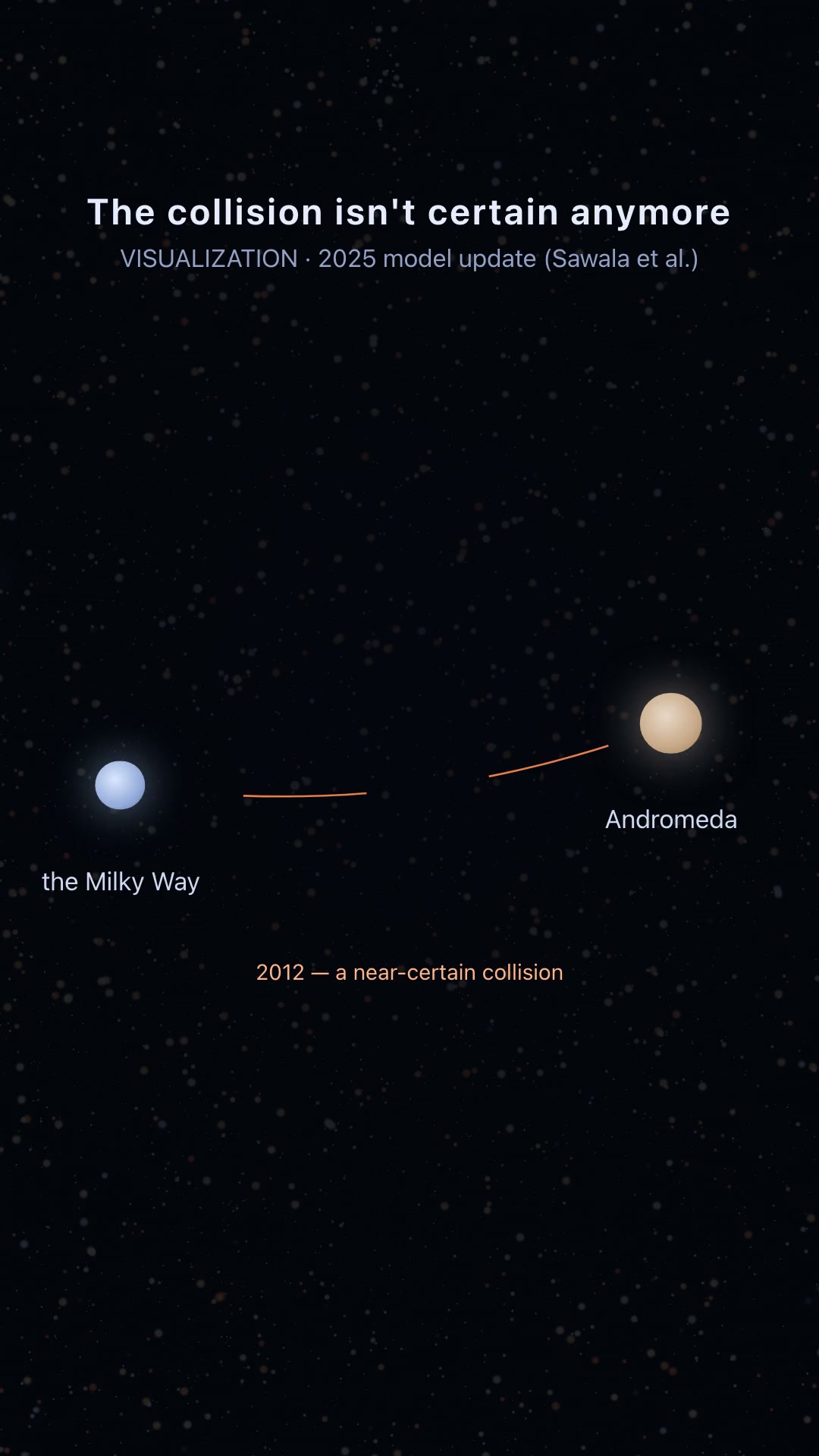
For years the story was a certainty: the Andromeda Galaxy would collide head-on with the Milky Way. In 2025, astronomers redid the calculation - with better measurements, and with the gravity of our neighbor galaxies included - and the answer is now roughly a coin flip over the next 10 billion years. This short is a flight to Andromeda, built from published measurements. That faint smudge below Cassiopeia's W holds roughly a trillion stars, about 2.5 million light-years away - the light arriving tonight left it around the dawn of early stone-tool making. Photographed deeply it spans about six full Moons on our sky, and under dark skies it is the farthest thing most human eyes can see unaided. The close-up views are visualizations, and the video labels them as such while they are on screen. That distinction matters to us. You can fly to Andromeda yourself, and to everything else we have catalogued, at https://universefinder.com/?utm_source=facebook&utm_medium=organic_social&utm_campaign=andromeda_short Sources: Sawala et al. 2025 (Nature Astronomy) - merger probability ~50% within 10 Gyr; van der Marel et al. 2012 (ApJ 753) - earlier collision modelling; Li et al. 2021 (ApJ 920) - Cepheid distance 765 +/- 12 kpc; NASA/ESA Hubble heic2501 - 2.5-gigapixel M31 photomosaic. Galaxy imagery: NASA, ESA, B. Williams (University of Washington). #andromeda #galaxy #astronomy #space #milkyway #m31 #stargazing #science #universe #astrophysics #nightsky
Engagement over time
Not enough history yet to show a trend.