Lauren Mitchell
50% OFF — berberine alone isn't enough
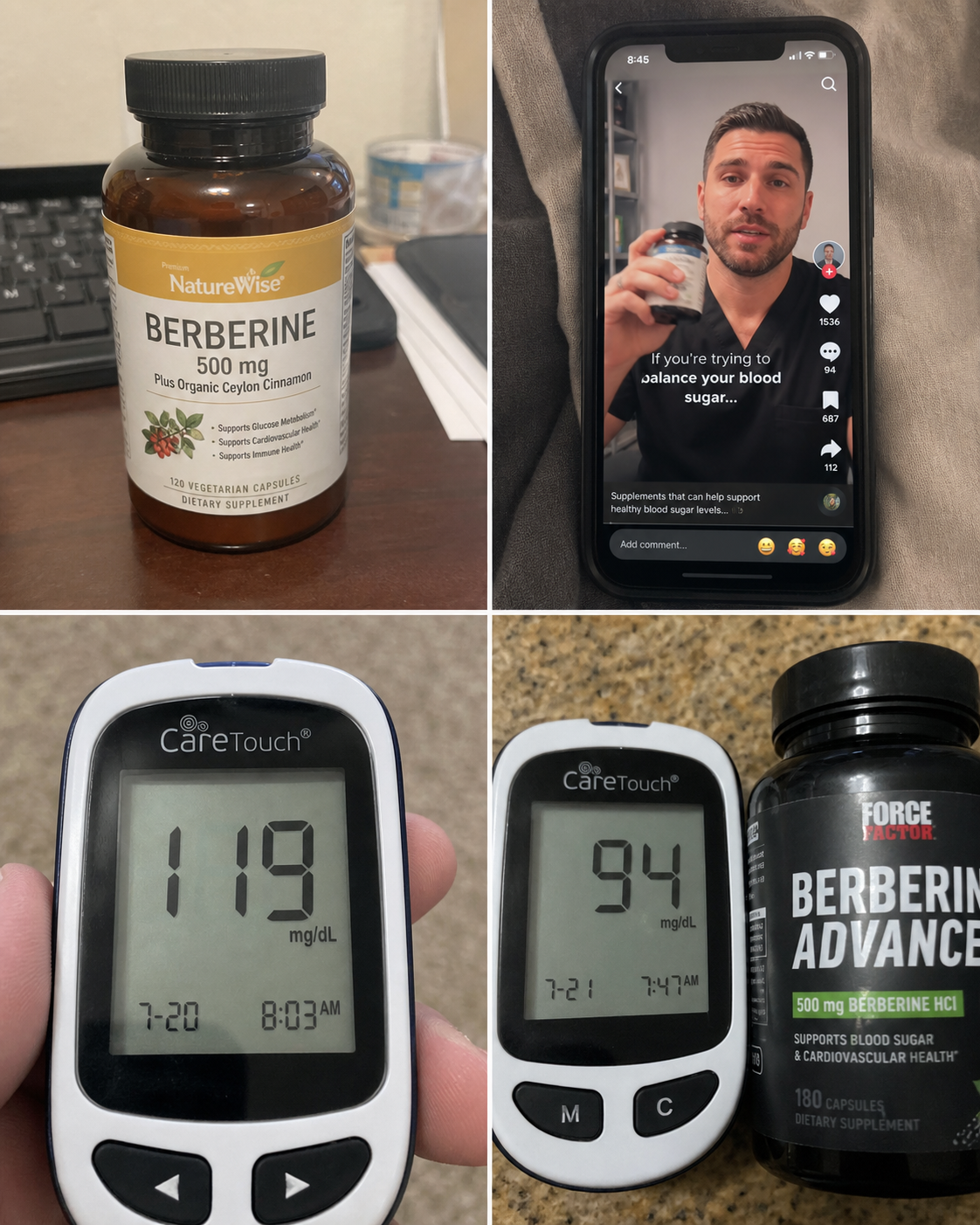
I took berberine for 6 months because TikTok called it "nature's Ozempic." Here's my A1C. 6.4. Same as when I started. Six months. $214 in supplements. Hours of TikTok videos from wellness girlies telling me berberine was going to change my life. And my A1C didn't move a single point. My name is Jess. I'm 31. I live in Mesa, Arizona. I'm a project coordinator for a construction company — the only woman in an office of 14 men, if that gives you any context for my stress levels. I was diagnosed pre-diabetic at 29. A1C of 6.4 at my annual physical. My doctor — Dr. Reeves, very nice, very by-the-book — told me I had "about a year" before he'd want to start me on Metformin. I said I'd handle it with lifestyle changes. He smiled the way doctors smile when they've heard that exact sentence 400 times. So I did what every 29-year-old woman does when she gets a scary diagnosis. I went to TikTok. And TikTok had answers. SO many answers. Berberine. Nature's Ozempic. The supplement Big Pharma doesn't want you to know about. The golden root that lowers blood sugar naturally. Video after video of girls holding up yellow capsules like they'd found the Holy Grail. I ordered Thorne Berberine from Amazon. $38 for a bottle. 1,000mg a day, split into two doses with meals, just like the videos said. Month 1: I thought I felt something. A little less bloated after lunch. Maybe slightly less of that 3PM crash where I wanted to put my head on my desk and sleep through my 2:30 meeting. Could have been placebo. I didn't care. I was DOING something. Month 2: Bought a glucose monitor because a girl on TikTok said to track your numbers. My fasting glucose was 118. She said that was "a little high but berberine takes time." I believed her. She had 340,000 followers. She must know something. Month 3: Fasting glucose 114. Down 4 points. I posted in a Facebook group about it. Got 47 likes. Someone said "nature's Ozempic is REAL." I felt like I was winning. Month 4: Fasting glucose 116. Back up. I told myself it was because I had pizza the night before. Month 5: 119. Higher than when I started. I switched brands. NutriRise, $24, 1,200mg. The reviews said it was stronger. A guy on Reddit said Thorne was overpriced for what you get. Month 6: Dr. Reeves ran my bloodwork. A1C: 6.4. EXACTLY where I started. He looked at me over his glasses and said "so should we talk about Metformin?" I sat in that exam room and wanted to disappear into the paper on the table. Because I'd spent six months telling everyone — my mom, my boyfriend Marcus, my coworker Diane who's also pre-diabetic — that I was handling it. That I found this natural thing. That I didn't need medication. And my body hadn't changed at all. I went home that night and did something I should have done six months earlier. I stopped watching TikTok and started reading actual studies. Here's what I found. And here's what none of those TikTok girls told me. Berberine DOES lower blood sugar. That part isn't a lie. There are real clinical studies showing it can reduce fasting glucose and improve A1C. The mechanism is legit — it activates something called AMPK, which helps your cells absorb glucose. But here's the problem: Berberine has about 5% bioavailability. That means if you take 1,000mg, your body actually absorbs and uses about 50mg. The rest passes straight through your gut, which is why so many people get stomach cramps and diarrhea from it — your intestines are processing 950mg of a compound your bloodstream never even sees. The studies that showed results? They used 1,500mg/day in controlled settings with specific meal timing. Most people on TikTok are taking 500-1,000mg of whatever brand had the best packaging. But that's not even the real issue. The real issue is that berberine alone is doing ONE thing. It's pushing one lever — AMPK activation — in a system that has multiple broken pathways. Think about it like this: your blood sugar is a bathtub overflowing. Berberine is like opening the drain slightly. Good start. But the faucet is still running. The overflow pipe is clogged. And there's a leak in the wall feeding water from the pipes next door. Opening one drain doesn't fix a plumbing disaster. Here's what I mean specifically: AMPK activation (what berberine does) helps your cells absorb glucose. Good. But it doesn't address insulin sensitivity at the receptor level. It doesn't protect your blood vessels from the glucose damage that's already happening. It doesn't support your liver's role in glucose regulation. It doesn't help with the chromium deficiency that 60-80% of insulin-resistant people have. Berberine is one ingredient trying to do a five-ingredient job. I found this out because of Diane. My coworker. The one I'd been telling about berberine for months. Diane is 48. She'd been pre-diabetic for three years. A1C of 6.7. She tried berberine for a while too — same results as me, basically nothing. But she'd found something else about two months earlier and hadn't said anything because she didn't want to jinx it. We were eating lunch at our desks on a Thursday — I remember because it was the day the concrete guys flooded the 3rd floor and everyone was yelling — and she said "my fasting glucose was 94 this morning." I almost choked on my sandwich. Diane hadn't been below 110 in three years. 94 was NORMAL. I said what are you taking. She pulled a bottle out of her desk drawer. YOLO Daily Sugar Control. I'd never heard of it. I immediately assumed it was another Instagram supplement in pretty packaging that does nothing. She told me to look at the label. So I did. Berberine 500mg — okay, same as what I was taking. But then: Ceylon Cinnamon extract — clinically studied form, standardized. Multiple studies showing it supports insulin sensitivity at the receptor level. Not the grocery store cinnamon. The specific extract that actually does something. Chromium Picolinate — the most bioavailable form of chromium. Chromium is a trace mineral that helps insulin work properly. Most Americans are deficient. Multiple studies show supplementation supports healthy blood sugar in people with insulin resistance. Benfotiamine — fat-soluble vitamin B1 that helps protect blood vessels from glucose damage. Used in European clinical practice for decades. Most Americans have never heard of it. Banaba Leaf Extract — contains corosolic acid, which supports glucose uptake into cells through a pathway DIFFERENT from AMPK. It wasn't one ingredient. It was a formula. Five compounds hitting five different pathways in the same system. I looked at Diane and said "how long have you been taking this?" She said "nine weeks." Then she showed me her glucose log on her phone. Week 1: 117. Week 3: 108. Week 5: 101. Week 7: 96. Week 9: 94. A straight line down. Steady. Not a spike and crash. Not a random good day. A consistent downward trend over nine weeks. I ordered it that night. $59 with the 50% off deal. I want to be honest about what happened next because I'm not going to do the TikTok thing where everything is magical and instant. Week 1: I felt the same. Maybe slightly less bloated. I almost convinced myself it was doing nothing. Week 2: My fasting glucose, which had been stuck between 114-119 for six months on berberine alone, was 109. First time below 110 since I'd started tracking. Week 3: 104. I texted Diane a screenshot. She sent back three fire emojis. Week 4: Something happened that I didn't expect. The 3PM crash disappeared. Not "got a little better." DISAPPEARED. I sat through my 2:30 meeting and didn't want to die. I drove home at 5 and didn't need coffee to stay awake. That had never happened. Week 6: Fasting glucose 97. NORMAL. I stared at the number on the monitor for about 30 seconds because I didn't believe it. Week 8: I went back to Dr. Reeves for bloodwork. Sat in the same exam room. Same paper on the table. A1C: 5.7. Not pre-diabetic. Normal. 6.4 → 5.7. In eight weeks. After six months of berberine alone did NOTHING. Dr. Reeves looked at the number, looked at me, and said "what changed?" I told him. He wrote down the name. He didn't say anything negative about it. He just said "whatever you're doing, keep doing it. This is exactly where we want you." Marcus — my boyfriend — said I seemed like a different person. Not because of the glucose numbers. Because I had energy. Because I wasn't crashing. Because I stopped being irritable at 4PM every day and snapping at him for no reason. I didn't realize how much of my mood was my blood sugar. Nobody told me that was connected. NOBODY. I still take berberine. It's IN the YOLO formula. 500mg. It's doing its job — activating AMPK. But now it has backup. Five pathways instead of one. The bathtub drain is open AND the faucet is partially closed AND the overflow pipe is clear. I'm not anti-berberine. It's a real compound with real science behind it. But TikTok sold me a single ingredient as a miracle cure, and that's not how blood sugar works. One ingredient can't do the job of five. If you're taking berberine right now and your numbers aren't moving, it's not because berberine doesn't work. It's because berberine alone isn't enough. 🛡️ 50% OFF — check if YOLO Daily Sugar Control is still in stock: P.S. — I still follow some of those TikTok girls. Most of them have moved on to the next trending supplement. None of them ever posted their actual A1C. Think about that. P.S.S. — There's a 365-day money-back guarantee. I paid $38/month for berberine that did nothing for six months and there was no guarantee on that. $59 with a 365-day guarantee feels like they're daring you to try it. P.S.S.S. — Diane's last A1C was 5.4. She's been on it for five months now. Her doctor officially took her out of the pre-diabetic category. She printed the lab report and pinned it to her cubicle wall. I love that woman.
Engagement over time
Not enough history yet to show a trend.