Dental Health Insider
Read This If Your Child Has Braces 🇨🇦👆
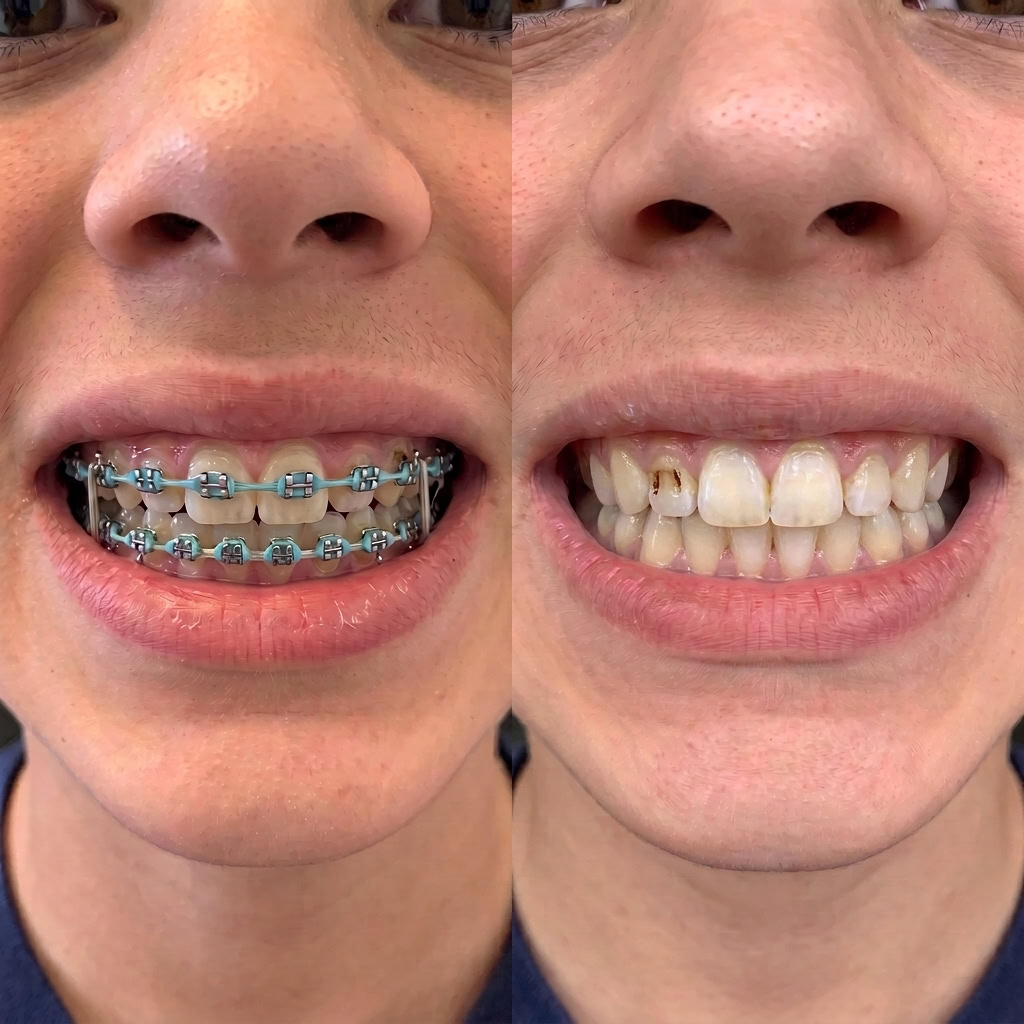
"The day those braces come off, you are going to find decay eating through every single tooth where the brackets sat. Right now, acid is silently melting your child's teeth underneath the brackets. By then there is nothing you can do." I found this out last week when my son's orthodontist pulled me aside after his adjustment appointment. My son Jake is 13. He's been in braces for seven months. She said four words I haven't stopped thinking about since. "The clock is ticking." Not about the treatment timeline. About his teeth. The worst part wasn't the warning itself. It was that I'd heard it before. At Jake's very first appointment — the day the brackets went on — his orthodontist handed us a pamphlet. Hygiene during treatment is critical. Plaque around the brackets can cause permanent damage. We nodded. We took the pamphlet. I wasn't worried. Jake brushes every night. He always has. He's not the kid who skips nights or fakes it. He does the full routine. Every step. Every time. I thought the warning was for other families. The ones whose kids fought about brushing. The ones whose parents had to stand in the doorway every night just to make sure it happened. Not us. Seven months later his orthodontist was pulling me aside to tell me the damage was already forming. Not because he didn't brush. Because the brush he was given couldn't reach where the decay was starting. And nobody told me that part. The brackets on Jake's teeth create tiny enclosed spaces — gaps between the metal and the surface of the tooth that his toothbrush cannot physically reach. Food gets trapped in those spaces. Bacteria breaks it down. The acid that's produced doesn't just cause bad breath. It eats the tooth surface underneath the bracket. She explained the chain slowly. The food gets trapped in spaces the brush cannot enter. Bacteria ferments it into acid. The acid sits against the tooth surface — not for a day, not for a week, but for months. Every night Jake brushes, the surface plaque is removed. But the acid in those enclosed spaces keeps working. Silently. Against the same patch of enamel. Day after day. The bracket hides it. You can't see it forming. You can't feel it happening. It doesn't start as a cavity. It starts as decay — invisible, structural, eating through the enamel one layer at a time. First the minerals are stripped from the surface. The tooth looks normal. Then the surface weakens. Still looks normal. Then the surface collapses. That's when it becomes a cavity. That's when the drilling starts. "We see kids come in after braces come off," she said. "Parents think it's going to be a celebration. Then we find what the acid has been doing underneath those brackets for eighteen months. Cavities we couldn't see forming. Brackets that need to come off before we can even treat them. Drilling that should never have been necessary." I drove home in silence. I thought about the $6,500 CAD. I stared at the payment contract on the passenger seat and thought about what she'd just described. Not an ugly smile. A medical emergency. A cavity underneath a bracket means the dentist can't reach it. The orthodontist has to remove the wire. Pop the bracket off. Send us to a general dentist for drilling and filling. Then back to the orthodontist for a new bracket. Months added to treatment. Additional fees on top of what we're already paying. I kept thinking about Jake in that chair. He is only 13 and already facing permanent crown work. Hands gripping the armrests. White knuckles. Eyes filling up. A needle going into his gum. Crying. Trying not to. He doesn't deserve to be terrified in a dental chair because nobody told us the tool we were given couldn't do the job. I thought about the eleven months still ahead of us. I thought: every single night between now and deband day, that acid is going to keep working in those sealed spaces. Unless something actually reaches it. Nothing we were using could. Here is what nobody told me when we started treatment. The decay doesn't announce itself. There's no smell that gives it away. No bleeding. No swelling. Nothing Jake can feel. Nothing I can see. The brackets sit there looking perfectly normal every single night while underneath them, in the spaces his toothbrush was never designed to enter, the acid quietly does what acid does. It strips the minerals from the enamel. Stage 1 — the surface is porous and weak. Invisible. Stage 2 — the surface collapses. The cavity forms. Stage 3 — it reaches the dentin layer. It spreads fast. It approaches the nerve. Seven months of this building invisibly underneath his brackets. Seven months I didn't know was happening. And then the orthodontist told me. That night I sat down on the bedroom floor completely drained. I looked at the $6,500 CAD contract on my desk. Seven months of the wrong tool. Eleven months still ahead. A wave of rage and helplessness crashed over me. I thought: I am paying thousands of dollars and I had no idea the tool we were given was physically incapable of preventing this. I pulled out my phone with shaking hands. I called my sister that night. She's a pediatric orthodontic specialist. Based in Zurich, Switzerland. Has been for twelve years. I described what the orthodontist had told me. The invisible decay. The acid. The drilling that becomes inevitable when the brackets come off and the damage is finally visible. She listened without interrupting. When I finished she said: "I know exactly what she described. We see it too — but only when families come from abroad. Almost never in our own patients." I asked her why. She explained that in Switzerland — and across most of Europe — when a child gets braces, the right tool comes with it. The specific tool European orthodontists settled on decades ago — because nothing else reaches the enclosed spaces that brackets create. "European children in braces develop decay at a fraction of the rate of American children," she said. "Not because they brush better. Not because they have better genetics. Because they start with the right tool from the first appointment." "The orthodontist who warned you today," my sister said. "She gave Jake that same standard brush at the first appointment. The one that can't reach where the bacteria builds — where the acid forms — where the decay starts. That's not her fault personally. It's just that nobody updated the standard of care here the way we did in Europe." She paused. "You weren't given the wrong information. You were given the wrong tool. There's a difference." "The one I'd recommend is called Bellarè OrthoShield," she said. "It's what we use in our practice. Built to European orthodontic standards and CDA Seal of Recognition and Health Canada approved — not a toy, not a gadget, a clinically engineered tool. "Not the soft silicone versions you'll find on Amazon that look similar but don't actually clean — real medical-grade nylon bristles driven by 30,000 sonic vibrations per minute, arranged in a U-shape that wraps around every tooth simultaneously. Inner surfaces, outer surfaces, bracket edges, every space the standard brush physically cannot enter. "And while the bristles work, the built-in blue LED light delivers antibacterial wavelengths directly to the gumline and enamel — eliminating the bacteria producing the acid before it ever gets the chance to start stripping the enamel. "The bristles clear what's physically there. The light eliminates what's left behind. "And it comes with plaque disclosure tablets — so you're not guessing whether it worked. You can see it." I looked up the research she sent me. And the further I read, the angrier I got. The toothbrush Jake had been using every night is built on a design principle that is over a hundred years old. Bristles on a handle. Moving across tooth surfaces. One surface at a time. Designed for flat, straight teeth. Nobody ever updated the engineering for a mouth full of metal brackets, archwires, and dozens of sealed spaces where bacteria builds and acid forms and decay starts — invisibly, silently, every single night. In the EU, a cleaning tool marketed for children in orthodontic treatment must be clinically proven to reach the specific spaces that braces create. Not just safe. Proven to work. In Canada, a toothbrush only needs to meet Health Canada safety standards. Not proven to prevent the decay that begins in the sealed spaces behind the brackets. Not tested against the biology of what happens when acid builds in an enclosed space for eighteen months. The tool I had been trusting to protect Jake's teeth from decay had never been required to prove it could do that job. It was a general brushing tool. Given to a child with specific medical hardware. And nobody told us. European orthodontists stopped giving children standard brushes for braces years ago. Canadian orthodontists are still handing them out at the first appointment. And the children in between are sitting in dental chairs discovering what eighteen months of acid in an unreachable space actually does to a tooth. Jake still has time. But the clock is ticking. I looked it up that night. Bellarè OrthoShield. The exact brush my sister described. Built to European orthodontic standards. CDA Seal of Recognition. Health Canada approved. I sat there for a moment looking at the screen. $84.99 CAD. $84.99 CAD to keep the acid source cleared every night. To keep the enamel intact. To keep the drill out of my son's mouth. Versus an emergency orthodontist visit. A bracket removal. A filling. Months added to treatment. A teenager with injection anxiety sitting in a dental chair because acid had been building in a space that cost nothing to clear — if we'd had the right tool. I ordered it. The first time Jake used it he looked at me like I was joking. "That's it?" That's it. He bit down. Pressed the button. The brush wrapped around every tooth simultaneously — inner surfaces, outer surfaces, the spaces around the archwire, the edges of every bracket. The blue LED activated inside the U-head — working directly on the bacterial colonies producing the acid while the bristles cleared the physical debris. Two mechanisms. One device. Sixty seconds. Everything. At once. No threading. No technique. No twenty-minute battle at the sink. I handed him a plaque disclosure tablet — the kind that dyes remaining bacteria pink so you can see exactly what the cleaning missed. The bracket edges. The molar bands. The spaces that had been the problem the whole time. Pink-free. For the first time in seven months. I stood there and thought about the orthodontist's words. The clock is ticking. For the first time since she said them, I felt like it was ticking in our favor. Three weeks later we went back for Jake's adjustment appointment. The orthodontist examined his teeth, sat back, and looked at me. "I need to see this more closely," she said. She leaned in with her light. Took her time. Then she sat back. "The buildup is completely gone. His brackets are clean all the way to the gumline — places I almost never see clean on a patient seven months into treatment." She looked at me. "No new demineralization. No progression. The enamel around the bracket bases is intact. Whatever you switched to — it's working. His teeth are protected." Jake looked at me from the chair. Then the orthodontist said something I didn't expect. "What tool did you switch to?" I told her. Bellarè OrthoShield. The U-shaped brush my sister in Zurich recommended. She nodded slowly. "These brushes — we know about them. We've known for years." She paused. "It's a shame we don't routinely advise families to use them from the start. We should. We just don't." I didn't say anything. I just thought: we still have eleven months. Eleven months of the right tool reaching the right places. Eleven months of the acid source being cleared every night. Eleven months to make sure the day those braces come off is not the day the drilling starts. If your child is currently in braces and the decay is already building in spaces their toothbrush was never designed to reach — It wasn't bad brushing. It wasn't bad parenting. It wasn't bad genetics. It was a tool that was never built for what's inside a mouth with braces. We found something that was. It's called Bellarè OrthoShield. Jake still has eleven months left in treatment. Eleven months of either the acid source running unchecked — or being cleared every single night before it can do what acid does to enamel. Before Stage 1. Before Stage 2. Before the drill. The cycle breaks tonight or it doesn't break at all. If any of this sounds like your family — it might be worth looking into.
Engagement over time
Not enough history yet to show a trend.