Rachel Porter
Fix yourself at the cellular level
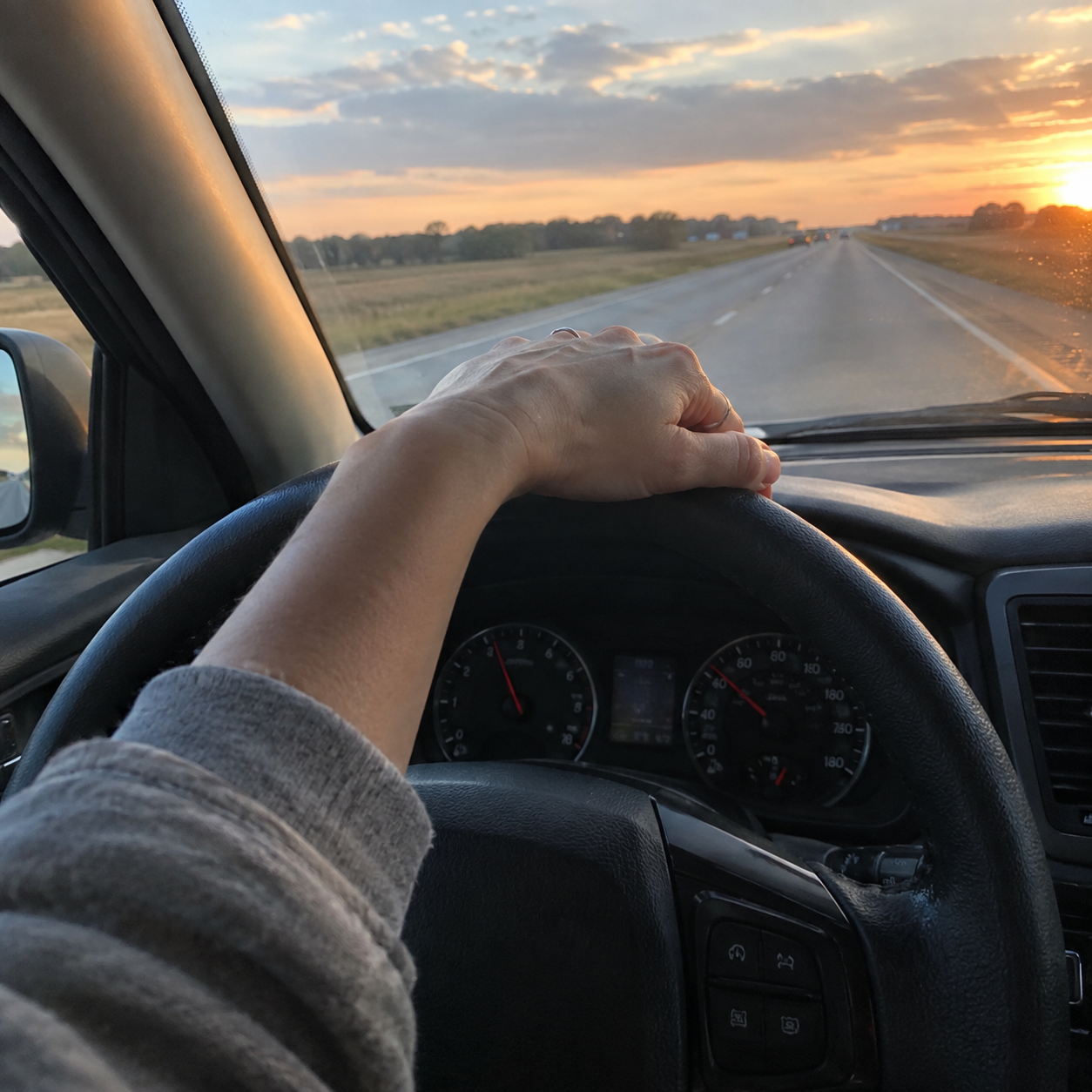
51 cats. One woman. A jar of pasta sauce she couldn't open. That's what I found when I knocked on a stranger's door on a dead-end road in southern Ohio. Everyone else had driven past. But I'm getting ahead of myself. Let me go back to the morning it started. My name is Shelby. I'm 46. I live out in the country — eleven acres, three dogs, a husband named Kevin who comes home every night smelling like diesel and sawdust. The kind of place where you know every sound and you notice when something's wrong. It starts on a Wednesday in September when my oldest dog Biscuit doesn't come home. Biscuit is twelve. Gray muzzle. Bad knees. She doesn't wander — she hasn't had the energy to wander in two years. By noon she still hadn't come back. I drove the roads around the property looking for her. Turned onto Cedar Road — a dead end I've driven maybe five times in eleven years. That's where I saw the cats. Twenty-six of them, sitting in the road, on fence posts, in the tall grass. Thin. Quiet. Waiting for something. I came back three days later with food. Then again. Then every Tuesday and Friday. By October there were fifty-one. They belonged to Margaret Hollis — a woman living alone a quarter mile down the road. Her husband Earl died two years ago. He'd taken care of everything. Without him, Margaret couldn't keep up. The cats multiplied. The garden collapsed. The house went quiet. But the cats aren't why I'm writing this. Margaret is. The first time I knocked on her door, what I noticed wasn't the cats inside. It was her hands. She opened the door partway and gripped the frame with both hands — not to block me out. To hold herself upright. Her knuckles were white. Her fingers were shaking. Not from cold. From effort. She was gripping the doorframe the way you grip something when your hands have forgotten how to be strong. I started cooking at Margaret's every Friday. Made enough to fill containers for the days I wasn't there. Labeled them with the day. The second Friday, I brought a jar of pasta sauce. I set it on the counter and started pulling out pots. Margaret picked up the jar. She wrapped both hands around the lid. Twisted. Nothing. She shifted her grip, tried again. Her face changed — not frustration. Something worse. Resignation. The look of someone who's been losing this fight for so long she's stopped expecting to win it. She set the jar on the counter and pushed it toward me without a word. I opened it with one hand. She looked at the jar. Then at her hands. Then at the counter. "I used to can forty jars of tomatoes every August," she said. "Earl and I would do it together. He'd carry the bushels in from the garden and I'd do the rest — the blanching, the peeling, the sealing. Every lid hand-tightened. Forty jars. My hands could do anything." She opened and closed her fingers slowly, like she was testing a machine she no longer trusted. "Now I can't open one." That moment — that jar on the counter, pushed toward me — is the moment this story is really about. Because I knew that moment. Not from Margaret's kitchen. From my own. I'm 46. In my head, I'm still the woman who threw hay bales onto the truck bed at twenty-three without thinking about it. Who carried a sleeping four-year-old up the stairs with one arm. Who opened every jar, lifted every bag, gripped every tool like her hands were made for it. That's who I am inside. That's the version of me that lives in my memory, my identity, the story I tell myself about who I am. But somewhere around 40, reality started disagreeing with the story. The first time I noticed was a Tuesday morning. I was carrying two grocery bags — one in each hand — from the car to the kitchen. Maybe forty pounds total. I'd done it a thousand times. Halfway up the porch steps, my right hand gave out. Not cramped. Not hurt. Just — released. Like someone had turned off the signal between my brain and my fingers. The bag hit the steps and a jar of pickles shattered on the concrete. I stood there looking at my hand like it belonged to someone else. That was three years ago. Since then: The gallon of milk. I carry it with two hands now. I used to grab it one-handed from the back of the fridge without thinking. Now I cradle it with both hands like it weighs twenty pounds. Kevin noticed. He didn't say anything. He just started putting the milk on the lower shelf where I could reach it with a better grip. The dog leash. Biscuit pulls — she's twelve and arthritic but she still pulls when she smells something. I used to hold the leash with one hand and my coffee with the other. Now the leash takes both hands and the coffee stays home. Because if she yanks, my grip isn't strong enough to hold. The steering wheel. I drive three hours some days to get to Kevin's job sites. By the second hour my hands ache. Not the road — the grip. Holding the wheel at ten and two for an hour makes my forearms burn. I've started driving with my wrists on the wheel. Palms up. Resting instead of holding. The laundry basket. I used to carry it on one hip, baby on the other, like every mother I've ever known. Now I drag it to the stairs and carry it down in two trips because my arms shake under the weight of wet towels. The simple things. A stuck window. A stubborn drawer. A child's bicycle that needs to be lifted into the truck bed. Every one of them a tiny confrontation between who I think I am and who my hands say I've become. And the worst part — the part nobody tells you — is the lag between your brain and your body. Your brain still thinks you're thirty. It sends the signal: grab this, lift this, grip this. And for a fraction of a second, you expect your hand to respond the way it always has. Strong. Immediate. Certain. And then it doesn't. And in that gap — that quarter-second gap between expectation and reality — is the loneliest feeling I've ever known. Because it means the woman I am inside no longer matches the woman my hands can be. I didn't connect it to anything. I thought it was aging. I thought it was normal. Every woman I talked to said the same thing in the same tired voice: "Yeah, my grip isn't what it used to be either." We all said it like it was weather. Like it was just what happens after 40. Then I met Elena. Elena is Dale's daughter — Dale, the neighbor who told me about Margaret. Elena was home from vet school for the semester, helping at her father's clinic. Sharp. Direct. The kind of person who says things plainly and doesn't decorate them. I was telling her about Margaret's hands. About the jar. About the forty jars of tomatoes she used to can every August. Elena stopped what she was doing. "Shelby. How old is Margaret?" "Seventy-two." "And when did she start losing grip strength?" "She says it started in her fifties. Got worse every year." "And you? When did yours start?" I looked at her. "How did you know about mine?" "Because you just carried a forty-pound bag of cat food from your truck using both arms and you were out of breath. Three months ago you threw bags like that one-handed." She sat down. "Here's what nobody tells women over forty about muscle. You lose 3-5% of lean muscle mass per decade after thirty. That's the baseline. But after menopause — or perimenopause, which for most women starts in the mid-forties — estrogen drops. And estrogen is protective of muscle tissue. When it drops, the rate of loss accelerates." "By fifty, most women have lost enough lean muscle that it's affecting their grip strength, their bone density, their metabolic rate, their balance, their daily function. By sixty, the clinical term is sarcopenia — age-related muscle wasting. By seventy, it's the number one predictor of falls, fractures, loss of independence, and mortality in women." She paused to let that land. "Grip strength specifically is one of the most studied biomarkers in gerontology. Below a certain threshold, it predicts all-cause mortality better than blood pressure. Margaret isn't just losing the ability to open jars. She's losing the thing that keeps her alive." "And you're on the same path. Three years early." "So what do I do? Lift weights?" "That helps. But here's the part nobody says out loud: your muscles can't build if they don't have fuel. Every cell in your body — muscle cells, brain cells, bone cells — uses a molecule called creatine to produce ATP. ATP is the actual energy that powers contraction, repair, growth. Without enough creatine, your muscles can't respond to the signal your brain sends." "That's the gap," I said. "The gap between my brain saying 'grip' and my hand saying 'I can't.'" "Exactly. Your brain sends a perfectly good signal. But the muscle cell doesn't have enough energy to execute it. So the grip fails. The bag drops. The jar won't open. And you think you're weak, but you're not weak — you're depleted." "Women produce 70-80% as much creatine as men. After forty, production declines further. By fifty, most women are running their muscle cells on a fraction of the fuel they had at thirty. The muscle wasting isn't just from disuse. It's from cellular energy depletion." "Creatine supplementation in women over forty has thirty years of research behind it. Measurable increases in lean muscle mass. Measurable improvements in grip strength. Measurable improvements in bone density. This isn't bodybuilder territory. This is functional survival territory." She told me about the form — gummies, not powder. YOLO Creatine + Electrolytes. Five grams clinical dose. The gummy absorbs immediately, no stomach bloating like powder causes. Plus electrolytes that creatine needs as cofactors. "Most women try creatine powder, bloat for a week, and quit," she said. "The bloating isn't the creatine. It's the form. Powder sits in your stomach and pulls water before it absorbs. Gummies bypass the stomach entirely." I ordered three bottles that night. One for me. One for Margaret. One for my mother. I brought Margaret hers on Friday with the groceries. She held the bottle and turned it in her hands — slowly, carefully, the way she turns everything now. "Earl tried creatine once," she said. "The powder kind. Mixed it in his coffee. He hated it — said it made him feel bloated. Quit after a week." "This is different. It's a gummy." She took two with her coffee at the kitchen table. Butterscotch — Earl's orange tabby — sat on the windowsill and watched. Week one. The first thing I noticed wasn't my hands. It was the fatigue lifting. By day five, I woke up and my body was just — ready. Not wired. Not caffeinated. Ready. The way it used to feel before whatever was draining me started draining me. Week two. I was carrying a bag of cat food from the truck to the feeding station on Cedar Road. One bag. Forty pounds. I threw it over my shoulder without thinking about it. I stopped walking. I'd done that without thinking about it. The signal went from my brain to my arm to my hand and the hand answered. No lag. No gap. No quarter-second of doubt. Week two Margaret called me on a Wednesday. Not our usual day. "I opened a jar," she said. I sat down on the porch steps. "The peanut butter. The one with the tight lid. I've been asking Dale's wife to open it for months. I tried it this morning. One hand. One twist." Her voice broke on the last word. "One twist." Week three. My grip test — I bought a hand dynamometer online — showed 64 pounds. When I started, it was 48. The clinical threshold for sarcopenia risk in women is 44. I'd been six pounds above the danger line. Now I was twenty above it. Week three Margaret deadheaded the roses in her garden with pruning shears. "My hand didn't cramp," she said. "I went for twenty minutes. It didn't cramp once." Week four. I carried a sleeping four-year-old — my niece — up the stairs at my sister's house. One arm. The way I used to. My sister watched from the hallway and said, "I thought your back was bothering you." "It was," I said. "It isn't." Because the back wasn't the back. The back was my arms compensating for grip strength they didn't have. When the grip came back, the compensation stopped. The chain works both ways. Week four Margaret canned six jars of tomatoes from the garden she'd replanted in spring. Six jars. Hand-tightened every lid. She lined them up on the counter and took a photo. Sent it to her daughter Sarah in Colorado. Sarah called me an hour later, crying. "She hasn't canned anything since Dad died." Week six. I was at the grocery store. I grabbed a gallon of milk from the back of the fridge with one hand. Didn't think about it. Walked to the car. Put it in the truck bed. One hand. It wasn't until I was driving home that I realized what had happened. I'd grabbed it one-handed. The way I used to. The way I hadn't in three years. I pulled over and sat there for a minute with the engine running. Because it wasn't the milk. It was the gap closing. The distance between who I am inside — the woman who threw hay bales and carried sleeping children and opened every jar — and who my hands could be. That distance was shrinking. The story and the reality were starting to match again. Week eight Margaret lifted the cast iron skillet from the stove with one hand and set it on a trivet. She looked at me and smiled. Not a big smile. The quiet kind. The kind that means something has been returned that she thought was gone for good. Butterscotch jumped up on Earl's chair that night and slept there. He'd been sleeping on the bed — Earl's side — for weeks now. But the chair was new. Margaret said Earl used to eat dinner in that chair every night, and Butterscotch used to sit on his lap. "He knows something's different," she said. I'm telling you this because I think you might be where I was six months ago. Standing in your kitchen with a jar you can't open. Carrying the milk with two hands. Making excuses for the grip you lost and calling it aging. In your head, you're still her. The version of you that could do anything with her hands. Carry anything. Lift anything. Grip anything. But your hands stopped agreeing with your memory. And in that gap — that quarter-second between the signal and the failure — is a woman who hasn't been told the truth about what's happening to her. You're not weak. You're depleted. Your muscle cells are running on a fraction of the energy they had at thirty. The creatine your body used to make — the fuel that powers every grip, every lift, every contraction — has been declining since your forties, and nobody mentioned it because the world still thinks creatine is for men in a gym. It's not. It's for your hands. Your grip. Your independence. Your ability to open a jar, carry a child, lift a skillet, tighten a lid. YOLO Creatine + Electrolytes. Five grams, clinical dose. Gummy form — no powder, no grit, no bloating. Plus electrolytes your body needs to put the creatine where it belongs. 🛡️ 50% Off + Free Shipping. 365-day money-back guarantee. A full year. Take it for two months. See if the gap closes. If it doesn't, every dollar back. But if it does — if you grab a gallon of milk one-handed and don't realize until you're in the car that your hand just did what your brain has been asking it to do for years — you'll wish you hadn't waited. Margaret canned six jars of tomatoes last month. She's planning forty for next August. Earl would have loved that. P.S. — My mother is 68. She tried to open a jar of pasta sauce with both hands while I stood three feet away. I took it from her and opened it and neither of us said anything. That silence is the sound of a family accommodating a decline nobody's named. I gave her the gummies the next morning. Six weeks later she opened the jar herself and called me to tell me about it. She wasn't telling me about the jar. She was telling me she's still in there. P.P.S. — Grip strength below 44 lbs in women is associated with increased all-cause mortality. That's not a fitness metric. That's a survival metric. I was at 48 when I started — four pounds above the danger line. Margaret was at 31. If your hands shake when you carry groceries, if jars have become a two-person job, if you've quietly stopped doing things because your grip can't hold — this isn't vanity. This is the most important muscle measurement nobody is taking. P.P.P.S. — The gummy form matters. Most women who try creatine powder quit because of the bloating. The bloating isn't the creatine — it's the delivery. Powder sits in the stomach and pulls water. Gummies absorb through the mouth and upper GI. The water goes to muscle cells, not your gut. That's why Margaret got stronger without getting puffy. If you tried powder and hated it, you haven't tried creatine. You've tried the wrong form.
Engagement over time
Not enough history yet to show a trend.